After having a strong showing in its last tournament, finishing 6th in the Golfweek Red Sky Classic in Vail, Colo., the Miami Golf team did not keep up the momentum, finishing near the bottom of leaderboard in the Ruth’s Chris Tar Heel Invitational in Chapel Hill, N.C. this past weekend.
In a field of 15 teams, the Hurricanes finished tied for 13th with the FIU Panthers, only beating the Rollins Tars.
UM finished the tournament 62 over par, with round scores of +24, +17 and +21. The Auburn Tigers were the victors of the event finishing 5-under par along with three of their team members finishing in the top five, including tournament winner, junior Anna Davis who shot 7-under par.
Miami’s top performer of the invitational was junior Ashleen Kaur, who shot 11-over, finishing tied for 35th on the tournament leaderboard.
UM’s other competitors finished as follows:
Senior Stella Jelinek: +15 (T-49)
Sophomore Cloe Amion Villarino: +16 (T-53)
Senior Rebekah Gardner: +20 (T-67)
Senior Katie Carman: +50 (80th)
The Hurricanes will head out of the country for their next event, as they head to The Bahamas, for the White Sands Invitational Oct. 24-26.
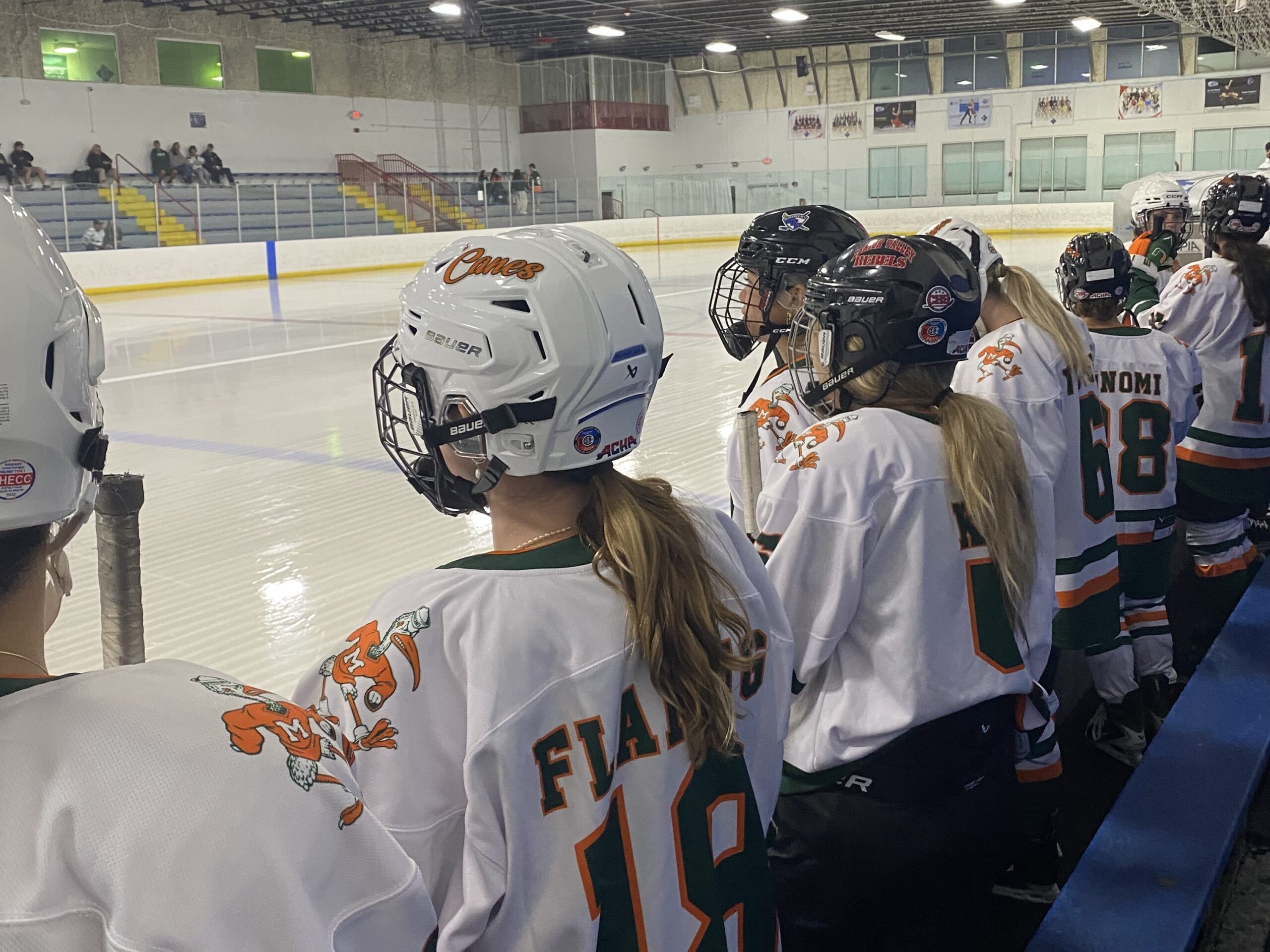
At the Kendall Ice Arena, the home rink of the University of Miami Women’s Hockey team, the air is as charged as it is cold.
The players treat it like a temple, each other as family — it’s one of the most tight-knit, quietly revolutionary teams on campus.
Having recently been promoted to a Division II team under the American Collegiate Hockey Association, the upcoming season brings these Hurricanes skaters tougher opponents, official standings and more visibility than ever before.
But for the Hurricanes, that was never the whole purpose. This team isn’t just playing for points — they’re playing for people. What carried them to D2 classification isn’t budget or prestige, but rather the unbreakable sisterhood that comes alive every time the puck drops.
That bond is sacred to sophomore forward Alex Meola and junior goalie Ana Baurle.
“We’re the same person, just a different font,” Baurle says. “I’d do anything for her.”
UM Women’s Hockey brought these two together, and as they laugh together in the locker room, you might mistake them for having grown up playing together.
They met a week ago.
That kind of closeness isn’t a rarity on this team — it’s the culture. In a city better known for surfboards than slapshots, the UM women’s hockey team has built a community where anyone who shows up with heart and hustle belongs.
Some players grew up skating before they could walk, like freshman Izzy Schaeffer, whose father built a rink for her in their backyard. Others, like sophomore Samantha Bonomi and freshman Bella Rodriguez, picked up a stick for the first time in college.
All that matters is that you show up, ready to work. And from there, the team works its magic.
“Hockey is a community,” freshman Amelia Kong says. “This program was a big reason I came [to UM].” Kong brings four years of experience to the rink.
Players come from all corners of the country, drawn not just by the sport, but by the promise of something deeper: inclusion, trust and a shared refusal to let geography or gender norms define what hockey should look like.
“If you see her, you can be her,” graduate defenseman Allie Litzinger said. “We live by that.”
For a sport often still closed off to women, the players on this team aim to be a driving force in helping to increase the number of girls who lace up their skates come winter. Although it’s one of the fastest growing sports in the U.S., hockey isn’t always an easy space for women. It’s expensive, isolating, often underfunded and overlooked.
Captain Kaila Griffin, who’s been playing hockey for eight years and has been on Miami’s team since its inaugural season in 2022, watched this unfold in real time.
“The men’s teams are preferred over us for ice times because there are more teams, they’ve been around longer, and they have more stakes in the rink,” Griffin said. “We’re at the bottom of the totem pole.”
But that doesn’t discourage the Hurricanes.
In a city where ice shouldn’t exist, the UM Women’s hockey team has built a home for everyone who needed one.
When their skates touch the rink now, it’s not just about playing the game they love — it’s about creating a sense of belonging and carving out space for themselves, pulling up a chair to a table they refuse to be excluded from anymore. The team’s Division II classification is a well-deserved recognition of how they leave everything on the ice. And thanks to these pioneers, there will be many more chairs to come in the future.
“It’s so cool seeing girls get the opportunity to play hockey past high school,” Griffin said. “Hockey is family.”
And this team is a formidable one, at that.
Because greatness doesn’t always come from privilege — sometimes, it’s born from persistence.
That’s what it takes to build something that lasts. Thankfully, this team is as strong as they come.
And in Miami, a city synonymous with heat, the UM Women’s Hockey team proves the fiercest flames can be found on the ice.
UM Women’s Hockey team lines up on the bench before its game against USF on Oct. 3, 2025. Photo Credit: Bella Armstrong
At the turn of the millennium, Miami ruled college football. The choice was simple for recruits: play for them, or get beat by them.
But after their late 90’s to early 2000’s championship runs, the Hurricanes’ dominance and recruiting edge began to fade. Now, two decades later, Miami is clawing back with head coach Mario Cristobal leading the charge.
Miami’s downfall stemmed from a mix of factors, the first being their on-field performance.
While head coach Larry Coker’s tenure started out hot, it quickly cooled off. While Miami still landed top-tier talent, many recruits failed to meet expectations. Prospects who were almost guaranteed to be future Sunday stars like Willie Williams never lived up to their potential, hurting UM’s on-field performances.
From 2006 to 2021, Miami only recorded one season with double-digit wins and rolled through a carousel of coaches from Randy Shannon to Manny Diaz.
As their on-field performance dwindled, the identity behind The U went with it. This led local talent, which used to yearn to play at Miami, to start getting poached by powerhouse SEC schools, such as Alabama and Georgia.
In dire need of a jumpstart to their dormant giant of a football program, the Hurricanes brought in former player and master recruiter Mario Cristobal to lead the next generation of ’Canes.
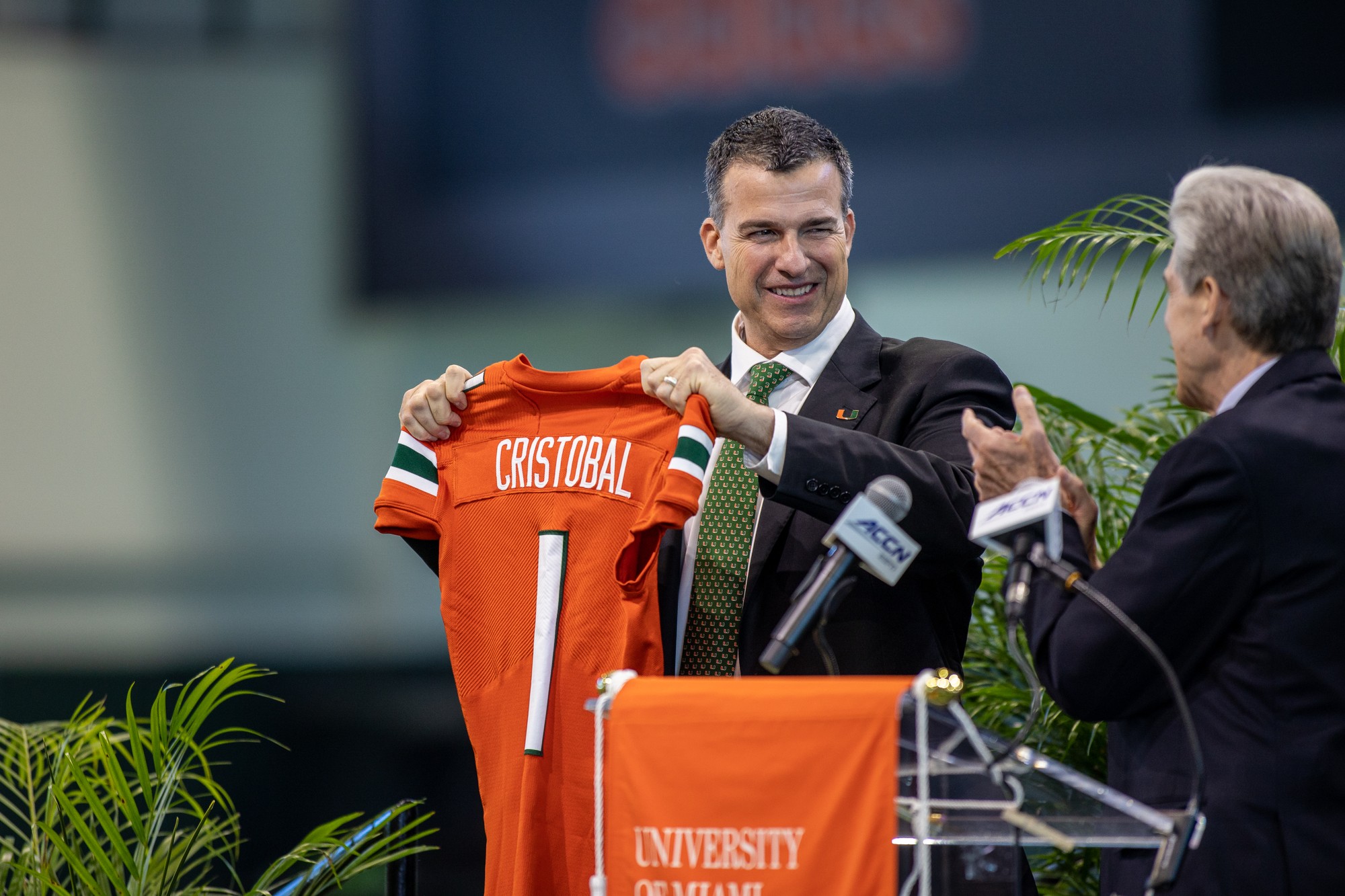
Head coach Mario Cristobal holds up a Miami jersey as he is introduced by University President Julio Frenk at the Carol Soffer Indoor Practice Facility on Tuesday, Dec. 7. Photo credit: Josh Halper
Cristobal, a Miami native and ’Cane himself, was an offensive lineman at UM from 1989 to 1992, where he won two national championships during his tenure.
After a brief stint playing pro, Cristobal returned to The U as a graduate assistant, jumpstarting a decorated coaching career. His coaching career can be defined by one famous football phrase, made popular by his former coach Jimmy Johnson, “It’s not about the X’s and the O’s it’s about the Jimmy’s and the Joe’s.”
Cristobal’s first taste of success as a head coach came right down the road from UM at FIU.
Instead of landing blue-chip talent, Cristobal had to find diamonds in the rough due to the small size of the FIU program. His most notable recruitment was three-star wide receiver T.Y. Hilton, who blossomed into an outstanding collegiate player and NFL star. Cristobal’s work at FIU transformed the program from a struggling bottom-feeder to 2010 Sun Belt champions.
After proving his head coaching credentials at FIU, Cristobal joined Nick Saban’s staff at Alabama — a masterclass in recruiting and program-building. Cristobal learned priceless lessons from Saban on both recruiting and coaching, which helped him earn 247Sports National Recruiter of the Year in 2015.
After his stint at Alabama, Cristobal went across the country to Oregon. He turned the Ducks into a recruiting giant, landing the highest-rated classes in school history alongside winning two Pac-12 Championships.
His story came full circle in 2022, as Miami brought him on as head coach, the latest attempt at bringing back the swagger and culture of The U.
Cristobal started off with what he knew best; recruiting. In 2023, he landed five-star lineman Francis Mauigoa and Samson Okunlola, which established his philosophy built on physicality and toughness, while also showing his recruiting capabilities.
Cristobal also prioritized keeping South Florida talent home, as he has built relationships with countless high-caliber high schools and coaches in the area.
The last huge reason for Miami’s recruiting success as of late is name, image and likeness. Cristobal and the ’Canes have embraced the ability to give student-athletes compensation for their play, and are using it to their advantage in recruiting.
Cristobal’s most recent use of NIL was in early 2025, when former Georgia star quarterback Carson Beck transferred to Miami instead of opting for the NFL Draft. According to multiple reports from sources such as Sports Illustrated and Athlon Sports, Beck is making an estimated three to five million dollars in NIL. Miami had the money to spend and used it on the best player available in the transfer portal.
With the Hurricanes undefeated and ranked in the top two in the AP Poll, their flair and presence remind fans of the legendary teams of the 80s and early 2000s. The energy inside Hard Rock Stadium on Saturdays is electric, and feels like games back in the Orange Bowl during Miami’s heyday.
As stated by ESPN personality Pat Macafee, “The U is Back!”
The rest of the country better get used to it.
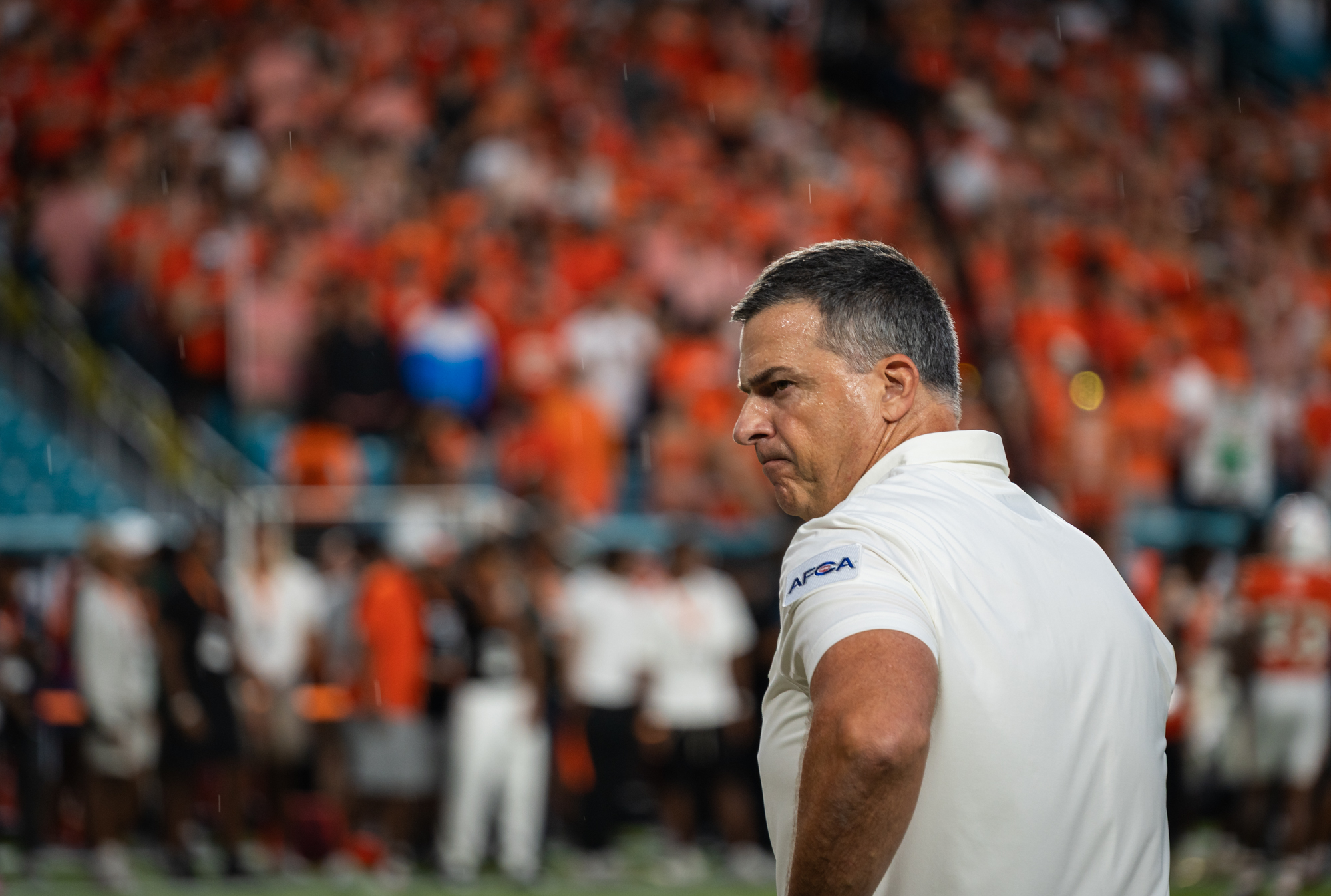
Mario Cristobal stares down his players pregame. Photo Credit: Brian Mulvey
For many of UM’s more than 60% of commuter students, the day starts not only with coffee but with bumper to bumper traffic. It’s a daily frustration that could easily be fixed by expanding the city’s public transportation systems.
Cities such as New York and Chicago have incredibly effective public transit systems that assist in moving people faster from place to place. A busy city like Miami needs more transportation options so people can commute with ease.
Publications such as Bloomberg have labeled Miami as a global city. Miami operates as a financial hub for many private equity firms and hedge funds and is the center of significant international trade and commerce.
Global cities demand more access to public transportation due to the amount of people that live and work there. But, Miami’s public transportation is not up to par with other global cities.
Chicago, for example, has several public transit options including an underground metro, a wide ranging elevated train network and commuter trains to and from the suburbs.
Investing in more public transit could significantly reduce traffic congestion on the roads. The more people there are on public transit routes, the fewer people there are on the roads causing traffic. This shift in public transit would not only ease the daily commute for thousands of people, but it would also improve the overall flow of traffic within the city.
Fewer cars on the road also means less CO2 emissions into the atmosphere. Since climate change is a major concern in Miami, adapting to more environmentally friendly forms of transportation will inevitably help our very vulnerable region. An investment in public transportation is an investment in a more sustainable and environmentally conscious South Florida.
The city of Miami can also restrict where personal vehicles are allowed to go. New York City has lanes dedicated to buses and other public transportation vehicles, which is something easily adoptable in Miami.
Bus-only lanes would benefit the many people that rely on public transportation as their only means of transportation. It will also improve the efficiency of public buses, because they are often delayed due to major backups on our roads. Additionally, limiting access for private vehicles in certain areas could incentivize residents into using public transportation as a faster and more efficient alternative to private vehicle usage.
In 2024, Miami-Dade residents voted overwhelmingly in an unofficial August vote to expand the Metrorail to new places across the county. As of now, Metrorail operates two lines, but the plan calls for expanding the orange and green line while adding more lines to connect riders all across Miami-Dade county.
Expanding Metrorail is a necessary first step in ensuring that all of Miami-Dade county has access to vital forms of public transportation. Everyday, Metrorail carries students and commuters to work and class all across Miami-Dade county. And by expanding the Metrorail, it gives people more access to public transportation when it otherwise might not have been available to them.
Even with potential plans to expand Metrorail, Miami’s public transit system remains inadequate for the needs of the growing population.
Miami was built as a car-centric city, so people are more incentivized to use private forms of transportation more than efficient public transportation. The limited walkability of Miami has also made it difficult to encourage residents to want to talk public transit.
If Miami is to become the global city that it wants to be, the local government must invest heavily in its public transportation system. No city can thrive without the use of effective public transportation. Beyond the fact that public transit saves time during our commutes, it’s also an investment in sustainability and our quality of life. For Miami to achieve its global ambitions, it must embrace public transportation for the sake of its future.
Students, faculty and staff kicked off this semester while exposed to extremely hot weather. According to the National Weather Service, August had over 25 days reaching 90 degrees or more across Miami. Constant exposure to extreme heat can threaten student health considering it can worsen episodes of stress and tension — a far too common occurrence as a result of schoolwork and balancing extracurriculars.
The University sparsely advises students to avoid the negative effects of extreme heat by sharing educational content on its wellness center website, but it is not enough to ensure safety and comfort across campus. In addition, the University needs to mandate certain heat precautions and improve the management of water refilling stations on campus.
First, executive administrators should create a heat stress policy similar to University of Florida’s.
Managed by the UF Department of Environmental Health and Safety, this heat stress policy holds every department accountable for implementing heat precautions, training for heat stress symptoms, providing easy access to clean drinking water and adjusting work schedules to reduce heat exposure during extreme events. Most importantly, UM has a similar organizational structure as UF and also has an Environmental Health and Safety department suggesting the introduction of such a policy would certainly be feasible.
In addition to updating the rulebook, the University needs to make physical changes on campus. On hot days, open spaces with unshaded pavement heat up the air around it, becoming dreaded parts of a walk to class. Comfortable lounge and study areas, such as Lakeside Patio or the court yard in front of Cox Science, become toaster ovens due to the large amounts of the unshaded heat-radiating concrete.
Temporary canvas shadings or tented walkways around campus during hotter months could be a legitimate solution. This temporary shading could be in school colors, adding to campus spirit especially during an exciting football season. Innovative installments like solar powered cooling fans should also be considered — these could even provide an eye-catching stop on a campus tour.
Most importantly, hot days require hydration. Yet, many fill-bottle stations on campus either don’t work, are extremely slow or show a red light indicating the need for a filter change. These obstacles become a nuisance, disincentivizing students from using these stations which lead to purchasing plastic water bottles instead.
The Miami Hurricane reached out to the University’s administration for an official statement regarding their efforts for heat precaution.
“Drinking water refilling stations can be found in many buildings on campus, providing easy access for the community to remain hydrated throughout the day,” said the University in a statement to The Miami Hurricane.
However, it is clear that these essential stations are not monitored. This situation is a simple fix that university administrators and student government should be on top of.
While there seems to be a lack of common ground, the University has demonstrated consistency for certain vital services which help deal with the heat. Primarily, these services are air cooling systems within university buildings and the Hurry ‘Canes shuttle buses.
Additionally, the University does well planting and maintaining trees — earning its 11th designation as a ‘Tree Campus’ by the Arbor Day Foundation this past year. Trees can protect us against the heat by shading walkways and the cooling effect of evapotranspiration, pulling water through their roots and evaporating it through their leaves. Lastly, the University’s Student Health Department has contributed to heat precautions by featuring an extreme heat precautionary guide on its home page.
“On campus, every effort is made to provide a safe and comfortable environment maximizing shady areas for the University community to enjoy and seek out during hot weather, which is very much a part of the South Florida experience,” the University said.
The attitude that students chose Miami knowing its climate is shared by many, including the University. However, not every student or staff member has the same ability to tolerate high heat frequently.
Weight, age and medical conditions can affect tolerance and risk of experiencing an extreme heat illness. UM has a responsibility to ensure campus is a safe space for everyone who is either a student, employee or volunteer.
These solutions are not all encompassing, but important proposals the University should consider.
Closer walks to most classes, non-communal bathrooms, more socially connected floors, and Glen’s greeting at the dining hall. These are all things that the Mahoney-Pearson Residential Colleges bring to the table.
The freshman community at UM is greatly divided into two groups: Mahoney-Pearson and Centennial Village. While the system for who got which dorm was completely random, the residents have seemingly been categorized as the students who “won” and got Centennial. Those who got Mahoney or Pearson are not the losers. What Mahoney-Pearson lacks in sterile, hotel styled rooms, it makes up for with character and community.
As someone who has lived in 11 houses throughout my life, I always had a checklist when picking what room to live in. My priorities were always set on the room’s size, my own bathroom and the closet size.
Centennial’s rooms are 200 square feet, compared to Mahoney/Pearson’s which are 240 square feet. There is also a more evident choice when it comes to the bathroom situation.
Mahoney-Pearson’s bathrooms offer complete privacy, with space to leave your toothbrush, hair products and body wash. The location of the bathroom being a couple steps from bed is supreme for brushing teeth on late nights, and is a major time saver for mornings when you are almost late to class. In contrast, Centennial’s bathrooms are communal, meaning not only can you not leave personal items there, but also you will never know the condition of the bathroom before walking into it.
Sophia Clark, an Ibis resident, said that Centennial’s location is not always the most convenient.
“I like that it is located closer to the gym, because if I lived in Pearson I don’t think I would be as motivated to go, but it does suck because it’s far from my classes” said Clark.
On the other hand, Pearson resident Shannon Brickley loves living in Mahoney-Pearson specifically for the proximity to her campus obligations.
“I love the location because when I accidentally sleep in too late, I have such a short walk to class, and to be honest I don’t mind the walk to the gym, I use it as a warmup of sorts,” she said.
Brickley also appreciates the community she has built in Pearson and doesn’t feel that her friends in Centennial benefit from the same built-in social scene. She detailed how she is close with all of the people in her hall and how she feels welcome to walk into her neighbors’ rooms at any time.
“I love that my floor is social and that there is a huge community within the dorm. A lot of my friends in Centennial have said that they don’t get that feeling in their hall,” Brickley said.
Despite not loving her walk to class, Sophia still prefers living in Centennial because “it just feels fresher, like the air feels cleaner.”
Admittedly, living in Centennial feels like living in a hotel. But who really wants to live in a hotel for a year?
Pearson resident Shannon Brickley said that Mahoney-Pearson “has the appeal of more space, private bathrooms and a welcoming dorm culture at tne end of the day.”
If you are a Mahoney-Pearson resident struggling to enjoy your dorm room, remind yourself that no sleek lobby can compare with the feeling of belonging — or to the simple joy of a fresh omelet from Glen.
If you’re a freshman like me, then you’re probably tired of having to take an Uber to the nearest Trader Joe’s or Target just for a roll of toilet paper.
Yes, I could walk or take the Metrorail, but it would be much easier if I could park my car right outside of my Pearson dorm room. Freshmen should be allowed to park their cars on campus, and I’m not the only one who thinks so.
“It’s so stupid that we can’t park on campus,” said freshman Hannah Salles. “I spend almost $50 a week on Ubers, it’s insane. I’m just trying to buy my groceries.”
The new Publix might be within walking distance, but most freshmen-frequented places are not. The average student spends between $40-100 on Ubers in just one week. When you multiply that by four, you get up to $400 a month just on transportation costs alone.
”I easily spend like $60 on Ubers in one night. It’s ridiculous, especially with how expensive this city and school already is,” said an unnamed freshman.
Parking is already tight as it is, but with UM’s tuition being nearly $32,000 a semester, it should have the funds to build another parking garage in place of some older residential colleges to get freshmen off the Uber-train and put some money back in their pockets.
Miami is a big city, and not an easily walkable one. I should be able to use my car whenever I need it, and not have to pay $20 to ride with a stranger, spend $50 to $100 on groceries and then another $20 on the ride back to my dorm.
As a girl, taking an Uber alone can be scary or uncomfortable. I shouldn’t have to wait for friends to go somewhere or ride back when I’m ready to go home.
According to a New York Times article, cases of sexual assault or sexual misconduct were reported on 400,081 Uber trips between 2017-2022. While the reality is scary, it is something that most college girls think of the moment she steps into her Uber.
Freshmen could resort to using Freebee instead. However, the service only takes you to certain areas around campus and does not beat the luxury of having a car whenever you want it.
“The policy to restrict on-campus parking for first-year students was implemented — with the support of Student Government — in the early 2000s,” the University of Miami said in a statement to The Hurricane. “The goal is to maintain safe, accessible, and well-regulated parking for everyone across campus.”
If UM really wants to make parking safe and accessible for every single student on campus, then freshmen should also be considered.
If I want to go on a late-night Taco Bell run or go shopping outside of the radius that Freebee offers, I shouldn’t have to pay a crazy amount of money. Rather than leaving students stranded, the University needs to provide parking options for students on or around campus.
Freshmen should not be overlooked when it comes to providing students with “safe and accessible” parking. We need to be given the opportunity to travel safely both across campus and the greater Miami area, and that starts with allowing us to have cars and park them on campus.
Political science courses are not a graduation requirement at UM, but they should be. We are a top university and Miami is one of America’s most politically dynamic cities. Despite this many students leave without any knowledge of the government or politics.
UM should adopt a mandatory general education political science course for all undergraduates. It equips students with essential civic literacy, critical thinking and the ability to engage thoughtfully in democratic society. Civic knowledge is declining nationwide and Miami is a place where politics directly affect daily life.
Less than half of Americans can name all three branches of government, according to a 2023 U.S. Chamber Foundation study. Civic illiteracy is not solved by diversity of thought and background alone, it takes structured learning.
Students at UM may be passionate about climate resilience in Miami or affordable housing in Coral Gables. But without understanding how city, state and federal institutions function, advocacy risks irrelevant noise rather than impact.
A required political science class would close civic literacy gaps and give students tools that transfer across careers. Learning how institutions operate sharpens analysis, debate and communication, which are all skills demanded across fields like business, medicine, law and the arts.
Florida’s public universities already mandated civic literacy courses and private institutions like Purdue have similar requirements. UM is falling behind UF and FSU’s efforts on political education, but this can be easily solved by adding even one required course.
This course could be POL410, a course on Civic Synergy taught through the George P. Hanley Democracy Center. It is a hands-on program where students from diverse political backgrounds collaborate on real-world policy proposals to address local challenges. It also has no prerequisites, meaning adding this course is more accessible .
Dylan Long is the primary instructor for POL 410 and serves as the associate director of the program through the Hanley Democracy Center.
“Every semester, I watch students from completely different majors sit down together, debate and draft real policy proposals for Miami-Dade County,” Long said. “They begin the semester unsure of where to start, but by the end, they’re engaging with city officials and presenting solutions to problems that actually matter.”
Civic engagement and knowledge is not just an area of study, but an imperative facet of daily life and citizenship.
“If you’re going to live, vote, pay taxes and raise a family in this country, you should understand the framework that governs it. We don’t expect engineers to design bridges without physics or biologists to conduct research without understanding the scientific method,” Long said. “Why should citizens be expected to make decisions about democracy without ever studying how it works?”
A student who wishes to remain unnamed says she feels “constrained by all the other mandatory classes,” especially as a freshman in courses like writing 105 and math.
Students already face many requirements with their majors and cognates, so one more class may feel burdensome. But this course could be integrated into existing social science or writing requirements, not added on top.
Others who oppose adding a political science requirement worry that not every student is interested in politics or the humanities. A well-designed class would not be partisan or ideological. It would be about literacy, not persuasion. In fact, teaching politics in a balanced way helps reduce polarization and equips students to resist extremism.
For those who think UM students are already knowledgeable enough, data from the National Chamber Foundation says otherwise. In the current state of our nation, we must take preventative measures to not become a part of the problem. Passion without process is not enough– a political science course will empower Miami’s students to be more civically engaged..
The University of Miami is uniquely positioned for this transformation. Miami is a frontline city for climate change, income inequality and immigration, all of which are issues intertwined with politics. Our campus’ diversity makes it an ideal setting for comparative discussions.
By embedding civic learning into the UM experience, the university would strengthen its reputation as a civic-minded institution aligned with its mission of preparing students to be engaged global citizens.
Civic literacy is not optional, it is a responsibility. A required political science course would be an investment not just in UM students, but in Miami and democracy itself. The Faculty Senate, administration and Student Government should pilot this requirement and students should demand it for the health of the democracy we will inherit.
Julia Thomas is a well-known face on campus thanks to her almost 65,000 TikTok followers.
Before becoming a popular creator and coming to Miami, the UM freshman attended high school in Dallas, Texas and cheered competitively for eight years.
She started making content her senior year and blew up at the beginning of the summer when she posted a video with her boyfriend Hunter, who plays baseball at Texas A&M. The video received a lot of attention and many people shared their opinions about their soon-to-be long-distance relationship.
“People really liked that video because it was about my boyfriend. They had a lot to say and some people didn’t think we’d make it,” Thomas said.
The backlash didn’t bother her. She knows her boyfriend, who has been with her for more than four years, and her relationship better than strangers on the internet.
Thomas uses her platform to build an authentic community, posting a mix of content like “Day In The Life” videos, sit-down chats, fashion content and wellness. Her favorite videos are ones where she sits and talks directly to her followers about her life or advice she has for them.
“I feel like people like to put a huge facade up on the internet. It’s nice for people to hear that others struggle too,” Thomas said.
When choosing where to go to college, Thomas chose UM because of the big city but smaller campus community.
Her favorite spot on campus is the Lakeside Patio by the stage where she likes to eat dinner, study and watch the sunset with her roommate. Outside of campus, she loves to explore spots in Coconut Grove, Brickell and South Beach.
While Thomas shares a lot of her fun experiences on her platform, she makes the college experience as a whole a large part of her content. She gets vulnerable with her audience, even discussing the difficult parts of college like navigating homesickness and having a long-distance relationship.
So far, she has found the academic transition to be pretty smooth due to her strong time management skills from high school cheerleading. She notes the importance of staying organized since professors aren’t as hands-on as high school teachers.
Despite the negative public opinion about the longevity of her relationship, Thomas shares how positive long-distance has been going for her so far.
“Long distance has actually strengthened our relationship because we have so much to talk about now,” Thomas said.
Her advice for other couples going through a long distance relationship is to communicate daily in fun ways like planning FaceTime dates, making time for visits and not viewing talking as a chore.
Social media is not an end-all-be-all for her, and ultimately she is at UM to get a degree and have a fun college experience. Thomas is currently studying business undecided, but has a strong passion for wellness and hopes to explore something in that field.
While balancing being a creator and college student may seem like a lot, she has a good handle on it.
“My plan is just take it day by day and post whatever I’m interested in. I don’t think that stressing about it or getting burned out is what I want to do.”
Thomas uses social media as an outlet for creativity and building a safe and supportive community.
“I just want to have friends and a community that makes me feel safe,” said Thomas. “If you don’t like me, that’s okay — I’ll find my people.”
Colette Couillard, lifestyle influencer and UM freshman, was only a high school sophomore when she first went viral. She made a video on a new TikTok account talking about her then boyfriend breaking up with her.
“I posted it on TikTok, and it went super viral,” Couillard said. “At first I thought it was just funny, but then I realized people were actually following me and interested in my life.”
That single post launched her career. She racked up 500k followers in the months after her initial post. Even after the account was banned, her new account has since caught up to the original follower count, with more than 660k followers.
The UM marketing major describes her niche as lifestyle. Couillard’s feed offers a glimpse into college life, Miami culture and the realities of growing up online with get ready with me videos and vlogs of her nights out with friends.
“I’m on my phone all the time, doomscrolling,” Couillard said. “Whenever I see an interesting concept, I take inspiration from it or just think of the things people might find interesting about my life here.”
A typical day for Couillard involves juggling her classes with not only her social life, but her job as an influencer. She posts two or three videos daily, and has already found her routine on campus.
She usually films a “Get Ready With Me” video in the morning, goes to classes in the afternoon and then scrolls for more inspiration at night. After years of balancing schoolwork and sponsorships, she’s learned how to manage both worlds without letting either side take over.
“I’ve been doing it since my sophomore year of high school, so it’s just a habit now,” Couillard said. “If I have a big brand deal due the same week as exams, I just tell them to wait one second — school comes first.”
Brand partnerships have become a part of her everyday life. She’s worked with major brands like DoorDash, Best Buy and Ulta Beauty. Couillard says these collaborations help fund her tuition and even let her go to New York Fashion Week.
At fashion week, Couillard met Ashtin Earle, the sister of UM alum Alix Earle. Couillard says that Earle sisters are some of her favorite influencers, and even though she has wanted to come to UM since middle school, seeing Alix posting about how fun the school was influenced her in the long run.
She looks up to Earle’s success and sees her as a role model for the impact she would like to leave on campus. With her growing following, Couillard recognizes that she is starting to become a role model to her more than half a million followers.
“I went to the Olivia Rodrigo concert and there were little girls coming up to me, and one girl was crying and I didn’t know that I had that effect on younger kids,” Couillard said. “Just knowing that young girls are watching me too is just really special.”
Couillard makes it a point to keep her online presence authentic, but she also recognizes that it is okay to want to keep certain things for yourself. She credits her parents for giving her support growing up to be able to let any hate roll right off her back.
“I post almost everything, but my relationship is something that I keep private,” Couillard said. “I just don’t want to hear people’s opinions on that at all.”
As for her future, Couillard plans to graduate early and hopes to pursue a master’s degree in business law or political science. She puts her studies first, because she knows social media is not always going to be there.
“I could lose all my followers tomorrow,” Couillard said. “So I’m making as much money as I can now, investing in my education and seeing where it takes me.”
Sienna Long is one of the University of Miami’s fastest growing social media stars with 22.9k followers. But she never saw herself in Miami.
When applying to colleges, Long struggled to picture herself liking UM until she visited her brother, who was a junior at UM, for spring break. During the trip, she fell in love with the school.
“I came and I stayed with him in the dorms and got to experience the life here, people and energy,” the freshman said. Long’s great experience with her brother is why she decided to apply early decision to the University while also managing her unexpected fame.
Long’s journey to starting content creation parallels her unexpected move to the University of Miami. One of her first videos that ever went viral was a complete accident. It was the 30th of December 2024, right before the new year! The video was a clip of her sister laughing in bed at Instagram reels which she woke up to find racked up more than six million views.
She found her true niche when she made a “Get Ready With Me” video in Spanish. This video along with her First Day Of Classes video transformed her hobby into a career.
When she was first going viral on TikTok, she often stressed herself out over how much she needed to post a day. There were days where the pressure of posting would get to her.
Eventually she focused on uploading whenever she felt like it. She has a schedule, but if she’s not enjoying what she does, Long says no one will.
“I think I let the pressure of social media and posting three times a day get to me so much in the beginning. I was so stressed all the time,” Long said.“And then I kind of, like, one day I took a step back and said, ‘Girl, what are you doing? This is supposed to be fun.’”
In an industry dominated by artificial personas, Long strives for authenticity. She challenges the “life’s great all the time” stigma and isn’t afraid to be openly vulnerable.
“I will go on there and be like, ‘I’m not having a good day. ‘I feel like crap,” Long said.
Her goal is to tell the world that “nobody is perfect” while using her struggles to offer solutions. She states that showing your vulnerable side makes creators human. Long sticks to a dedicated routine of focusing on herself. Things like her “sunday reset” and “mental health days” are vital in calming her down.
Her drive and determination started at home. Long’s mother who also works in social media serves as her daughter’s biggest fan but also her most honest critic.
“It’s more like, ‘what can we do better next time?” Long said. “I generally don’t think I would thrive as a human being if my mom just let everything slide.”
Beyond her social media presence, Long has a deep passion for performing. She grew up a competitive dancer, doing full makeup since she was four years old.
While she’s left dancing in the past, she still loves to sing. Long credits Tate McRae as one of her biggest inspirations.
Long has a very resilient attitude towards online negativity. She operates with a powerful mindset stating she doesn’t have time for the negativity. She states that she’d rather have people talking bad about her than not talking at all.
She speaks about the importance of the mantra “If you don’t have anything nice to say, don’t say anything at all,” it reflects on her journey as a creator. She notes that she’s become a more positive person than she initially was.
It’s a gesture of passing the love she receives in her own community. You never know how you might brighten someone’s day. Long believes the best way to thrive is to be yourself.
“Be prepared to be made fun of, set your goals and don’t let anything, or anyone, shake your confidence.”
You are sure to find a fuchsia-colored stand with a half moon logo while walking through campus to a class in Dooly or the School of Communication. Half Moon empanadas have been a large part of UM since they opened their first on-campus kiosk in 2011.
Half Moon was founded in 2008 by husband and wife Juan Zivala and Pilar Guzmán Zavala. Their first takeout-centered store opened in Miami Beach where joggers and tourists would grab the popular Miami treat. People loved the food, however the store was not as profitable as they planned it to be.
After attending a street food festival and selling all their empanadas, they knew the kiosk model was the way to go for their business.
Half Moon’s philosophy is to, “nourish the hustle and heart behind every journey.”
“Everything we do is built around our philosophy of ‘grab-and-go greatness,’” Marcella Lissandrelli, Director of Retail Operations at Half Moon said. “Just like our food, our team is all about leveling up, moving forward and being ambitious.”
Half Moon now has 25 kiosk locations nationwide, including spots at major airports like Miami International Airport. It also just opened its first-ever store this past June in South Miami, located at 6625 S. Dixie Hwy.
The University kiosk menu includes a variety of empanada flavors ranging from sweet to savory, as well as a coffee and tea.
The three sweet empanadas are Dulce de Leche, Guava and Cheese and Nutella. The savory empanadas include Beef, Chicken, Ham and Cheese and Bacon Egg and Cheese, with Spicy Chicken being the most popular savory flavor. All empanadas are priced at $4.67.
Half Moon takes pride in its empanadas. Employees dice the meats, make the white sauce for the spinach empanada, cook the bacon, egg and cheese with real omelette-style eggs and slow roast the pork with BBQ sauce and guava.
The drink menu includes espresso, cappuccino, cortadito, a Cuban-style espresso drink, hot tea and even hot chocolate. It even serves organic coffee catered towards fueling college students.
“My favorite drink is an iced latte with almond milk,” UM freshman Gaby Wakszol said. “They have amazing coffee.”
Half Moon also sells empanada and drink combos. Combo one has one empanada and one soda or brewed coffee for $6.81, and Combo two includes two empanadas and one soda or brewed coffee for $9.95.
“A box of empanadas is ideal for a dorm get-together, watching a game or movie with friends, or even tailgating before kickoff,” Lissandrelli said.
Half Moon views Miami as its home and they plan to continue to build here and stay true to their fast, convenient, delicious philosophy. Their vision is to make the empanada as iconic as the burger or taco in America.
You don’t need to be an empanada lover to like something at Half Moon, it has something for everyone.