After a stagnant performance on both sides of the ball against mid-major Southern Miss, the Miami Hurricanes took care of business in the second half to remain a perfect 6-0 at home with a 88-64 win.
Despite the lopsided final score, it was the Golden Eagles who got out to an early lead with a 8-0 run.
From there on out, sloppy ball movement and poor decision making led it to be an ugly yet contested first half.
Southern Miss had 11 turnovers compared to Miami’s eight, but the Golden Eagles did have the hot hand from the field, making 50% of its first half shots compared to UM’s 35%.
A major storyline through Miami’s first 10 games has been the team’s inconsistency from beyond the arc. Some nights, like the last outing against Ole Miss, the shots fall, and others they don’t.
In the first half of the game, the Hurricanes went just 3-for-10 from deep, a 30% mark.
Despite Southern Miss leading 24-19 at one point Miami was able to tie the game 34-34 at half in parts to 13 points from Reneau.
“Our intensity, our energy, our effort was there in the second half and it was not there at all in the first half,” first-year UM head coach Jai Lucas said.
In the second half, Miami showed Southern Miss what it is like to play in a power four conference.
Freshman Shelton Henderson moved the score to 43-40 at the 15:49 mark, and from that point momentum fully shifted in favor of the Hurricanes.
And after a corner three from freshman forward Timotej Malovec to move the score to 47-44, the Hurricanes went on a 17-2 run.
After shooting 1-for-4 from deep in the first half, Malovec dialed in with 13 second half points, shooting 3-for-6 from behind the arc in an increased role.
“It takes time. I’m happy for those minutes,” Malovec said. “ I hope to do a good job, and we just have to wait for the guys to get back, and we keep stacking good days and getting good days.”
Miami’s shooting numbers were much better in the back half of the game, shooting 57% from the floor.
Senior guard Tre Donaldson continued his great play as point guard, registering his second double-double of the season with 12 points and a career-high 11 assists.
At the 1:44 mark in the second half Miami led by as much as 27 as they cruised to its eighth victory of the season.
The Hurricanes look to get healthy during their three non-conference games.before ACC play later this december.
Miami will be back at the Watsco Center on Dec. 13 to take on ULM at noon and will air on ACCNX.
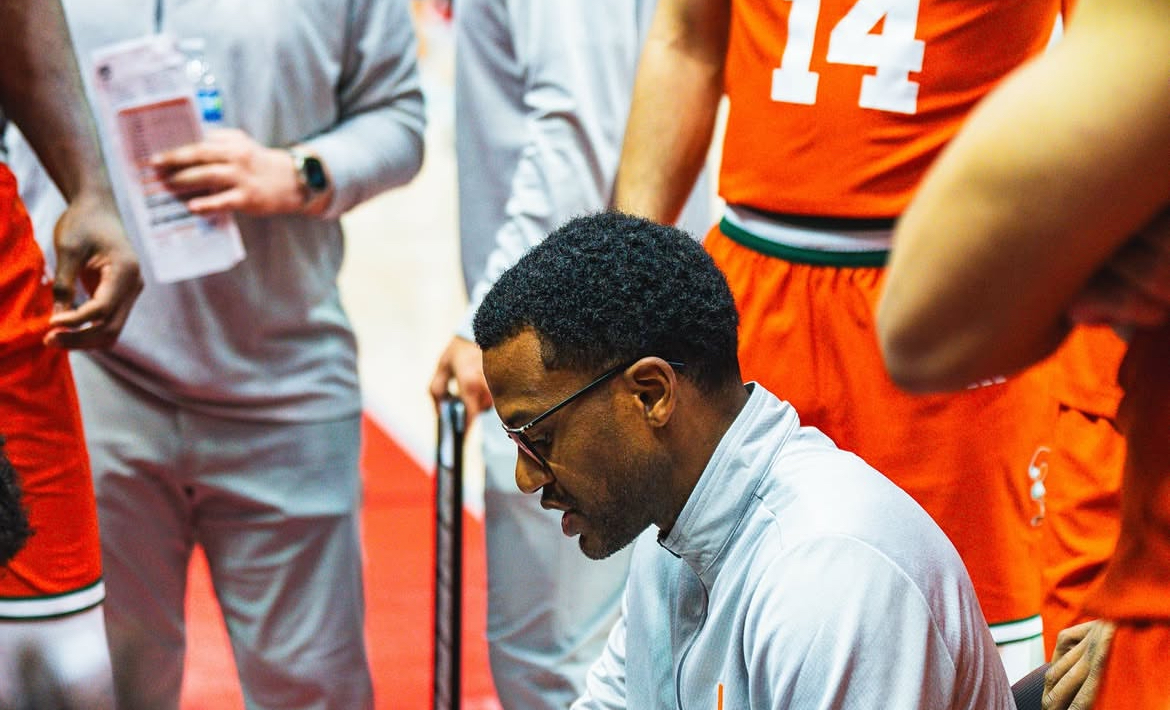
UM head coach Jai Lucas talks to his team during a timeout versus BYU on Nov. 27 2025. Photo Credit: University of Miami Athletics
The Miami Hurricanes are hanging on by a thread. As Championship Saturday approaches, Miami doesn’t control its own destiny, and can’t play any games to prove to a group of 12 committee members that it belongs in the College Football Playoff.
Despite sitting at home in Coral Gables, steam has picked up on the Hurricanes, and their odds of making the playoff has increased significantly. Media members across the country are starting to put pressure on CFP Committee chairman Hunter Yurachek and the rest of the committee to give the ’Canes the last spot.
The door for the UM isn’t wide open. But it’s cracked – and Miami has every reason to believe that it can squeeze through.
A playoff-caliber résumé
The process to make the CFP is dependent on a number of factors, including head to head, strength of schedule, common opponents, and the subjective “eye test” that grades a team best on how they play on the field.
When looking at the remaining at-large teams between BYU, Notre Dame, Miami, and Texas, the Hurricanes have a legitimate case to take that final spot.
BYU is 11-1 and the committee has done no favors in telling the Cougars that a loss in the Big 12 Championship essentially eliminates them from the playoff.
However, BYU had an extremely weak out-of-conference schedule, with wins over Portland State, Stanford, and East Carolina. Miami and BYU have one common opponent, a Stanford team that the Hurricanes beat by a wider margin (42-7).
The Cougars best win is No. 15 Utah and their only loss is to No. 4 Texas Tech, where they lost 29-7. BYU likely has the best résumé out of the bunch but a loss on Saturday in a rematch against the Red Raiders will likely put the team from Provo out of contention.
The biggest discrepancy that has caused national attention all the way up to the highest level of American politics is the debate between No. 12 Miami and No. 10 Notre Dame.
The Fighting Irish have won 10 straight games after starting the season 0-2 and have a defense that has turned a corner and an offense led by strong quarterback play and the best running back in the country.
The two programs have very similar résumés too. Notre Dame leads Miami in the strength of schedule metric, although the margins are so tiny that it’s impossible to tell who gets an edge. According to ESPN, ND has an SOR of 13 and SOS of 42, while Miami has an SOR of 14 and SOS of 44.
The Irish and the Hurricanes hold four common opponents with each other; Syracuse, Stanford, NC State, and Pittsburgh, in which both teams went 4-0 in those games.
However, Miami beat those opponents by a wider margin than Notre Dame in three of the four games. ND’s 70-7 onslaught of Syracuse is the only common opponent that the Irish have an advantage over.
The Irish’s best win this season is No. 16 USC and is 2-2 against teams when they were ranked. Miami’s best win is a 27-24 victory over No. 9 Notre Dame on Week 1 in a game the Hurricanes never trailed. Against teams when they were ranked, Miami went 4-0, with wins over ND, South Florida, Florida State, and Pitt.
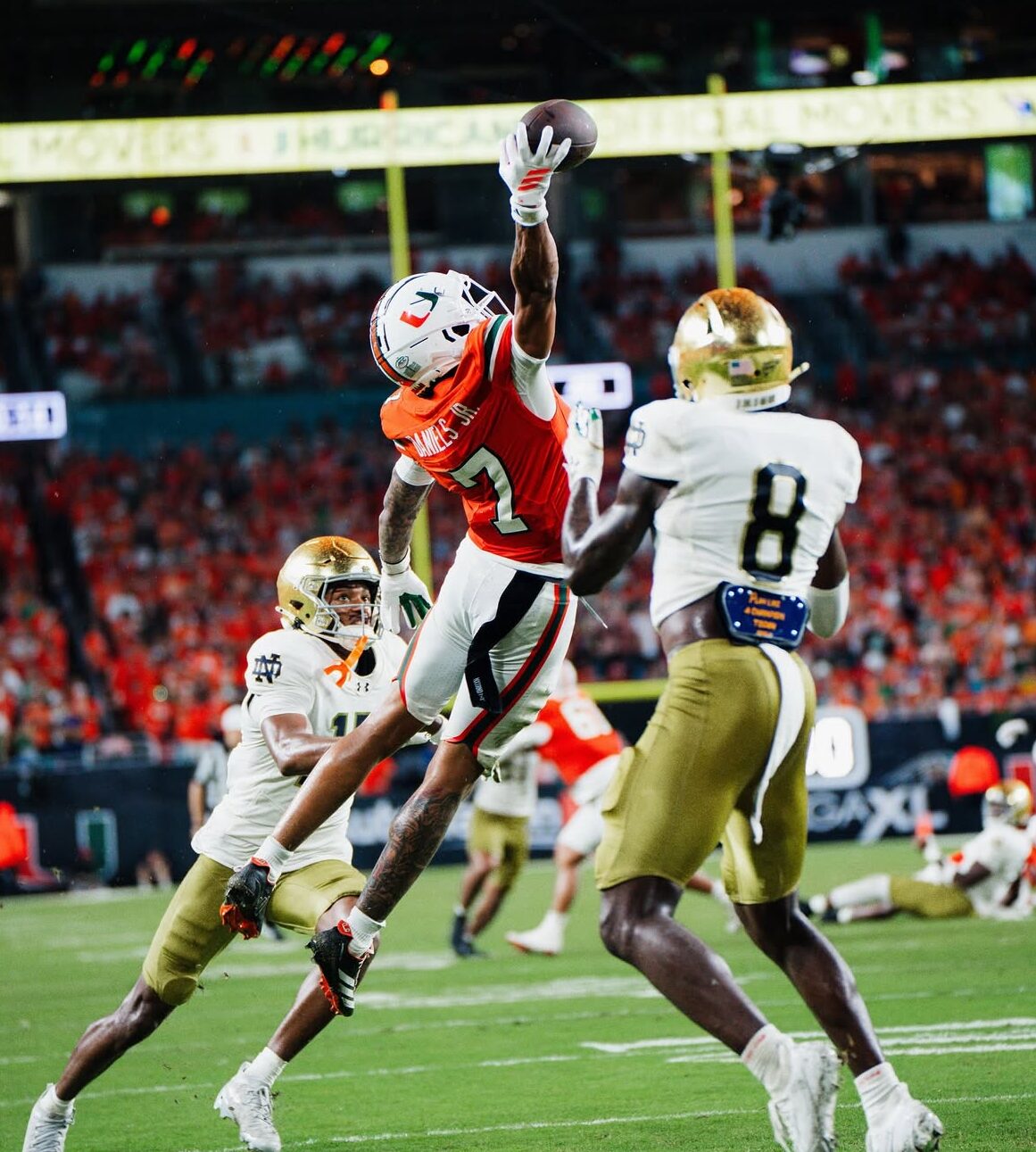
Wide receiver CJ Daniels reels in a one-handed touchdown against Notre Dame. Photo credit: Alex Muniz
Miami’s only blemish is that Notre Dame’s “quality losses” are stronger than the Hurricanes. The ’Canes dropped two out of three games between late October and early November against 8-4 Louisville and 8-4 SMU, games that UM lost by a combined nine points.
While the losses hold weight, Louisville and SMU are quality conference opponents that at one point were ranked. If SMU beat California to end the season, the Mustangs would have been the ACC favorite to win the conference.
When résumés are extremely similar and nearly all stats are the same, the factor of head to head has to matter. The game on the field has to matter.
Just because a game was played in late August should not penalize the team that won. Miami won and Notre Dame ends up getting more credit for its loss than Miami does for its win.
Miami’s win over Notre Dame ultimately should end the discussion. However, the Irish are the favorite to get the last spot in the CFP and not Miami.
Media members and Hurricane fans aren’t the only ones confused and annoyed by the committee’s lack of love for Miami and favor towards Notre Dame.
“If the University of Miami gets screwed out of the College Football Playoff after going 10-2 and beating Notre Dame, the whole thing should be scrapped and [President Trump] is gonna have to take over next year,” United States Secretary of State Marco Rubio said on Tuesday.
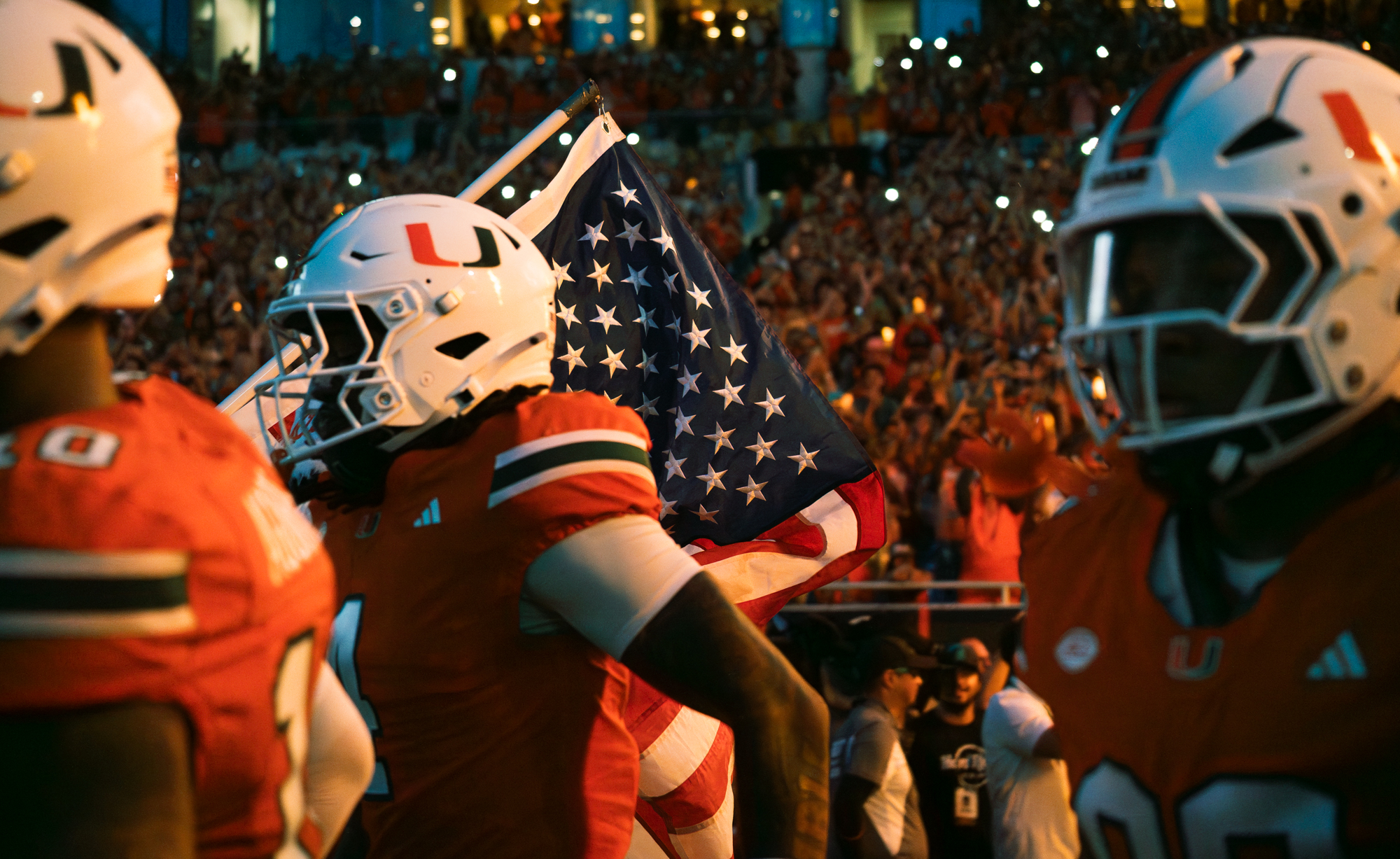
Miami exits the tunnel at Hard Rock during season opener versus ND. Photo credit: Brian Mulvey
Peaking at the right time
When the Hurricanes suffered their second loss of the season on an overtime loss to SMU, Yurachek told ESPN’s Rece Davis that Miami needs to show consistency if it wants to make the 12-team playoff.
Most people wrote of Miami and the ‘same old ’Canes’ mantra came back to haunt Mario Cristobal and UM. But the Hurricanes fought back, and played their best brand of football since the beginning of the season.
In the four games that followed against Syracuse, NC State, Virginia Tech, and Pittsburgh, the Hurricanes played dominant football, outscoring their opponents 151-41, winning by at least three scores in each of those games.
Since SMU, the offense has totally transformed, with freshmen stepping up at the skill positions. 18-year old receiver Malachi Toney broke Ahmmon Richards 2016 record for the most receiving yards by a true freshman with 970 yards. He’s a Freshman All-American that can run, pass, and catch at an elite level and has played an integral role in the Miami offense.
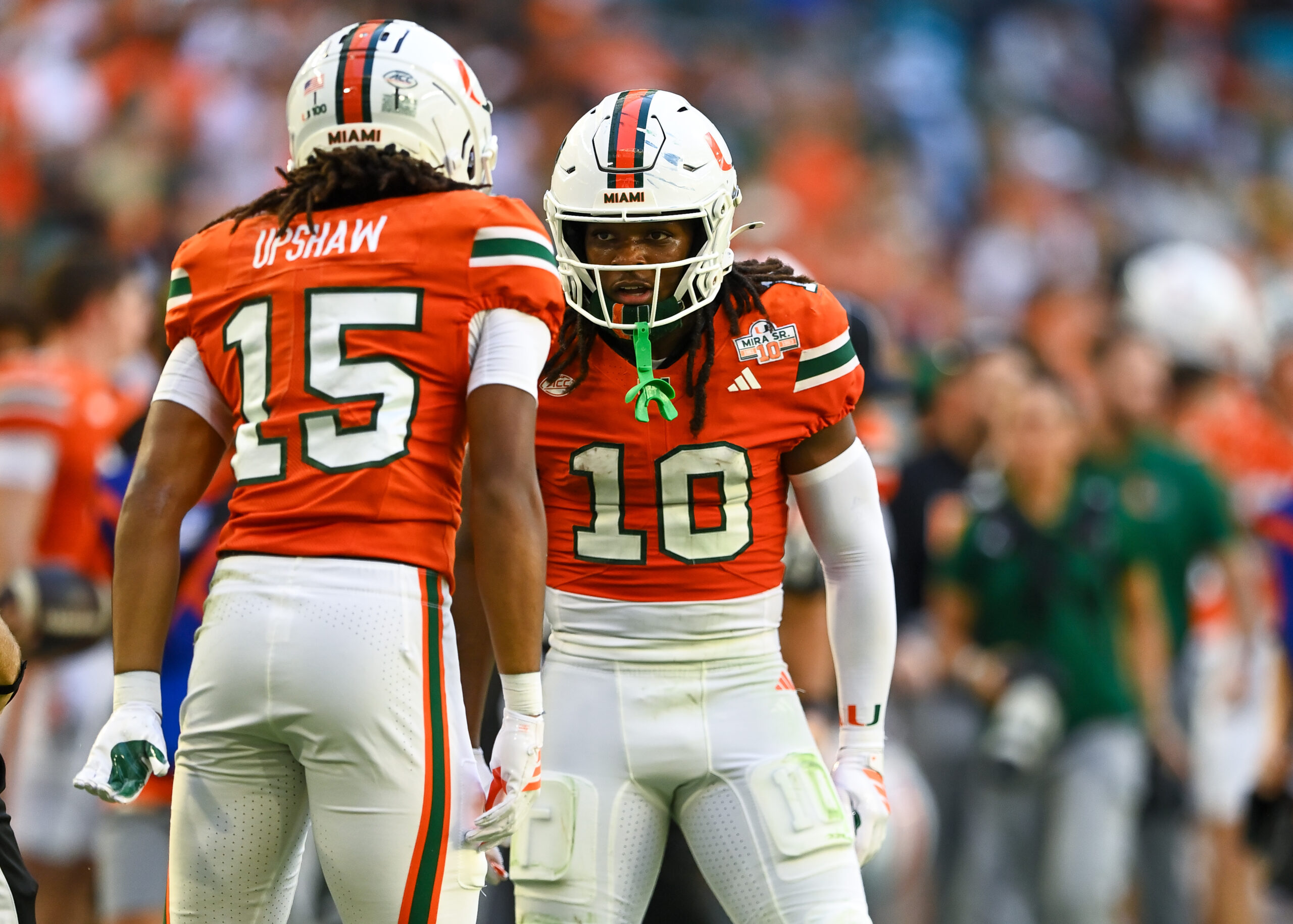
David Lebowitz, Staff Photographer/ Freshman wide recievers Daylyn Upshaw (15) and Malachi Toney (10) celebrate after a big play on November 8, 2025.
Stepping up for midseason injuries to CJ Daniels and Mark Fletcher Jr., running back Girard Pringle Jr. and receivers Joshua Moore and Daylyn Upshaw have made their presenceses felt.
In his last four games, Pringle has put the rest of the ACC on notice, averaging 5.2 yards per carry and making explosive plays in the process.
After struggling in the middle of the season against Louisville and SMU, sixth-year redshirt senior Carson Beck is playing his best football since his 2023 campaign at Georgia.
In the last four games, Beck has completed nearly 80% of his throws, totaling 1,125 yards for 11 touchdowns and just one interception. Since suffering a torn UCL nearly a year ago in the SEC Championship game, Beck is back to 100% and has shown it.
Miami’s defense, a unit that was one of the worst in all of college football in 2024, is among the best in the country this season. Led by first-year defensive coordinator Corey Hetherman, and defensive linemen Rueben Bain Jr. and Ahkeem Mesidor, the UM defense is one of the most feared units in the country.
In an article from The Athletic’s Bruce Feldman, an anonymous ACC head coach praised Miami’s elite defensive line.
“ND’s [Notre Dame] D-line is good, but it’s not Miami,” the coach said. “Their D-line is ridiculous. And that’s why Miami beat them. The trenches are where it all starts.”
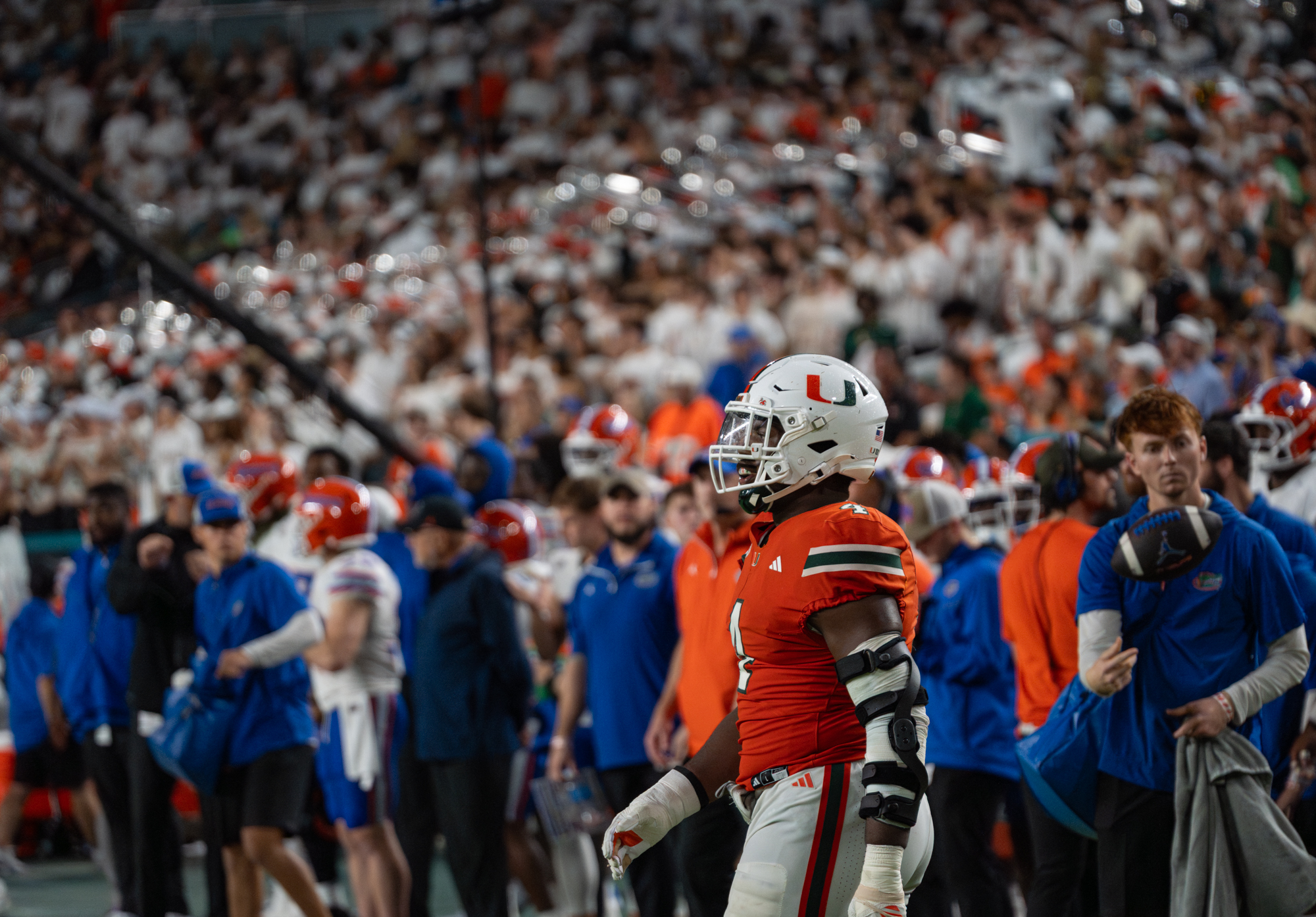
Assistant Photo Editor Brian Mulvey // Junior defensive lineman Rueben Bain Jr. (4) consistently found himself in the backfield versus the Florida Gators on Sept. 20, 2025
The Hurricanes defense is sixth in points allowed per game, seventh in rushing yards allowed per game, and 11th in the country in total yards allowed per game, at 13.8, 86.8, and 277.8, respectively.
As hall of fame head coach Nick Saban said “They’re [Miami] going to be the most dangerous team anybody has to play because of the talent level they have.”
Miami’s path
Although the path is unlikely, it’s still possible for Miami to sneak into the CFP. The best possible scenario for Hurricanes involves three conference championship games that puts the pressure on Yurachek and the committee to let the ’Canes in.
The only game that eliminates Miami from playoff contention is the Big 12 championship game between BYU and Texas Tech. If Miami wants to inch closer to Notre Dame and make the committee look at the head to head intensely, BYU must lose convincingly.
In the SEC Championship game, an Alabama win ultimately might be best for ’Canes. If the Crimson Tide win and BYU loses, the top nine is solidified and sets the best case scenario for Miami.
The Hurricanes would move up to No. 11 and Notre Dame would stay at 10. In the eyes of most, the head to head should ultimately be the deciding factor and be enough to push Miami over the edge.
If the Irish remain at 10, it could set up a dangerous precedent going forward for the committee. Teams may stop scheduling tougher out-of-conference games and will elect to stop playing Independent teams like Notre Dame.
The last game, the ACC Championship, could also cause chaos and favor Miami. If 7-5 Duke wins the conference over Virginia, both Group of Five teams of Tulane and JMU will get the nod over the Blue Devils, opening a world where there are no ACC teams represented in the playoff.
The committee could have a hard time imagining a 12-team playoff without a Power Four conference and could add the highest ranked ACC team, Miami, into the playoff over Notre Dame and BYU.
Ultimately, Miami’s fate will be decided by 12 men consisting of athletic directors, former coaches, players, and journalists that will confer in a hotel conference room on Sunday morning.
But, Miami has done all it could in the last month to prove its case to make the CFP and that still may not be enough. It would spell back-to-back seasons of 10 win seasons that end just short of making the bracket.
The College Football Playoff Show will air at Noon on Sunday, Dec. 7, on ABC.
David Lebowitz, Staff Photographer – Sixth Year Redshirt Senior Wide Reciever CJ Daniels makes an incredible catch over a Stanford cornerback on October 26, 2025.
If the college football regular season ended today, the Miami Hurricanes would be on the outside of the College Football Playoff looking in. Luckily for them, there’s one weekend left and they still have a chance of sliding in despite not playing.
The odds aren’t in their favor, with ESPN Analytics currently giving the ‘Canes a 10% chance to make the playoff, but there’s still a path. Here’s what Miami and its fans should be rooting for to give the team the best possible chance at clinching their first ever CFP berth.
Even though the Hurricanes were ranked No.12 in the latest CFP rankings, they still are not in the playoff because the No. 11 and 12 spots will go to the two lowest ranked conference winners. Therefore, they need to be in the top 10.
The first team they need to pass is No. 11 BYU. The Cougars are currently sitting at 11-1, but their only ranked win is against No. 23 Utah (now ranked No. 15). The Hurricanes on the other hand have four ranked wins against teams at the time of playing the game, with wins over No. 6 Notre Dame, No. 18 South Florida, No. 18 Florida State, and No. 22 Pittsburgh. In the current CFP ranking, the Fighting Irish are the only team still ranked, sitting at No. 9 in the nation.
BYU enters Saturday’s game as 12.5 point underdogs in the Big 12 Championship against No. 4 Texas Tech. A win from the Cougars would likely knock both Miami and Notre Dame out of the playoff, so a Red Raiders win is a necessity.
If BYU loses Saturday, the committee is likely to put the Hurricanes above the Cougars. This may not stand if BYU keeps it extremely close, but even then, the Hurricanes could slide ahead thanks to their stronger out-of-conference schedule and better wins.
In the event that Miami passes BYU, UM will be ranked one spot behind 10-2 Notre Dame. At that point, it will be difficult for the college football playoff committee to ignore the head-to-head game between UM and ND on Aug. 31 and could be enough for Miami to jump to the No. 10 spot. This scenario is likely the only avenue for the ‘Canes to make the playoff and even if it happens, may not be enough.
The Big 12 Championship game at AT&T Stadium Dallas, Texas is slated for a Noon kickoff and will air on ABC.
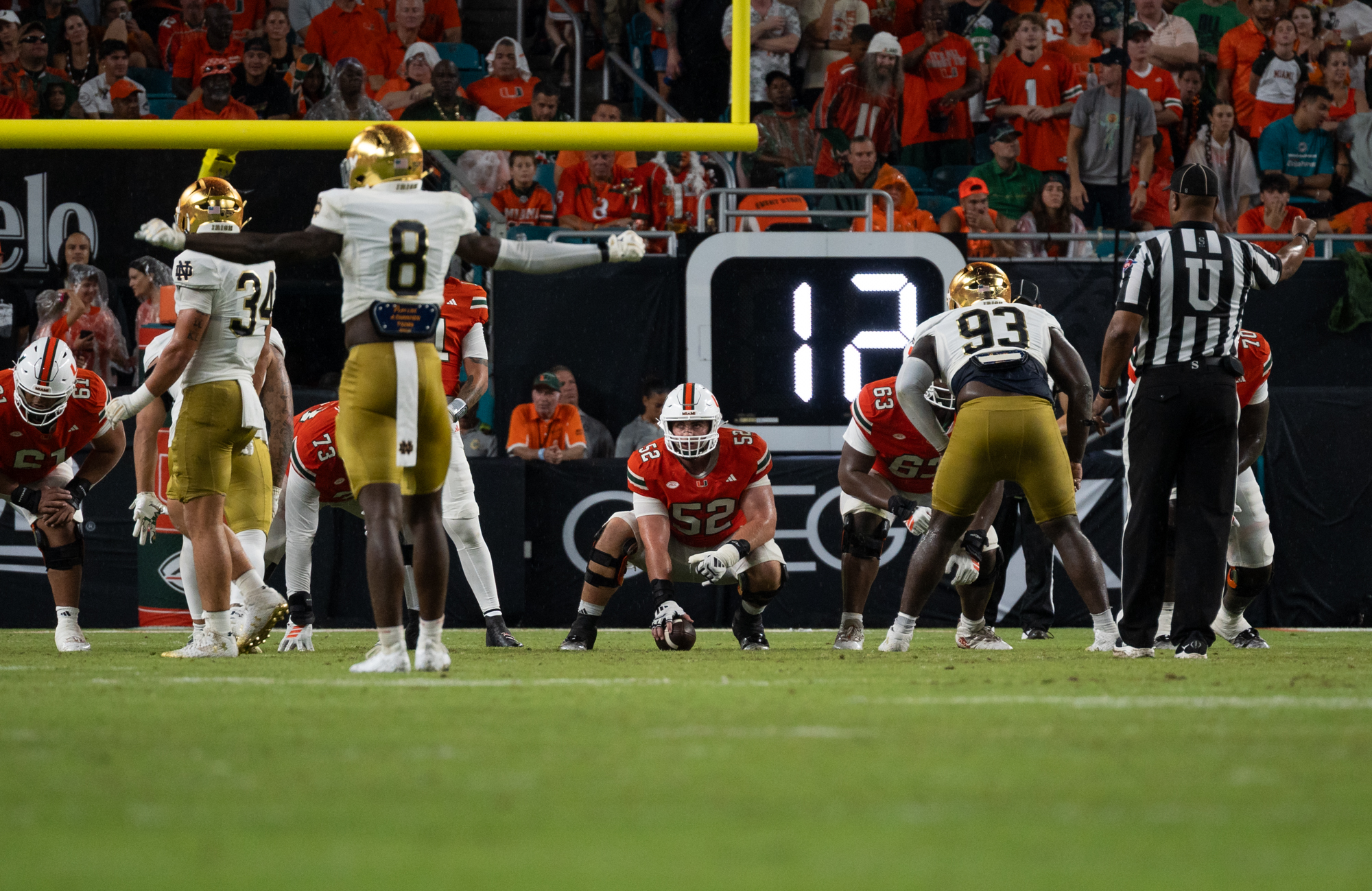
Brian Mulvey – Assistant Photo Editor // Redshirt senior James Brockermeyer waits to snap the football against Notre Dame on Aug. 31, 2025
No. 9 Alabama beat No. 3 Georgia
On Tuesday, the committee moved Alabama to the No. 9 spot over Notre Dame, all but solidifying the Crimson Tide’s chances of making the playoff unless something cataclysmic were to happen.
While a loss to Georgia on Saturday would put Alabama at three losses, don’t expect the committee to take the Crimson Tide out of the playoff. Instead, Alabama could drop to No. 10 and be the “buffer” between Miami and Notre Dame. Having Notre Dame at nine, Alabama at 10, and Miami at 11 will give the committee reason to not factor in the ‘Canes head-to-head victory over ND and keep UM out of the playoff.
But, if Alabama wins on Saturday, the top nine in the bracket is solidified, leaving one final spot for an at-large bid in the playoff. In the event a BYU loses and Alabama wins, that final spot will go to Miami or Notre Dame, which keeps Miami’s dream scenario alive.
However, in the event that Alabama were to lose by a significant margin to the Bulldogs, there is a world that the committee knocks out the Crimson Tide entirely and puts in both Notre Dame and Miami, but Hurricane fans shouldn’t rely on that happening.
The SEC Championship game at Mercedes Benz Stadium in Atlanta, Ga. is set for 4 p.m. and will air on ABC.
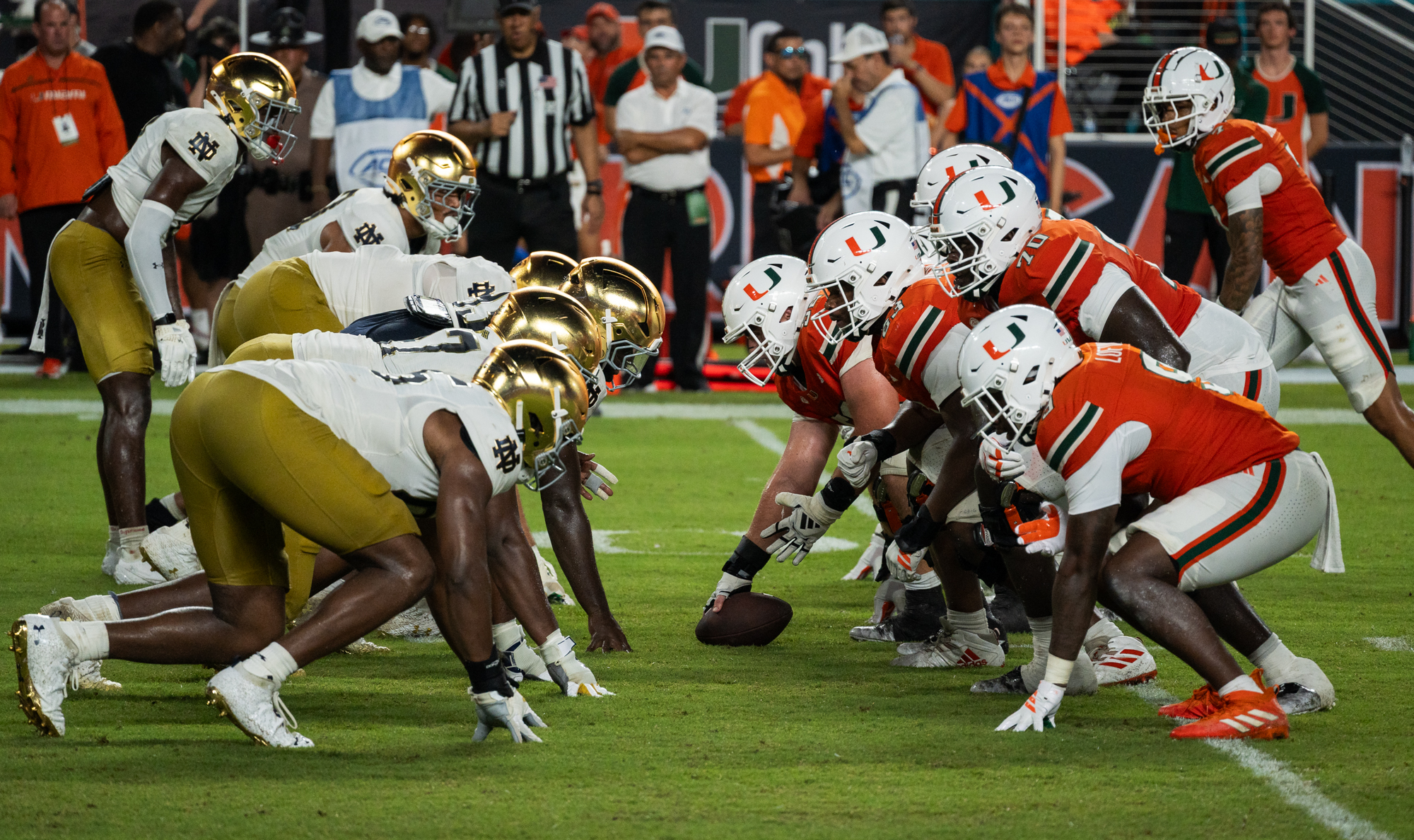
Credit: Brian Mulvey – Assistant Photo Editor //
Miami and Notre Dame face off at the line of scrimmage during their game at Hard Rock Stadium in Miami Gardens, Fla. on Sunday Aug. 31
Duke beats Virginia in the ACC Championship
This is where it starts to get a little weird — If former Miami head coach Manny Diaz can lead his Blue Devils to a win this weekend, the ACC champion would be a 7–5 team outside the CFP top 25.
In the event that James Madison beats Troy on Friday night and Duke wins on Saturday night, the ACC will be without a playoff representative and could force the committee to consider Miami, the highest-ranked ACC team, as the league’s best option.
The ACC Championship game at Bank of America Stadium in Charlotte, N.C. is set for 8 p.m. and will air on ABC.
It’s a long shot, but if chaos reigns this weekend, Miami could sneak into the CFP for the first time in program history. The final bracket will be released at Noon on Sunday, Dec. 7, when the College Football Playoff Show airs on ABC and the Hurricanes fate will be decided.
Wide receiver CJ Daniels reels in a one-handed touchdown against Notre Dame. Photo credit: Alex Muniz
Growing up in the Midwest, the holidays always came wrapped with cold air and a fresh coat of snow. The cool crisp air and quiet streets blanketed in white snow made the season feel like the most wonderful time of the year.
But when I started college in South Florida, winter felt strangely incomplete. There was no snow, no cold or any of the familiar clues that winter was upon us.
At first it was disappointing. All that nostalgia that I felt for Midwest winters and the traditions that I had associated with the holiday season seemed out of reach. In places where the weather never changes, the usual markers of the season fades leaving me picturing bright afternoons on the beach instead of the familiar holiday scenes that I grew up with.
The contrast between the Midwest and South Florida couldn’t be more stark. In my hometown of Buffalo Grove, Illinois, winters meant scraping the ice off my car, seeing my breath in the morning and turning the nearest ditch into a place to sled.
Here in South Florida, the warmth, humidity and constant bright sunshine make winter feel less like a season and more of a milder extension of summer.
While Midwesterners decorate pine trees at the start of the season, Floridians wrap strings of colorful lights around the trunks of palm trees. Inflatable snowmen sit proudly on green lawns that may never feel a single snowflake. It’s festive, just not in the way that resembles the winters that I grew up in.
Adjusting to this environment took time. I found myself longing for the traditions and routines that I now realize were taken for granted. I missed warming up by the fireplace after coming in from the cold. I missed watching snowfall from my bedroom window and waking up to see the green grass transformed into all white after a night of heavy snowfall.
It felt as if the “holiday magic” that I grew up in had slipped away.
But over time, I began to understand that the holiday season isn’t just defined by temperature or snow. The longing that I felt wasn’t really for the snow, but for what the snow signaled. It reminded me of the family gatherings we had, the traditions that we celebrated and the comforting rhythm of a Midwest winter.
Slowly, I learned to stop measuring the holiday spirit by how cold and snowy December had felt.
Experiencing the holidays in South Florida has taught me something important, the season is shaped by people and not just the weather. The warm temperatures, palm tree decorations and unfamiliar routines that once felt strange eventually took on a meaning of their own.
I realized that the holiday spirit comes from the moments we create, and not just the scenery around us.
Even without the flurries, the holidays can feel just as special as in the Midwest — but just in their own unique South Florida way. While a part of me will always miss the magical snowy Decembers of my hometown, I’ve learned that holiday joy doesn’t melt away in the warm weather. Down here, students celebrate the season differently by trading snow days for beach days, swapping hot chocolate for an iced cafecito and enjoying long days on the boats over sledding on hills.
The traditions may look different but the spirit is still there; it simply thrives in the sun instead of the snow.
Democratic Socialist Zohran Mamdani defeated former New York Governor Andrew Cuomo and Guardian Angels founder Curtis Sliwa to win the mayorship of New York City on Nov. 4.
Mamdani makes history as both the youngest and first muslim mayor in the city’s history. His campaign was strategic. He used social media, bold graphics and actively campaigned on the issues that mattered most to voters.
Republicans need to implement some of his strategies ahead of the crucial 2026 midterm election season.
Campaign Take Aways
Mamdani campaigned heavily on one key issue: cost of living. Unlike in the other races happening across the country, CBS noted that only 40% of voters found that Trump was a factor for them as they headed to the booth, compared to nearly 60% in the California Prop 50 initiative.
Mamdani’s policy proposals grabbed the attention of voters, with ideas including rent freezing, replacing police with social workers, city owned grocery stores and free child care. While a lot of his policy would require state or federal approval, they were bold and focused on issues that mattered to New Yorkers.
Republicans need to continue campaigning on the issues that won them back two branches of government. Issues such as crime, inflation, border security and school choice appeal to moderate and swing voters. If the GOP wants to compete they need to elevate these issues with the same clarity and consistency that Mamdani did.
Republicans should also embrace a growing faction of the electorate: Hispanic men. Trump made significant gains with this group by winning 54% of their vote. Perhaps bringing in younger and hispanic male candidates in communities where they are largely represented could help republicans make further games with hispanic women and eventually other minorities. It’s very possible to see Secretary of State Marco Rubio on the campaign trail for a slew of republican candidates, being the highest ranking hispanic person in the federal government and recognized by Trump as a possible successor.
Additionally, social media played a crucial role in Mamdani’s voter outreach.
The Guardian chronicled his videos and social media posts, noting how Mamdani appeared charismatic and his posts were polished.
His kickoff video featured him walking around NYC with upbeat music and pointing out how he could fix the issues he showed on camera. Another video captures him running the New York City Marathon, hitting all five boroughs, and delivering his message amid the exercise: “If you want to run for mayor, you need to go to every single borough … today we are the first campaign to hit five in a day.” These videos kept Mamdani in the public conversation despite starting in 9th place at the start of the Democratic primaries.
The campaign also featured strong visuals: bold letters and vivid colors which were chosen to evoke the city’s streets according to designer Aneesh Bhoopathy. Bhoopathy drew inspiration from colors that are typically found in the city’s bodegas, yellow cabs and hot-dog vendors.
The branding of the campaign also reflected Mamdani’s roots as a South Asian man, referencing Bollywood.
Republicans need to match this level of energy.
That means getting out on social media and crafting messages unique to their constituents. The issues that matter to voters in New York may not matter to voters in Kentucky, so it’s important to make sure they follow the trends in their area and ensure they have an effective message to their potential voters. Running youthful charming candidates who understand social media and its workings would make a huge difference.
Impact on 2026 midterms
The election occurred at the same time as the longest government shutdown in U.S. history. President Trump acknowledged that republicans in key races, including the mayoral race, could not meet the moment due to the shutdown. “I think if you read the pollsters, the shutdown was a big factor, negative for the Republicans,” Trump said the morning after the election at breakfast with GOP senators.
Polls have Democrats with major wins in 2026, with 46% of people polled saying they would vote blue compared to 39% for the GOP. Reuters also found that Democrats seem to have their groove and confidence back with 44% of them feeling ‘very enthusiastic’ about the midterms.
For the Democrats, the question is if progressives are willing to take on establishment figures and use the momentum Mamdani’s win gave them as the push to win control of congress.
For republicans, Mamdani’s win should serve as a warning. If he could beat a veteran Democrat like Cuomo, what are the chances for Republicans in purple districts or states?
The midterms will ultimately serve as a referendum on Trump’s second term. It’s only a matter of which party will meet the moment. Both parties need to adapt, sharpening their messages, mobilizing voters and meeting communities where they are.
A few months ago, no one would have predicted that 34-year-old Zohran Mamdani would rise from ninth in initial polling to win the mayorship in New York City. Yet, NYC Mayor-Elect Mamdani has defied all expectations in his swift rise to the top to defeat former New York Governor Andrew Cuomo and Republican candidate Curtis Sliwa.
One question remains: What next? The American left can take away multiple things from Mamdani’s campaign: progressive grassroots movements are a viable tactic in American politics, and remain viable against significant lobbying and powerful political dynasties, regardless of identity.
Mamdani was the correct choice for mayor against a candidate like Cuomo who has sexual harassment allegations, and will bring a refreshing brand of politics that will genuinely attempt to meet the needs of New Yorkers concerning affordability and living conditions. Mamdani’s win has the chance to bring more electoral victories to progressives across the country.
Key Takeaways
Money doesn’t win elections. A single independent expenditure committee, Fix the City, Inc., spent almost $28 million to support Cuomo. FTCI accounted for 55% of all independent expenditures in the mayoral race. That’s more than Mamdani’s total campaign spending and his supporting independent expenditures combined.
Yet, Mamdani beat Cuomo by nearly 181,056 votes. Mamdani said in an interview with MSNBC, “[Billionaires] are spending more money than I would even tax them.”
Money isn’t the only challenge to grassroots movements; powerful elites are another. However, Mamdani’s win shows that powerful politicians aren’t impossible to beat.
Political dynasties are a strong group in American politics. The Kennedies, the Clintons and the Bushes are just some examples of some powerful political dynasties, handing their power down to each generation. Cuomo himself was part of a dynasty, being the son of former Governor of New York Mario Cuomo, a powerful figure in New York politics.
At times it feels that those same powerful politicians, like the Cuomos or current long-time figures like Nancy Pelosi might never be replaced unless they retire. However, Mamdani just proved that thinking wrong. Real change can happen, if you play your cards right to prove to voters that you are the better choice.
Among other things, Mamdani faced opposition based on his identity. His victory shows that identity doesn’t matter to people if you focus on their material needs, which is why Mamdani, who constantly spoke out about affordability in NYC, was the best mayoral choice. Mamdani is New York City’s first Muslim and Indian-American mayor, as well as the youngest since 1892. Mamdani is also an immigrant, becoming a naturalized citizen in 2018.
Throughout the race, Mamdani faced Islamaphobic rhetoric from the opposition, mirroring anti-Catholic and anti-Jewish rhetoric from the 20th century. These examples include figures like John F. Kennedy, who faced anti-Catholic rhetoric throughout his presidential race to become the first Catholic president. Similarly, Mamdani pushed aside Islamophobic rhetoric with emotional speeches and a steadfast focus on campaigning on New Yorker’s concerns like affordability to win the race.
Normal, everyday people will not care about identity if you campaign on addressing their concerns. A person working two jobs to put food on the table and pay rent on time doesn’t have time to scroll on social media to see what others are saying about each candidate. . What matters is the policy the candidates are proposing and if they deliver a better living condition for constituents.
On the campaign trail, Mamdani was often seen on the street talking to as many people as he could to find out the best way to help out NYC. The Democratic party especially needs to keep this in mind after seeing the Hispanic vote for Donald Trump increase and the Black vote for Kamala Harris decrease in the 2024 election.
What the future holds: 2026 Midterms
What Democratic candidates across the country focus on in their campaigns next year will depend on how well Mamdani handles the transition and his first few months as mayor. Candidates have always been cautious about campaigning on positions that are deemed too far to the left, though in reality, they are mostly center-left positions that are common and accepted in political cultures like Europe and Latin America.
If Mamdani does relatively well, the 2026 midterm elections could very well see an influx of politically left candidates with popular support, at least in the primaries. The main factor that determines these candidates’ success, however, depends on the public view of Mamdani’s administration by non-New Yorkers.
Any candidate running for office cannot forget the importance of adapting their message and campaign to the geographic location. The issues which affect New Yorkers might not affect Miamians in the same way, and candidates looking to succeed outside New York must focus on communicating with the community to figure out what are the pressing issues it faces.
There are candidates who are already attempting these strategies while adapting them to their respective constituencies. Graham Platner, a progressive underdog for the governorship of Maine, is fighting against his past controversies to show he has changed as a person and wants to work to meet the needs of Mainers.
In Michigan, progressive activist Abdul El-Sayed is also fighting against Islamophobia in the Senate race. His focus on progressive solutions to people’s issues mirrors Mamdani’s campaign and the struggles against racism in a state with an influential Muslim population.
Mamdani’s electoral victory in NYC sends several political signals: Money alone can’t win elections, political dynasties are not invulnerable and policy will always take precedence over identity. If his policy begins showing signs of success or progress before the 2026 elections, it will allow other progressive candidates across the country to use his success as a catapult for their own campaigns. However, any other progressive candidate must be creative in adapting progressive messages and campaign strategies to their constituencies.
Opera isn’t just an event for fancy people in gowns and tuxedos to watch for one evening at the Arsht Center here in Miami or the Lincoln Center in New York City. It is one of the most demanding, collaborative and competitive art forms out there.
After spending Nov. 12 and 13 behind the scenes of the Frost School of Music’s production of The Consul by Gian Carlo Menotti, I realized something: opera isn’t only alive. It’s thriving and needs to be more well known.
What goes unnoticed
Most people see the beautiful arias, the orchestra and thought out staging as the glamor of the opera. What you don’t see are the hours of rehearsal, the dozens of moving parts or the backstage chaos that somehow flawlessly comes together on stage.
I got to work on the shift team of The Consul this semester, moving props and reseting scenes in the dark while the story continues forward. It gave me the best view in the entire hall. Even standing offstage, listening to voices slice through the air with resonance left the music resonating with me. I understood how much precision opera demands from everyone.
Every prop we shifted was meticulously choreographed. Every moment depended on dozens of people working in perfect rhythm, whether they were onstage, in the wings or at the tech table. Watching the whole classical voice department create a show as complex and emotional as The Consul showed me that not only do the notes work in harmony, but the people do as well. This isn’t just with opera. Every single backstage performance, such as musicals or plays at the Jerry Herman Theater, shows the importance of working in harmony.
Opera still matters
Opera is often dismissed as outdated, but The Consul showed just the opposite. Menotti’s opera is a political show about bureaucracy, fear and freedom. It has themes of oppression, surveillance, human resilience and feelings uncomfortably relevant to today. Seeing this show embodied by young artists reminded me that opera has always been a mirror for society, even in storylines written years ago.
Classical voice majors spend hours each day refining technique in many languages, stamina, acting and musicianship. While learning one song takes weeks perfecting, a singing role can take months to prepare. An audience only gets to see the final product. That’s why it’s so important to remember and value all the work put into this wonderful art form.
Listen for Yourself
Opera isn’t just living on stages like Clarke Hall, but it’s finding new life online. Singers and students are bringing arias to TikTok, sharing opera clips on Instagram, and showing the behind-the-scenes work that usually stays hidden. I’ve been posting about opera and classical music on my own TikTok, and every time someone comments sharing their love for opera, I feel more connected to the community of classical musicians.
Social media is proving that opera doesn’t have to stay locked in tradition. It can be modern, accessible, humorous, experimental and emotional in a way that younger audiences can actually connect to. As someone who has grown up immersed in classical music — singing since I was little, performing on big stages, and now studying classical voice — it has shaped the way I see the world. It’s given me discipline, empathy and a sense of belonging that I carry everywhere and hope to share with others.
Productions like The Consul deserve to reach people far beyond the theater. If we want opera to keep evolving and share the emotional depth of a show, we have to let it meet audiences where they are — onstage and online. One performance at a time, we can help more people discover how alive this beautiful art form is and how to keep it thriving.
No. 5 seeded Miami volleyball beat Tulsa in the first round of the NCAA tournament Thursday night, winning handily 3-1.
The Hurricanes were led once again by standout player Flormarie Heredia Colon, who tallied 33 kills, four blocks and three aces. Senior Naylani Feliciano racked up 21 digs and five assists, while Ariana Rodriquez recorded 43 assists and 10 digs.
The ’Canes pulled away early in the first set, going up 17-13 following four early kills from Heredia Colon. Tulsa fought back, but ultimately fell short, 25-22.
Tulsa opened up set 2 strong, going up 10-4 and carrying that momentum to a 25-13 set victory.
Both teams knew the third set would be crucial, and it showed. It was a tight contest, starting out 9-7 in favor of Tulsa. Miami then went on a spectacular 8-0 run with three kills and a block from Heredia Colon for the 17-14 lead. They went on to win the set 25-22.
The last set stayed close, tied at 11, until the Hurricanes went on another dominant run. A 7-1 push helped lift the ’Canes to a 25-20 set win, punching their ticket to the next round.
The Hurricanes will face No. 4 seed Kansas in round two.
On this week’s episode of TMH Sportscast, Zach and Liam are joined by The Miami Hurricane’s Co-Sports Editors Sebastian Font and Jayden Gonzalez for an in-depth conversation about the college football playoff outlook. They break down what the committee had to say this week and what needs to happen this weekend to enhance Miami’s chances of making the playoffs.
Taylor Swift is everywhere. She dominates headlines, playlists and social feeds, turning nearly every move into a cultural moment. But as the private jet debates grow louder, fans crash out over a new album and social media replays another round of highly analyzed breakups. The overall conversation around Swift has started to feel bigger than the work she puts out itself.
Even though she remains one of the most beloved figures in pop, her cultural status is starting to feel overrated.
Swift’s newest album, “The Life of a Showgirl,” raises doubts about the direction of her artistry, with many listeners calling it her weakest release to date. Critics and fans on TikTok have described the project as unfocused and repetitive, lacking the lyrical sharpness and emotional clarity that once defined her work. The album leans heavily on familiar themes without offering new insight. Several tracks feel more like unused drafts than fully developed songs.
Online discussions with longtime fans show a noticeable divide, with some admitting they struggled to finish listening to the album at all. For an artist known for reinvention, the record marks a rare moment when the storytelling, production and ambition simply did not meet the expectations set by her earlier eras.
The concerns extend beyond the environment. Swift’s latest album left longtime listeners divided, raising questions about whether the praise she receives is grounded in the music itself or simply in th
e momentum of her brand. For some, the work feels repetitive and more focused on generating theories than producing depth.
Meghan Schorr, a senior at UM, said the repetitiveness of the music contributes to the perception that Swift is overrated. “Almost all of her music sounds the same. It is all about a man or a breakup and it has gone on for years,” Schorr said. “She spends more time making her music into a game with Easter eggs than focusing on making impactful music.”
Schorr said the shift in genres also made Swift feel less authentic. “I grew up on her older music and loved it. But once she switched to pop, it did not feel genuine. It felt like she was making music to make music and put on a show, not to connect,” she said.Swift’s public relationships add another layer to her cultural dominance. Her image as a perfect pop storyteller depends heavily on public fascination with her love life, heartbreaks and feuds. As these narratives grow louder, her morals sometimes becomes secondary to the spectacle surrounding her.
In the past, Swift has been praised as thoughtful and socially aware. Yet her public image often conflicts the reality behind it.
Swift, frequently criticized on social media for the carbon emissions produced by her frequent travel, has long claimed she can reduce her environmental impact. But Carbon Market Watch, an environmental advocacy group, disputes that defense, saying “the only way for high-flying celebrities and the superrich to reduce their climate impact is to fly less and choose more sustainable forms of transport.”
Other celebrities are more aware than Swift, including Grammy and Oscar winning singer-songwriter Billie Eilish. Eilish is known for her environmentally focused activism and recently announced that she is donating $11.5 million from her Hit Me Hard and Soft tour to support food equity, climate justice and efforts to reduce carbon pollution.
Billie Eilish has made a major impact because of this donation and has drawn attention from celebrities and billionaires around the world.
During her acceptance speech for the Wall Street Journal Magazine’s Music Innovator Award, she urged billionaires in the room to give more, saying, “If you have money, use it to do good … and if you’re a billionaire … give your money away, shorties.”On the tour itself, she partnered with the nonprofit Reverb to build “Eco Villages” at venues, encouraging fans to learn how to reduce their carbon footprints and offering more plant-based food options.
Taylor Swift, who faces ongoing scrutiny over her private jet emissions and large-scale touring footprints, could be doing far more to reduce her environmental impact. But she does not seem to care.
Even fans who adore her are grappling with this. Jamison Delaine, a junior at the University of Miami, said it affects how she sees Swift’s influence. “It is upsetting to hear how one person is drastically contributing to the issue of carbon emissions,” Delaine said. “As a leader in pop music, Swift should lead by example. As a billionaire, she has plenty of resources to be more eco-conscious and I hope she starts using them.”
“Swifties” often blur the line between admiration and obsession, according to Delaine. “The fandom became toxic. People started to believe she was exempt from criticism,” she said. “I did not think that was beneficial for her development or for our growth as a society.”
The question of who Swift really is has become harder for some fans to answer. “She has had so many different characters and genres and personalities that it is hard to know who the real Taylor Swift is,” Schorr said. “But I am sure she is not a bad person. Other than the carbon emissions.”
Despite her massive global platform, Taylor Swift often remains quiet on major social issues, speaking out only occasionally and usually when the moment feels safe or aligned with her brand.
While she has taken public stances in the past, critics argue that her engagement is inconsistent, especially compared with artists who use their influence more frequently to spotlight political or humanitarian causes. As her fame and commercial power have grown, so has scrutiny over her reluctance to weigh in on topics her audience cares deeply about.
Her influence remains enormous, and she could help spark meaningful conversations about issues her audience already cares about, yet she often stays silent while artists with far smaller platforms take more consistent risks.
None of this denies Swift’s talent or her impact on modern pop culture. She has shaped a generation of listeners and built a career that few artists can match. But it is possible to acknowledge her accomplishments while still questioning whether the hype around her is still valid. Calling for accountability does not diminish her music. It simply asks for honesty from someone with the power to influence millions.
For fans, the challenge is deciding whether they love the artist or the hype. For Swift, the moment may have come to recreate the image with the values her audience hopes she stands for.
Despite what haters think, Taylor Swift still makes the “whole place shimmer”.
With over 105 million monthly listeners on Spotify, it’s baffling to see people still argue and water-down Taylor Swift’s impact on not just the music industry, but pop culture itself.
From sold out stadiums to iconic award-show moments, Taylor Swift has revolutionized the idea of a pop star. Her fanbase is far from low-key, and it is for a reason. Swift’s musical brilliance and global fan base make her one of the largest influences on pop culture and music today.
Her most recent “Eras Tour” generated 2 billion dollars in ticket sales alone, and is meant to pay homage to her iconic albums and their re-recordings. Despite what many believe, though, Taylor’s tour did not just benefit her.
It was reported that Taylor Swift gave over 195 million dollars in bonuses to all of her Eras Tour employees, giving one employee a 100,000 dollar bonus with a hand-written note and bouquet of flowers. She gave each of her equipment truck drivers a 100,000 dollar bonus as well.
The economic impact was felt by entire cities that she performed in each leg of her tour. Melbourne reportedly generated 1.2 billion Australian dollars, London generated 300 million pounds, California made 320 million dollars and countless other cities also reported experiencing tremendous economic boosts as Taylor came through their city.
So, while some claim that Taylor Swift is “stuck-up” or too far removed from her fan base to understand just how much income she generates, the singer-songwriter has been more than generous with her earnings.
Many also make the argument that Taylor’s songs are recurrently male-centered and lacking in substance or value, and while these are only her most popular songs, there are also many other female artists who do the same.
Sabrina Carpenter just recently released her album “Man’s Best Friend,” which features over 10 songs that either center around or mention a guy. Don’t get me wrong, I love Sabrina’s music too, I’m just saying it’s a bit hypocritical to bash on Taylor but not Sabrina when it comes to male-focused music.
Additionally, reporters have consistently pushed the narrative onto Taylor Swift that she is “boy-crazy,” even from an extremely young age.
In a 2015 Grammy Awards interview, reporter Nancy O’Dell asked Taylor Swift if she would be going home with “lots of men” that night, to which Taylor replied, “I won’t be going home with any men. I’m going out with friends and then home to my cats.”
When you take a look at the songs that have gone the most viral — “Blank Space,” “Love Story” and “You Belong With Me” — they are consistently male-centered.
Her true fans know that her music is much more than songs about the latest teen heartthrob or her recent heartbreak. Her album, Folklore, features an intricate and well thought out story about three characters: Betty, Augustine and James. The songs tell a beautiful story about infidelity, teen romance and innocence.
Taylor’s song “Dorothea,” rumored to be about her friendship with Selena Gomez, describes a narrator telling a story of her childhood best friend who moved to Hollywood to pursue her dreams of fame and glamour.
Other songs such as “Ronan” and “Marjorie” feature important people to Taylor, aside from romantic partners.
Swift was inspired to write the song “Ronan” after reading a deeply moving blog post by the boy’s mother, who described how her son had passed after battling stage four cancer. Taylor used direct quotes from the blog in her song, even crediting Ronan’s mother as a co-writer on it, ensuring financial support for the mother as she was going through this difficult time.
“Marjorie” is featured on the album Evermore, and is a tribute to Swift’s grandmother and opera singer Marjorie Finlay. In the song, Taylor discusses how she wished she would have treasured all the time and memories she had with her grandmother because she didn’t know how short it would all feel.
An excerpt of one of her grandmother’s performances can also be heard in the background towards the end of the song.
Taylor’s discography includes dozens of other songs that truly capture the beauty of female friendship and childhood innocence, proving that she is not limited to songs about boys, boyfriends or husbands.
She’s also extremely connected to her fanbase and remains transparent through interviews, podcasts, and documentaries. In 2020, Swift released the “Miss Americana” documentary on Netflix, where she discussed a range of personal topics from her childhood to her political views.
She is now releasing a new documentary on Dec. 12 titled “The End of an Era” on Disney+. The six-episode series will cover behind-the-scenes footage from her multi-million dollar Eras tour and give fans a glimpse into all that goes into a global tour.
It’s time to put a stop to the Taylor hate-train. Her musical talent, lyrical genius, and immense platform growth make her stand out in the music industry. There’s no need to hate on another female artist on top, and she’ll probably just shake it off anyways.
Euphoricstacy and Exit2C transformed restaurant Paraíso Estéreo into a case study in how late-night events come together on Nov. 20. The night was less of a “club outing” and more as a carefully sequenced seven-hour project in pacing, logistics and collaborative curation.
Artists played one right after the other the whole night. The schedule was built like a relay. Latin DJ Edgar Santiago known as Edgy opened from 10p.m. to 11:30p.m. and set a welcoming atmosphere as doors opened and attendees filtered in.
From 11:30p.m. to12:30 a.m., Vega raised the energy and guided the room from warm-up to full engagement. Seron & Body came in after Vega and bridged that momentum into true prime time and prepped the floor for the headline: M3RCH..
M3RCH, was given a dedicated 1:30–3:30 a.m. window — an intentional choice that carved out enough time to build a narrative rather than just drop in for a quick appearance.
“Curating is like a big puzzle where you have all these pieces and you’re seeing what fits and what doesn’t,” Maximiliano Duarte, CEO of Euphoricstacy Group, said. “When all the pieces flow smoothly together it becomes such an amazing ride to be a part of.”
Craii b2b Jvi closed from 3:30 – 5:00 a.m., tasked with maintaining energy for attendees who committed to staying through the end.
This kind of structure reflects extensive planning: aligning artist availability, designing a running order, mapping arrivals, peak capacity and exit flow onto specific time blocks.
Beyond the music itself, for independent organizers like Euphoricstacy and Exit2C, mass advertising isn’t feasible, so promotion is highly targeted and community-driven.
Social media teasers, artist-led content and invite-only messaging were timed to build anticipation gradually, while encouraging attendees to share select moments helped create organic buzz.
Early ticket releases rewarded loyal followers and insiders. Later releases reached a wider audience and real-time monitoring of RSVPs and engagement allowed organizers to adjust messaging on the fly.
This integration of marketing directly into event planning shows that, for independent shows, promotion is an essential part of shaping the experience itself.
With limited-capacity promotion and a clear identity centered on forward-thinking electronic music, Euphoricstacy and Exit2C demonstrated how independent organizers can build immersive, late-night experiences with sequencing, collaboration and an attention to detail.
“You’re creating moments and a memorable experience, and sometimes you forget to check on yourself and say, wow, I really did this.”