Home Blog Page 229

Taylor Swift’s sold-out “Eras” tour dominates the box office

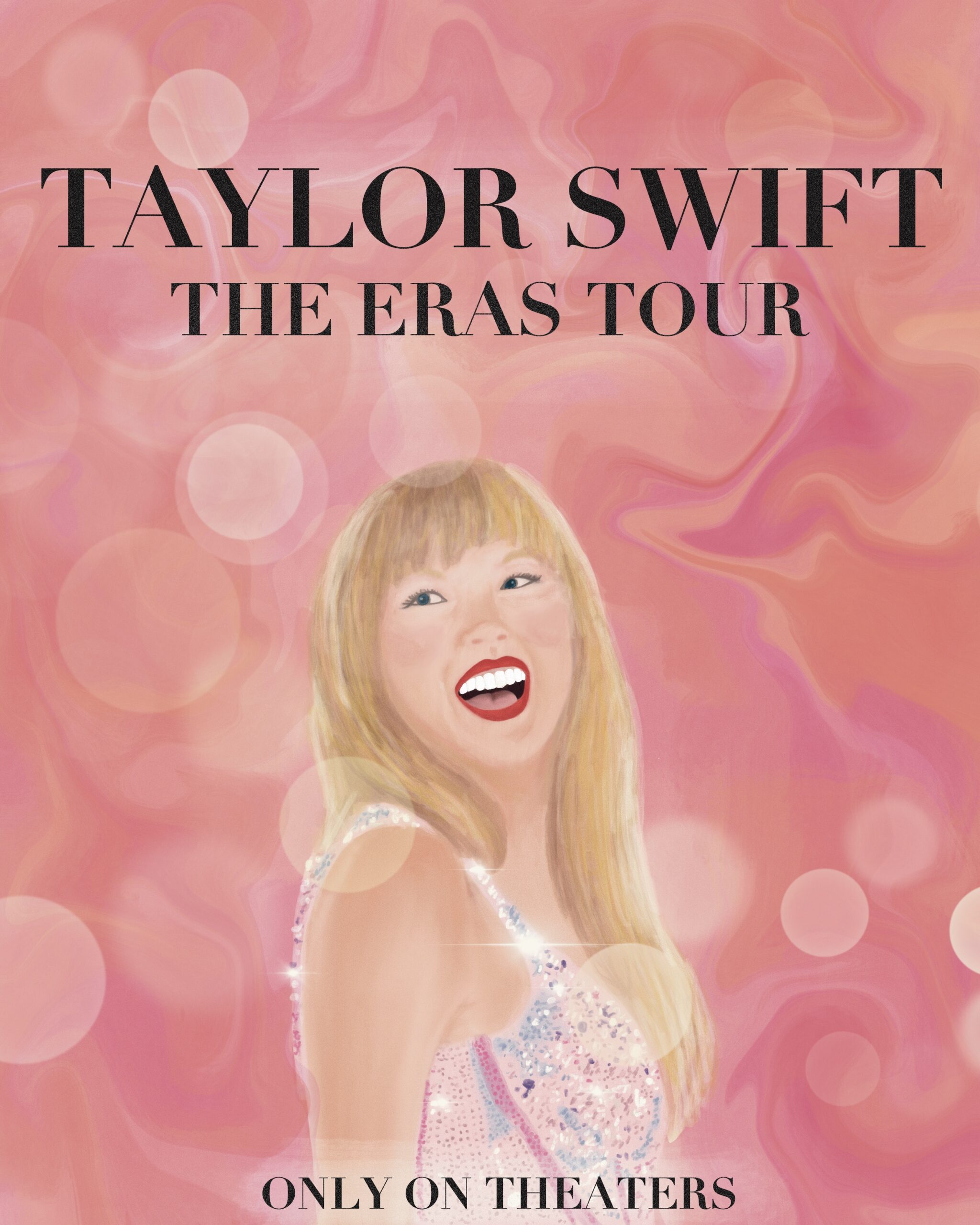
"Taylor Swift: The Eras Tour" film hit theaters on Oct. 13.
"Taylor Swift: The Eras Tour" film hit theaters on Oct. 13. Photo credit: Marialejandra Gonzalez

“Taylor Swift: The Eras Tour” film is here, and Swifties are selling out movie theaters across the globe to experience the iconic concert on the big screen. Moviegoers have transformed theaters into concert venues, donning their concert best and running up to dance in front of the screen.

When global popstar Taylor Swift announced that a filmed version of her sold-out Eras Tour would hit theaters on Oct. 13, Swifties dropped everything and ran to the AMC website to purchase tickets.

Swift self-produced the film and partnered directly with AMC. This partnership allowed the film to hit theaters just weeks after its announcement. Though tickets were nearly $20 — pricier than the average movie ticket — this did not stop fans from pre-ordering their tickets the day Swift announced the film.

“Taylor Swift: The Eras Tour” had the best opening weekend for a concert film ever, making up to $97 million domestically and $130 million worldwide. After breaking records with the first leg of The Eras Tour, it is no surprise that the film has done the same.

After seeing both the live concert and the filmed version, I can truly say that “Taylor Swift: The Eras Tour” was a perfect translation of the live concert and made for another wonderful night of singing and dancing.

Swift carefully crafted every detail of her film, down to the ticket price. The $19.89 cost represents her upcoming re-recorded album,“1989.”

Since I saw the first available showing, at first, viewers were unsure whether to stand up and dance or sing quietly in their seats. However, as the movie progressed, more fans got up from their seats to dance along to the film, and it made the experience just as enjoyable as when I saw the concert live.

The incredible audio quality allowed Swift’s voice to shine and let moviegoers hear every instrument clearly through the speakers.

As the credits rolled, Swift thanked her fans in a heartfelt message. Video clips of Swifties at the concerts trading friendship bracelets and enjoying the concert were shown.

Several UM students attended the film’s first few showings and have reported that the experience of seeing the movie in a room full of Taylor Swift fans was immensely fun.

“My favorite part of the movie was being able to get up and dance to all of my favorite songs,” said Layne Nagele, a senior psychology major. “Everyone in the theater was having so much fun, especially during [the] ‘Reputation’ and ‘1989’ eras.”

Junior neuroscience major Andres Hernandez shared that the movie reminded him of Swift’s Tampa show back in April.

“The show was so exhilarating and the energy from the crowd was insane,” Hernandez said. “Similarly, the crowd from my movie experience was full of energy, sang every lyric throughout the three hours and danced and cheered throughout the entire film.”

Movie-goers also enjoyed the perks of seeing the film during opening weekend.

“I loved the photo-ops and different kinds of merchandise that AMC offered, such as the popcorn buckets and posters,” Nagele said. “It really added to the experience and made it feel like a real concert.”

The film allowed viewers to notice details that were difficult to see during Swift’s live concerts. Fans discussed on TikTok that even celebrities like Swift have chipped nail polish and frizzy hair sometimes.

“I loved seeing all her facial expressions and the details of her costumes that I had missed in person,” said Cassidy Martens, a junior studying psychology and Spanish.

Another aspect that was enhanced during the movie was the theatrical qualities of some of the songs. For example, “Tolerate It” was a dramatic masterpiece that captured Swift’s acting skills.

The live Eras Tour was 3.5 hours long. In order to make the film an appropriate length for movie theaters, Swift shortened the transitions between her costume changes and cut songs with less choreography to make the movie roughly 2 hours and 45 minutes. Though the removed songs were missed, it did not detract from the overall enjoyment of the film.

Although shorter than in the actual concert, the transitions between the eras were a highlight of the movie, as they displayed a beautiful 3D logo of the next era. The logos matched the album cover aesthetic and fonts used for each album title.

The logo for the “Reputation” era could even be an easter egg for the re-recording of the 2017 record. Fans think this because the original album was titled “reputation,” with a lowercase “r.” However, in the film, “Reputation” had a capital “R.”

Don’t miss the experience and see “Taylor Swift: The Eras Tour” in theaters now until January 2024.

Rating: 13/10

GOP candidates target Trump, second debate receives lowest viewership since 2015

0

As the race for the 2024 presidential election continues, GOP candidates took the debate stage for a second time on Wednesday, Sept. 27 to fight for the Republican nomination.

In Simi Valley, California, seven qualifying Republican candidates were present, with the notable absence of former president Donald Trump.

Topics discussed ranged from the economy, child care, immigration and energy policies.

Florida Governor Ron DeSantis continues to take center stage as he leads the pack in poll numbers, yet is still trailing frontrunner Trump by 33 points.

“Governor DeSantis of Florida might be the primary alternative to Trump, but he has faded as his campaign season has moved forward,” said professor of political science Gregory Koger. “At this point, he is just one of three to five candidates who is in the running as an alternative.”

DeSantis used his first speaking opportunity to criticize the former president, stating that Trump “set the stage” for inflation with his national debt contribution and that he’s “missing in action” along with President Joe Biden.

Direct criticism of Trump marks a turning point in DeSantis’ loyalty to the frontrunner, and could impact his ability to both persuade Trump’s voter base and remain open as a running mate.

DeSantis wasn’t the only candidate throwing rocks at his opponents that night.

Former UN Ambassador and former South Carolina governor Nikki Haley took a commanding position toward the other GOP candidates. She was the first to attack DeSantis, criticizing his energy policies and his opposition to drilling and fracking in Florida. DeSantis denied those claims.

Her most heated exchanges were directed towards fellow candidates Vivek Ramaswamy and Tim Scott (R-SC).

She targeted entrepreneur Ramaswamy for his backtracking stances on China, specifically calling out his presence on TikTok, an app he once referred to as “digital fentanyl.”

Haley also took a jab at Ramaswamy for his persona on stage.

“Every time I hear you, I feel a bit dumber,” Haley said.

Haley and her fellow South Carolina native Tim Scott, who currently serves on the US Senate for the state, went neck and neck arguing about levels of experience.

Both cited the other’s inadequate work while in their respective positions, with the argument taking a turn to who was friendlier with the Obama administration.

Wednesday’s debate was the lowest viewed GOP debate since 2015. The second Republican primary debate of that cycle garnered 23 million views, while the most recent saw only 9.3 million.

“It does suggest a low level of interest in this debate and of voters to choose amongst this set of candidates,” Koger said. “One subtle difference this cycle is that the Republican party has been a lot more conscious about restricting access to these debates.”

Former vice president Mike Pence arguably had the most talked about moment of the night, despite having little speaking time.

In response to former New Jersey governor Chris Christie’s jab at President Biden and First Lady Jill Biden for being a part of the teacher’s union, Pence added, “My wife isn’t a member of the teachers union, but I got to admit, I have been sleeping with a teacher for 38 years.”

Doug Burgum, governor of North Dakota, visibly fought for airtime at the debate, but when given the opportunity he focused on the economy and America-first policies.

The strongest critic of Donald Trump on stage was Christie, who frequently lumped Trump’s failed leadership with President Biden’s. It was when Christie first called out the former president that crosstalk and interruptions began during the debate.

His most highlighted moment was when he used Trump’s own tactic to call Trump “Donald Duck” for consistently ducking the Republican debates.

All candidates refused to answer a “Survivor” themed question asked by moderator Dana Perino, who prompted the candidates to “vote off the island” who they think should drop out of the race.

Both Democrats and Republicans in recent years have sought to make it so only serious candidates are using the debate stage for its purpose, limiting its platform as a publicity stunt.

“A lot of presidential nominees are, for both parties for the last 50 years, have been people who ran once, didn’t quite get the nomination, and then ran again, having built up name recognition and organizational contacts.” Koger said.

The third debate is set to be held on Nov. 7 in Miami, but the Trump campaign is publicly calling on the Republican National Convention to cancel, stating that there’s no need for a third debate as Trump continues to be the center of attention.

“I look forward to Miami if it actually happens,” Koger said. “It’s quite possible we’ll see some of these candidates again in 2028.”

Sims: This is only the start for Rueben Bain Jr.

0

Simply put, the ‘Canes would not have won last Saturday’s showdown against the Clemson Tigers without their freshman superstar, Rueben Bain Jr.

At just 18 years old, Bain recorded his best game of the season against Clemson. With two sacks and eight tackles, Bain let the world know that he’s arrived.

“I feel great,” Bain said. “I feel like I’m on top of the world.”

Bain’s breakout performance against Clemson was just his sixth game of college football. There is no question that Bain was the best defensive player on the field that night for the ‘Canes. His most notable play was a strip-sack of Clemson quarterback Cade Klubnik for a crucial turnover in the game.

Miami head coach Mario Cristobal spoke very highly of his standout freshman.

“He’s a game wrecker, that’s what he is. Teams are going to try and chip him, slide the protection his way and double-team him and whatnot,” Cristobal said after the game. “Not only is he gifted, but he just plays the game at a relentless level, really uncommon. Tonight it showed against some veteran players; he was as disruptive as it got.”

Cristobal is not the only one that Bain’s play has caught the attention of. Bain was named ACC Defensive Lineman of the Week and ACC Rookie of the Week for his performance against Clemson. No. 44 for the ‘Canes was also named Pro Football Focus’ (PFF) highest-graded defensive lineman for his game against the Tigers.

Bain leads the team in sacks with 4.5. That’s two and a half more than the player in second place, linebacker Francisco Mauigoa. Bain is tied for fifth in the ACC in sacks as well as tied for second in forced fumbles. Bain is also among the team leaders in forced fumbles with two. Bain has been incredibly disruptive for this ‘Canes defense, and he’s made the most of his opportunities.

Defensive linemen Ahkeem Mesidor and Nyjalik Kelly have been sidelined due to injuries. Because of their absences, Bain was given an opportunity and has ran with it. It’s hard to imagine Cristobal and defensive coordinator Lance Guidry putting their star freshman on the sideline.

Standing at 6-foot-3 and 275 pounds, Bain is a powerful edge rusher. He is able to use his leverage and his strong hands to move offensive linemen and get after the quarterback. Bain is very fast for a player of his size. The way he’s able to move sideline-to-sideline allows him to be a threat from anywhere on the field.

Bain, a graduate of Miami Central (Fla.) High School and a former MaxPreps All-American, says it means more to be able to do this for his hometown. The Miami native was a 247Sports-rated four-star prospect, ranked in the top 100 of recruits for his class, 10th among edge rushers and 15th among players from Florida.

Bain hopes that he can be an inspiration to other young Miami area football players.

“Definitely means more … I feel like I did something amazing and I hope that kids see me, who probably look up to me, see my play, and hope they doing the same thing and they taking it into consideration because when we do it at home, it feels amazing,” Bain said.

“I swear this is the best decision that I made in the past 19 years of my life.”

Young South Florida athletes are looking up to what Bain is doing.

“Social media [is] going crazy,” said Bain. “I feel like that’s because I stayed home and I hope guys that are coming up and seeing that can do the same thing.”

Bain is one of the top players on the Hurricanes’ defense, and it’s only his eighth week of college football. This season, Bain is on pace for nearly eight sacks, which would be more than Mesidor had to lead the team last season. Bain is on pace to have as many sacks as former Hurricanes standout and current Miami Dolphin Jaelan Phillips.

Miami has landed themselves a monster in Bain, and he’s just getting started.

Sims: Takeaways from Miami’s thrilling win over Clemson

0

The Miami Hurricanes showed some grit at Hard Rock Stadium, toppling the Clemson Tigers in double overtime, 28-20. The ‘Canes battled back in the second half and ground out a victory on home turf in front of an announced crowd of 48,562.

This win moves Miami to 5-2 overall and 1-2 in the ACC. True freshman quarterback Emory Williams, filling in for the injured Tyler Van Dyke, showed up on offense to lead the ‘Canes to their most significant ACC victory of head coach Mario Cristobal’s career.

Miami got redemption for its 30-point loss in Death Valley last year. With the win, Coral Gables has a revived sense of optimism. Let’s jump into some takeaways from the big win.

Freshmen showed out

Two true freshmen stars carried the Hurricanes to their win. At the quarterback position, Williams made his first career start under center. It was a tale of two halves for the first-year quarterback.

Williams was incredibly limited in the first, with only 31 yards and an interception. In the second half, Williams turned it around. The freshman was efficient, going 14-of-17 with 120 yards and a score. Williams found some chemistry with wide receiver Colbie Young in the second half, which proved pivotal.

“When you have a guy like Colbie Young, he’s big, he’s fast, he’s physical, I want to turn to him, keep throwing him the ball,” Williams said.

On the other side of the ball, freshman defensive lineman Rueben Bain Jr. was a stud.

The Miami native recorded eight tackles, two sacks, and a forced fumble. Bain was an absolute game-wrecker and was the Hurricanes’ best player on defense.

Miami’s defense came up clutch.

The young ‘Canes offense needed to use the defense as a shoulder to lean on for most of the game. It looked like Miami fans were in for a bit of dèjá vu from last week the way the third quarter started, letting up ten unanswered points in the third quarter.

But the defense buckled down and stood tall, as the Tigers could only muster up three points in the fourth quarter and overtime. The goal line stand in overtime proved to be the difference in the game, as Clemson had four chances to score from Miami’s two-yard line. Linebacker Corey Flagg Jr. made the tackle on Cade Klubnik at the game’s end to secure Miami’s win.

Turnovers were key.

Miami dominated the turnover battle against Clemson. An interception in the red zone and a fumble at the one-yard line were detrimental to Clemson’s offense. Another fumble in the first quarter killed a Clemson drive.

The ‘Canes were able to capitalize with a score in the first quarter off of a Tigers fumble at the goal line. Williams only threw one pick on the other side of the ball, and both of the Hurricanes’ fumbles stayed with them. Miami won the turnover battle, keeping itself in the game early.

Brashard Smith was an unsung hero.

Smith is an electric playmaker, and he showed that it’s not just on special teams. An 80-yard scamper from the backfield put the ‘Canes up early and put some life back into the crowd at Hard Rock Stadium.

Smith also made a difference in the passing game, catching five balls for 36 yards, including a clutch 12-yard reception in overtime, to put Miami in prime position to score. UM may have dropped this game without Smith’s explosive ability while the rock is in his hand.

Miami has momentum again.

After a setback in back-to-back weeks with losses to Georgia Tech and North Carolina, Miami was able to right the ship with a massive home victory against a vaunted Clemson Tigers defense.

There is no understating it: this is a massive win for Miami’s football program. With a winnable game against Virginia at home on the horizon, the ‘Canes have an opportunity to keep the momentum building when the Cavaliers come to Hard Rock Stadium.

REVIEW: “Pet Sematary: Bloodlines” is better off dead

The prequel to the film adaptation of Stephen King’s “Pet Sematary” proves its iconic quote, “sometimes, dead is better,” true with its staid plot and one-dimensional characters. Despite introducing the history of Pet Sematary (2019), the prequel fails to mimic the horror and morality-bending themes of its predecessor.

Directed by Lindsay Beer, the film ad follows a young Jud Crandall (Jackson White) and his lover Norma (Natalie Alyn Lind) attempting to leave their hometown. But, when Jud’s childhood best friend Timmy (Jack Mulhern) begins acting strange, Jud discovers the Pet Sematary, an Indian burial ground which raises the dead. The dead, however, don’t return the same.

On the surface, Jud should face internal conflict over the morality of killing his childhood friend for the greater good. However, there’s little conflict as the film solely depicts Timmy as a monster, removing any shred of sympathy that viewers might show toward him.

Relying on jumpscares and gore for horror, the film initially succeeds at the shock effect, but it quickly becomes predictable as the film progresses.

This static film structure makes for a less thrilling watch than one would expect from a horror movie. Audiences will easily forget much of the scenes that are filled with boring, repetitive dialogue and lackluster acting performances.

The character’s motives are practically identical and their only goal — to kill Timmy — remains the same throughout the film’s 84-minute runtime. Though every character aims to end Timmy’s bloodshed, simplicity robs the film of exploring the unique reasons each character has for doing so.

Additionally, some of the character’s decisions don’t make sense. For instance, Timmy’s father has lived near the pet sematary for years and been aware of its evil power, but acts surprised when his choice to bury Timmy results in him acting demonic.

The protagonist, Jud, falls victim to the same problem. In “Pet Sematary (2019),” Jud is a pivotal character that helps bury a pet in the Sematary, thinking it will return the same as before.

Such a decision is paradoxical since Jud has witnessed the events in the prequel, making him aware that the pet will most likely bring harm.

Though the prequel focuses on the consequences of a human burial, Jud still shouldn’t be willing to take such risks knowing the possible lethal outcome.

The plot drags on at times, and the film does not include enough high-stakes, character-defining moments. Instead, exposition dumps and everyday conversation take up screen time.

Fans of Stephen King’s iconic novel should steer clear of “Pet Sematary: Bloodlines” — the flat plot and characters make it a tedious ride.

Rating: 2/5

‘Canes volleyball sweeps Boston College, earn third straight sweep

0

‘Canes Volleyball has been rolling over their past couple of matches. Sitting at 13-6, Miami is coming off two dominant victories, the first of which came against eleventh-ranked Georgia Tech last Sunday and then against Syracuse on Friday. This time, different name, same result, and against a 14-9 Boston College, the ‘Canes would come up with their third consecutive sweep.

Miami right away was spectacular, with a phenomenal goal from deep out of bounds to keep the ball in play, converting it into their first points of the match. Miami and BC would trade points back and forth until a 9-1 run featuring two of the Canes stars, Freshman Grace Lopez and Sophomore Flomarie Heredia-Colon, put the Canes up 15-8.

Boston did not relent and fought back to make it a one-score affair at 18-17, with Miami leading. That would be the closest things would get as Miami would go on a run, including a Yaidaliz Rosado ace that gave them a four-point lead that Miami would never relinquish. An Angela Grieve kill finished things off for Miami to win the first set 25-23.

The second set would start much similar to the first as Miami traded back and forth with Boston College until the score was 7-6 Boston College. From there, Miami went on an 11-1 run that featured Angela Grieve making plays all over the court, including a series of three straight kills. Both teams would trade a little back and forth from there, but Miami maintained firm control of the set, and plays by Lopez, Colon, Grieve, and sophomore Cienna Tejada led Miami to take the set 25-16 and a 2-0 match lead.

Another great play started off the third set as Miami tracked the ball off the lights of the Knights Sports Complex ceiling and kept it in play, converting it into a kill for Grace Lopez. This set started shaky for Miami as some serving errors prevented any momentum and allowed Boston College to take their largest lead of the match at 10-6. Miami pushed back, and consecutive Colon kills tied Miami back up at 10. Later, Savannah Vach made her mark on the day with some notable blocks that contributed to a 6-0 run that would put the Canes up 16-11.

Some plays from BC brought the game back closer, but Miami would take back control quickly with plays from all around to put Miami on match point. To end the match, the reigning ACC Freshman of the Week, Grace Lopez, sent a serve that was too hot for Boston College to handle, giving Miami the set at 25-19 and the match 3-0.

The stat leaders for the match included Grace Lopez, leading the Canes in kills with 16 and sharing the lead in blocks with Savannah Vach with two. Vach also led in assists, totaling 36. Yaidaliz Rosado led with 17 digs, tailed by Angela Grieve, who was also second in kills on the day with nine.

With that win, the Canes improved to 14-6 on the year and currently sit fourth in the standings in the ACC, right behind No. 13 Georgia Tech. Miami will go on the road next week, where they have struggled this year, sitting at 2-4 in road matches. Their first is against Notre Dame and then against the ACC’s top-ranked team and the fifth-ranked team in the nation, the Louisville Cardinals. Miami, who just upset the then-eleventh-ranked Georgia Tech, will hope to keep their sweep streak going next Sunday in South Bend Indiana against the Fighting Irish at 1 p.m.

‘Canes Volleyball sweeps in back-to-back games, this time beats Syracuse 3-0

0

Miami Volleyball secured back-to-back sweeps with a 3-0 win against Syracuse Oranges at the James L. Knight Complex in Coral Gables Friday night.

Their last sweep was an extreme upset in last Sunday’s 3-0 win to the No. 11 Georgia Tech Yellow Jackets. This conference win has boosted their ACC record to 6-3 right at the mid-conference-season mark.

The ‘Canes dominated on Friday night against Syracuse, leading convincingly over all three sets and solid performances all around. The stars of the match, with a potent offense, were sophomore Flormarie Heredia-Colon with 11 kills and three serving aces, junior Ashley Carr with a season high nine kills, and senior Angela Grieve with nine kills. Not to mention, fifth-year Savannah Vach consistently set her teammates up nicely, bringing in 23 assists for the game and tallying three kills, one of which was the match point in the last set and securing the victory for the Hurricanes.

With the ‘Canes leading 2-0 on sets, the Orange came back strong in the third set. However, Miami stuck to what they were doing all night, and continued to put up points with Syracuse. A powerful defensive effort from sophomore Cinarra Tejada, Grieve, and Carr gave Miami the boost to win the exciting set 25-15 in front of a full crowd of lively ‘Canes fans.

The ‘Canes will take on Boston College on Sunday at the James L. Knight Sports Complex. The game is set to commence at 1 p.m.

Thinking Pink in October with Zeta Tau Alpha

0

Pink as a color has historically represented a variety of qualities, including friendship, peace, harmony and compassion.

As we enter the month of October, commonly known as Breast Cancer Awareness Month, the University’s Gamma Alpha chapter of sorority Zeta Tau Alpha is sponsoring its annual ThinkPink Week.

In this week of philanthropic events, Zeta Tau Alpha routinely seeks to gain the support of UM students when bringing greater awareness to the disease.

“Throughout the week, we have planned various activities such as pickleball, Pie a Zeta, the fountain lighting, tabling and giving out pink pins to students,” said Caroline Frisiras, one of the ThinkPink chairs and director of philanthropy for the sorority.

ThinkPink Week aims to get students involved in events to have fun while being educated about preventive measures and the disease’s impact.

Around campus, many students are showing their support by wearing their Zeta pink pins with pride. Zeta Tau Alpha works to unite students by raising awareness of efforts to combat the perils of breast cancer by having media specialists give talks to members of the organization.

“At the fountain lighting event, various doctors such as Dr. Carmen Calfa, a breast cancer medical oncologist at Sylvester Comprehensive Cancer Center, Dr. Star Mautner a breast surgical oncologist at Miami Cancer Institute- Baptist Health and Dr. Felicia Knaul, the first lady of UM, who all came to speak about health checks and breast cancer education to all of the Zeta members,” said Frisiras. “There are also many other events going on throughout the week such as a bake sale, 50/50 raffle, and pop-up shows that all raise money towards the organization’s philanthropy.”

Gianna Galiano, a sophomore in Zeta Tau Alpha, discusses her involvement in the sorority’s ThinkPink week events.

“The fountain lighting is something every member attends and it’s a special event that happens every year,” said Galiano. “There is also a banner where people donate money for a ribbon by writing the name of a survivor or fighter they know. The organization also designs merchandise that people can purchase in support of the cause.” After this week the organization raised over $8,200 for all its efforts.

Allie Bishop, a sophomore and member of Zeta Tau Alpha, spoke about her individual experience with being a Zeta and what this week means to her and other members. Bishop’s grandmother battled with breast cancer, and this week means a lot to her and many others who have been directly impacted by this disease by spreading awareness but also providing support for those who have been affected.

“At the fountain lighting, one of the speakers mentioned the fountain was never lit pink when she attended the University, and it serves as a daily reminder for all to support the cause” said Bishop.

“On Thursday, Oct. 5 and Friday, Oct. 6, the Zeta suite held a bake sale, jewelry sale and bathing suit sale where the proceeds went towards breast cancer research, and the sale brought in many students and parents this weekend,” said Bishop.

This organization’s events have given students a chance to be involved in various activities to support breast cancer awareness and have allowed them to interact with members of the organization such as wearing their pins, pieing members of the sorority, visiting the tabling and Zeta suite to purchase items. Student involvement on campus makes ThinkPink week possible.

Members of the sorority hold this week very close to their hearts, both having a personal connection to those who have been diagnosed, while also coming together with other sisters to rally in support.

“There is a value of being in an organization such as Zeta,” said Galiano. “In being surrounded by sisters that also resonate with the cause, it brings people together and many share their stories about how breast cancer has impacted their lives and how the UM community can unite with the color pink.”

Family Weekend 2023: A Spirited Reunion for Students and Families

The University of Miami’s campus buzzed with excitement as Family Weekend unfolded, offering students and their families a chance to reconnect and explore campus life together.

Running from Thursday, Oct. 5 to Sunday, Oct. 8, 2023, this annual event aimed to immerse families into campus life through activities like model classes, sporting events, a block party, outdoor movie nights and more.

“It’s a time to experience our spirit, tradition, campus life, and the great city of Miami,” said Micheal Baumhardt, the Director of Orientation and Commuter Student Involvement.

On Friday, Family Weekend featured a packed schedule. Professors opened their classrooms to families, providing insight into students’ academics. Faculty held information sessions on topics ranging from study abroad to Greek life.

Each individual school and college within UM hosted receptions, tours and dean’s meetings, enabling families to connect with faculty, staff and administrators specific to their student’s program.

Friday culminated in a pep rally at 5 p.m.. University President Julio Frenk, Senior Vice President for Student Affairs and Alumni Engagement Dr. Patricia A. Whitely joined in the festivities at the rally alongside Sebastian and his family, the Hurricanettes Dance Team and the Sunsations dance team.

ESPN hosted a live broadcast at the Pep Rally.

“Unique to this year, we have the ACC network coming in. They’re doing a live two hour broadcast of the ACC PM show,” said Baumhardt.

Following Friday’s pep rally, a block party took over campus from 5:30 p.m. to 9 p.m.. Families indulged in a steel drum band, mocktails, photo booths, caricature artists, balloon animals, airbrush tattoos, carnival games, mechanical rides, petting zoos, food trucks and much more. There was also an outdoor movie screening and a glow-in-the-dark indoor climbing event to add to the festivities.

For many, the highlight of the weekend was the University of Miami’s football game on Saturday against Georgia Tech, an ACC rival.

“The football game is a major part of the spirit and tradition at the university here,” Baumhardt said.

Freshman finance major Zia Zelman said she’s looking forward to the game.

“I had so much fun at the last football game so I’m excited to show my parents what it’s all about,” Zelman said.

The organized events were a highlight of the weekend, yet there was a lot to do outside the events.

Students may also lead families to spots of their choosing. “Be okay with the unknown and let the students say, ‘I want to show you this sort of thing on campus, I want to take you to this restaurant in the city,’” said Baumhardt.

Families may take time throughout the weekend to follow the lead of the student to see other aspects of Miami life.

Freshman business analytics major Asher Nelson said, “I’m excited to take my dad to Koko, my favorite Mexican Restaurant in Coconut Grove.”

“I’m so happy to see my boy and spend the weekend with him,” said Chris Nelson, Asher’s dad.

Organizing an event of this magnitude is not without its challenges, but the growth in attendance over the years, now surpassing 5,000 participants, reflects the strong desire of families to be a part of this enriching experience.

“I ran statistics back to 2018 when I first started in this role and the total attendance was only 3,500, which is still a lot. But over the past five years, it’s gone up 1500 people and the weekend hasn’t even arrived yet,” said Baumhardt.

While orientation primarily focuses on settling students in, Family Weekend provides a further understanding of their life after about seven weeks on campus.

This event bridges the gap before Thanksgiving break, allowing families to spend quality time with their students before many head back home.

Here’s what you missed: Florida laws going into effect Oct. 1

0

Several pieces of legislation were passed in Florida on Oct. 1, following a busy legislative session that concluded last May.

These laws span several issues, from criminal justice to housing and transportation to banking and finance.

Here’s what you need to know about some of the prominent bills going into effect this month.

HB1297 – Death penalty in child sexual battery

House Bill (HB) 1297 allows the death penalty for people who commit sexual batteries on children under age 12.

“In Florida, we think that the worst of the worst crimes deserve the worst of the worst punishment,” Ron DeSantis, governor of Florida, said. “We have very heinous sex crimes that are committed against children under the age of 12 years old. These are really the worst of the worst. The perpetrators of these crimes are often serial offenders.”

Under this new law, judges can decide to impose the death penalty or life in prison through a separate sentencing proceeding to determine whether a capital sexual battery was committed.

This decision has been faced with controversy from groups and communities advocating against such a heinous sentence.

“This legislation will not help victims. It will, however, create more uncertainty and less finality, which in turn further traumatizes victims,” Maria DeLiberato, Executive Director of Floridians for Alternatives to the Death Penalty, said.

It is currently unconstitutional to sentence one to death for a non-homicide crime in the U.S. The United States Supreme Court and Florida Supreme Court precedents have avoided death sentences for rapists, so some legal challenges could be expected in overturning this precedence.

HB319 – Interfering with sports events

HB 319 regards interfering with participants in athletic or artistic events by going onto fields or stages without authorization, comprising a first-degree misdemeanor and sets a maximum fine of $2,500.

One cannot intentionally touch, strike or cause harm to a player, coach, manager, performer or similar entity during an event against the will of the participant, or willfully enter or remain in a restricted area during an event without being authorized.

This is increasingly relevant in the age of social media, where these are often bribed acts. The law prohibits people from making money off such exploits, and any person who solicits another person to violate by offering anything of value to engage in such activity constitutes a third-degree felony.

This bill, put forth by the criminal justice committee, protects those that devote their life to artistic and athletic forms of entertainment.

“People work their whole lives to get to the point of playing or performing professionally. They deserve to be protected, so that they can continue to succeed,” said Rebecca Elia, the chair of the Category 5 spirit board and senior majoring in biology.

With the recent addition of Lionel Messi to the Inter Miami soccer team as of July 2023, this law would be valuable in maintaining patron interference as the games attract growing crowds.

HB949 – Minors and golf carts

HB 949 regulates who can operate a golf cart in Florida. Now, teenagers under age 18 cannot operate or drive golf carts on public roads without a valid driver’s license or learner’s permit. Every driver must hold a valid government-issued photo ID.

Previously, golf-cart users must be at least 14 years old when on public roads designated for golf-cart use, but driver’s licenses are not required. Violations for this act will be noncriminal traffic infractions.

There are over 1,250 golf courses in Florida, more than any other state in the U.S., and golf carts have become a facet of residential and public life for several communities in the state.

Kiera Fielding, a master’s student at the Rosenstiel School of Marine, Atmospheric and Earth Science studying coastal zone management, is an avid golfer who grew up driving a golf cart in South Florida.

“Golf carts are a great mode of transportation and an easy way for younger generations to learn the rules of the road. I can argue it was easier for me to learn to drive because I was already accustomed to the basic concepts of driving while operating a golf cart since age 13,” Fielding said.

Raising the age limit to operate these vehicles can be a safety precaution taken for the citizens, but it can be difficult to change these innate habits. With the exponential population growth experienced throughout Florida, this bill will shape how future communities travel, interact and socialize around their local areas.

“I think the reason this bill is being introduced is because of the influx of people moving to residential communities. Golf carts are becoming a popular mode of transportation for younger kids who do not have their licenses or permits and the number of accidents involving golf carts is increasing. Safety concerns over proper use also contributed to arising concerns,” Fielding said.

HB941 – County prohibits bans on dog breeds and size

HB 941 seeks to limit dog breed discrimination and will effectively stop local governments from banning specific dog breeds like German shepherds or pitbulls. This bill will authorize public housing authorities to adopt policies related to dogs, so long as such requirements are not specific to breed, weight or size.

“The fewer restrictions for public housing, the better. If the aggression in dogs is the issue, it should be based on a dog-by-dog basis, not by breed,” Gabrielle Mraz, a senior majoring in computer science and classics and a puppy raiser for UPup and Canine Companions, said.

This ordinance can restrict owners from having a dog over a certain weight or size if the dog poses a safety and welfare concern following an attack if the order is not breed-specific.

“I live on campus with permission to have a UPup, but if I tried to live off campus landlords could turn me down because my dog’s too big. Limited housing because of a dog’s size or breed is an issue a lot of people run into and isn’t fair,” Mraz said.

“Owner responsibility and training play a much larger role in dog aggressiveness. Dogs considered aggressive are less likely to be adopted and more likely to be euthanized. In Miami-Dade [County], where pitbulls were illegal, the county could seize your pitbull, and it would then be euthanized because no one living in county lines could adopt one,” Mraz said.

HB1359 – Fentanyl dealers

HB 1359 increases penalties for fentanyl dealers and manufacturers, including imposing mandatory minimum 25-year sentences and $1 million fines for adults selling at least four grams of fentanyl to minors through products that resemble candy or similar tactics.

“That is just fundamentally wrong and it’s evil and if you do that, you’re going to spend the rest of your life rotting in prison,” DeSantis said. “You do need to hold the people accountable who are dealing with this stuff and they need to be treated like murderers.”

AI and College Admissions: A question of accessibility or ethics?

In this era of modern technology, it is becoming more and more difficult to distinguish between original thought and generated information. Artificial intelligence has been the culprit of making the conversation even louder, especially in the realm of college admissions.

There are often two sides to this conversation – accessibility and ethicality.

The college admission process is often regarded as a strenuous one, and each year acceptance rates seem to drop, including at the University of Miami.

With a 19% admission rate at UM as of last year, it’s evident that the process is becoming more competitive every day.

This competitive nature can lead students and families to look for extra guidance, and many hire private college counselors if they have the financial means to do so. These counselors help students with essays, test scores and GPAs, while specifically targeting a major part of the application – the personal statement.

In roughly 600 words, students are meant to humanize themselves to the college of their dreams.

The applicant’s goal is to display why they are the best fit for the school and what makes them different from the rest.

This process of writing the perfect essay can take countless hours and sleepless nights, and the guidance of a private counselor is a secret weapon not everyone can afford.

In addition to the Supreme Court decision that eliminated affirmative action in college admissions this past summer, the personal statement has now become an invaluable guide to the diversity of an applicant, arguably holding a greater monetary value than the rest of the application.

The ruling directly impacts many applicants who are struggling financially or come from first-generation, low-income backgrounds. Without the funds to pay for a counselor, many students reach for ChatGPT, an AI-powered language model (LLM).

Katrin Hussmann Schroll, the Associate Dean of Admissions for the University of Miami’s Law School, is very aware of the changes AI might make to the admission process. As this upcoming admission cycle is the first where AI will be playing a factor, the outcomes are still unknown.

“Many students have used consultants for years, and AI can bridge the gap from an equity perspective. However, using AI and consultants on your application is noticeable when there is a polished piece of work on the personal statement, and the LSAT or GRE writing skills don’t match,” said Schroll. “Ultimately, law schools want to welcome students who have strong writing, reading and analytical skills, and are ready to take on this new academic challenge.”

Due to the fact that AI has the potential to become a useful tool in any application process, Jennifer Khan, an assistant professor in the School of Education and Human Development, has a unique view on how AI intersects with the education system.

“On the student side, I expect ChatGPT or other generative AI tools will be used by applicants in the same ways they are being used in classrooms; to assist with writing,” said Khan. “Specifically for writing essays, whether to come up with ideas or to get feedback, or in perhaps the least desired way by admission administrators and educators, the actual writing of the text.”

According to Khan, this has led to concerns that the use of ChatGPT in admissions, especially in something as intimate as a personal statement, may give rise to question the ethics of AI in order to earn a competitive spot at a top-tier school.

This question of ethics also includes the well-known fact that ChatGPT cannot function like a human mind. The tool can certainly take the information given and cultivate an essay, yet it takes away the authentic and personal voice of the student.

However, a major part of the admission process is the personal statement, and the admissions office is looking for original thought.

“The admissions office is looking for original ideas in writing, because the point is to get to know each applicant, so when applicants use AI, they’re doing themselves a disservice. AI is a powerful tool that supports writing beyond grammar corrections. However, when it crosses the line of original idea and authentic thought we have a problem,” said Schroll.

This inauthentic voice generated by AI can also become a disadvantage to applicants. If too many students use ChatGPT for their application essays, there is a greater potential for admission counselors to notice the generic voice of the AI tool.

“College admissions officials will likely need to employ the same kinds of changes that educators are having to make to their courses, creating prompts that are more personal, applied, and verifiable,” Khan said.

This issue has led universities nationwide to look into extra steps to mitigate the use of AI to limit the technology’s unethical use.

Many universities, including UM are now looking into putting new systems in place to determine if AI-generated text was used, differentiating between sentences written by humans and those generated by tools like ChatGPT.

“I would imagine, if admissions were to use AI technologies, the same discriminatory biases that have been reported in the job market for filtering applications, that particularly negatively affect applicants from underrepresented or minority communities, will persist if used in a similar way for college level admissions,” Khan said.

The use of AI in admissions is a novel phenomenon, and with the current lack of research to view the effects on the admission process, this dialogue still has significant room to evolve.

With the college admission process as competitive and expensive as it is today, it is key to understanding whether applicants are utilizing AI as a free admissions counselor or as a copout.

“It really just depends on how these tools are used. But if they are used without caution and for decision-making, that’s where I see the risks,” Khan said.

Beyond the Pages: University of Miami’s contribution in the fight against book bans

With attempts to censor material in public libraries and schools on the rise, University of Miami students and faculty united during this year’s Banned Books Week in Richter Library to honor intellectual freedom and the importance of free access to knowledge.

“Bans or challenges are primarily about prohibiting access in libraries,” said Lauren Fralinger, co-manager for the Library Research and Adobe Scholars program. “Not everyone can afford to buy as many books as they want, so it’s a way of limiting access that is normally free in communities.”

From the “Satanic Panic” of the 1980s, where religious leaders(?) political orgs(?)attempted to ban fictional books like “Dungeons and Dragons,” to the attempts to ban fantasy novel series “Harry Potter” for its themes of witchcraft in the early 2000s, censorship of literature in the US continues to evolve based on the public’s moral and political opinions, threatening to hinder the free flow of ideas.

“The main thing the University is doing for Banned Books Week is putting up a display in the library showcasing an array of banned books for students to read,” said Fralinger.

During the week of Oct. 1, over 100 banned books were showcased and available in the Richter Library, encouraging students to familiarize themselves with the censored literature and push back against book banning.

The University will continue its efforts to support the freedom of access to literature at The Lowe Art Museum later this year. Local artist Chris Friday is set to unveil an interactive installation inspired by the several book bans across the United States, starting Oct. 20 and running through Feb. 24, 2024.

Utilizing works from a variety of contributing artists and currently banned literature, Friday will delve into ways in which artists of color are navigating topics such as race, gender, class and sexuality.

According to the American Library Association (ALA), there has been a 20% rise in book challenges since 2022, marking the highest recorded number since their data collection started more than two decades ago.

With 151 challenges for LGBTQIA+ sexually explicit content, the most challenged book of 2022 was “Gender Queer: A Memoir” by Maia Kobabe. Her autobiography describes her journey of self-identity and struggle with her own gender growing up as someone who identifies as non-binary.

Concern over LGBTQIA+ or racial content has been the most popular topic for challenged books within the last few years.

According to an analysis done by the Washington Post, 43 percent of challenged books had LGBTQIA+ themes or characters, and 36 percent targeting themes or characters of color and the issue of race and racism.

An increased amount of individuals are fearing these books will give the wrong ideas to children.

Students and staff at the University of Miami are working to counter this narrative through their display of challenged literature and exhibits and promoting the freedom to read and have access to information.

“Book banners want to silence people,” said Fralinger. “Speak out on behalf of libraries and to have a free exchange of ideas, because the only thing you can do to counter that narrative, is with your own.”

By participating and promoting challenged literature during Banned Books Week, students and staff are fostering an environment where knowledge and communication can flow freely, igniting important conversations and fostering a more inclusive and informed society at the University of Miami.

“The best thing you can do is be loud in your defense of reading, knowledge, and democracy. They are trying to shut down free spaces and the free flow of communication of ideas, which is really what underpins our society.” said Fralinger.