


I came close to becoming a victim of a scam you probably haven’t heard about: The College Art Muse Scam.
It started when someone claiming to be a UM student reached out through a GroupMe chat offering to pay me hundreds of dollars to use my profile photo in an art project.
The College Art Muse Scam, commonly known as the “Muse Scam,” is an online scheme in which scammers pose as artists and offer money in exchange for permission to use people’s profile photos as inspiration for commissioned artwork.
In a July 2024 warning, the Federal Trade Commission explained that scammers posing as artists send victims fake checks, instructing them to deposit the money, keep a portion and return the rest for art supplies. When the bank discovers the check is fake, it reverses the deposit, leaving victims responsible for the money they sent.
With winter break approaching, I was looking for ways to make extra money so I could travel. So when “Josephine,” a member of a UM GroupMe, reached out asking to use my profile picture for an art project, I didn’t think much of it.
She messaged me saying, “Sorry to bother you but I was wondering if I could use your picture for a project of mine.”
I don’t use GroupMe often, so “Josephine” suggested moving the conversation to messages. But once we started texting, I noticed how persistent she was.
She was thorough in explaining the project. She told me my photo would be recreated as an oil painting on canvas and promised to share updates throughout the process.
Josephine also mentioned that her “client” intended to send payment as soon as possible. This caught me off guard. I’d assumed this was some sort of school project, so where did a client fit in? I was also growing suspicious because she had ignored my earlier question about whether she attended UM.
When I asked again, she replied that she did attend UM but was “on a transfer right now.”
I had never heard someone refer to studying abroad as a “transfer,” so I asked if she was in another country. She told me she was in South Carolina and after checking whether we shared any other GroupMe chats, we were both members of the UM Mock Trial group.
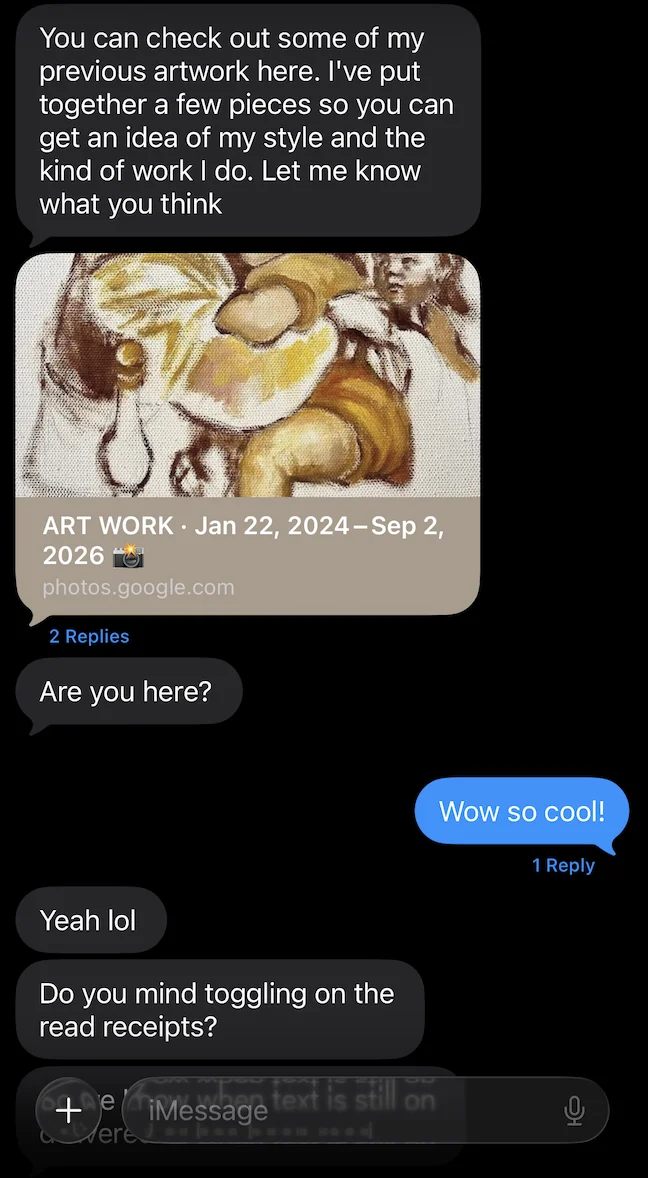
Before I could give it much consideration, she sent me an entire portfolio of artwork, complete with photographs of people alongside what appeared to be painted portraits of them. It looked convincing.
I didn’t respond for five minutes, and my phone buzzed again.
“Are you there?”
Then came a request I hadn’t expected: She wanted me to turn on my read receipts so she could see when I’d opened her messages.
Josephine promised to create something incredible and told me I would receive a $2,000 check. Of that amount, I would keep $350 and send her the remaining $1,650 to cover her supplies and commission.
Paying for the trip with my friends was still on my mind, so I asked if we could do $400 instead.
She said she’d check with her client.
While waiting, I took another look at the Google Photos album she’d sent. That’s when I noticed it belonged to someone named Elias Gonzales, not Josephine.
But Josephine had another explanation.
“Gonzalez is my best friend,” she said.
At that point, I wanted more than another text message, so I asked if we could speak on the phone.
She answered, but I could only hear muffled background noise, and the call kept “disconnecting.” She blamed my internet connection and promised to call back later.
But something still wasn’t sitting right with me. I decided to call my parents for an outside perspective.
Their advice was simple: Don’t do anything until you’ve spoken to her on the phone.
So I sent one final message.
“Ok before we move forward, I do want to speak with you on the phone. Until then, I don’t want my picture used.”
I never heard from her again.
What surprised me almost as much as the scam itself was how little coverage I found. Apart from warnings published by the FTC and two universities — the University of San Francisco and the University of Alabama at Birmingham — I struggled to find information about it.
The most unsettling part of my experience was where it all began: a UM GroupMe chat.
I had assumed that being in a University-affiliated group meant I was communicating with other students. But membership in a group chat isn’t proof of someone’s identity.
Maybe that’s a question universities should be asking, too: How can students be better protected in the online spaces they use every day?