


While students can fill out professor evaluations at the end of each semester, the official UM surveys are not the only tool students use to decide who to take.
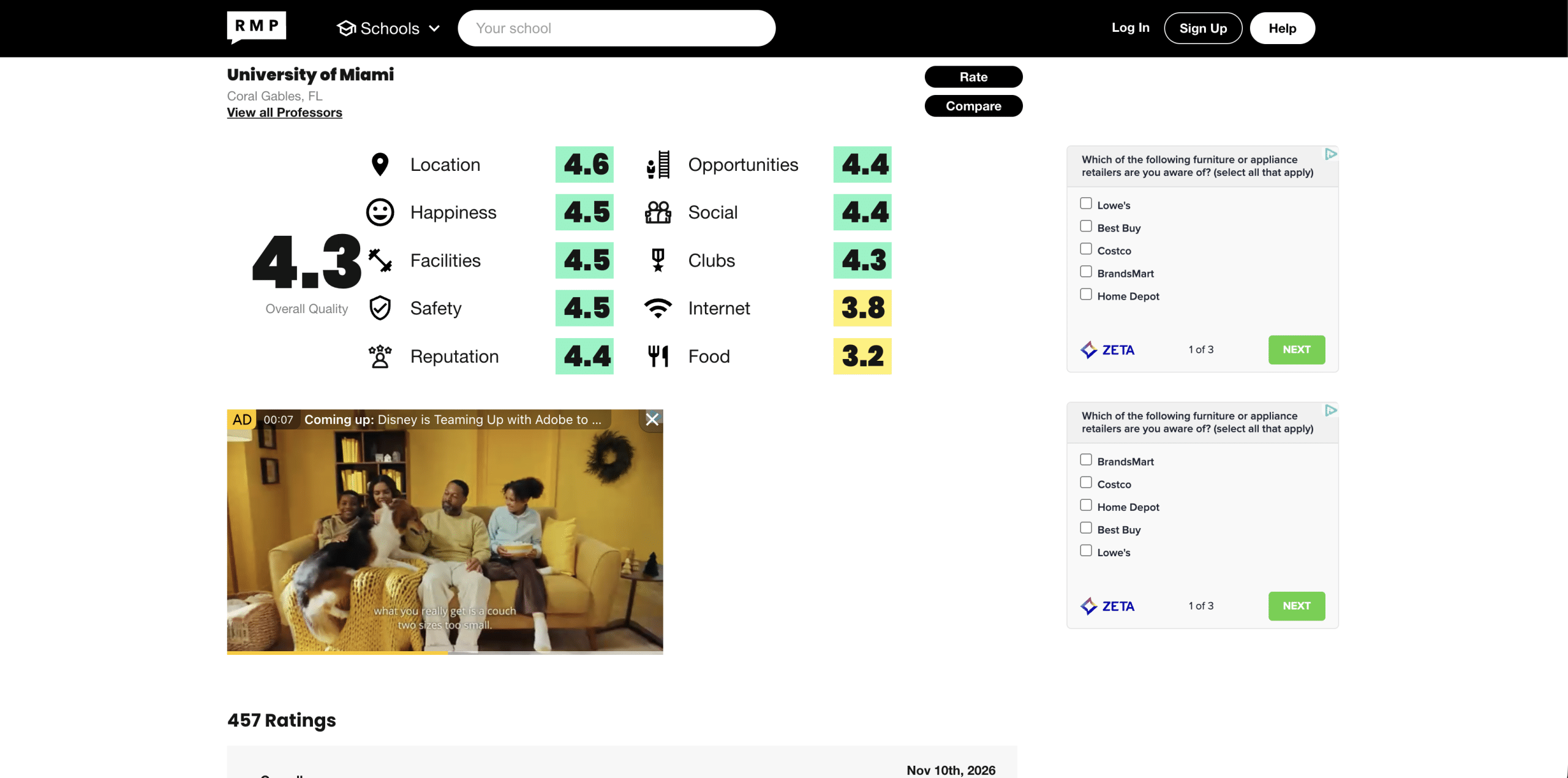
“Rate my Professors,” a website used to evaluate professors, includes more than 8,000 schools, 1.7 million professors and more than 19 million ratings, and is arguably more popular.
But how does Rate My Professors compare to the UM faculty/course evaluations, and how accurate is it?
In a non-scientific poll posted to The Miami Hurricane’s Instagram story for 24 hours on Nov. 9, 93% of 284 respondents said they use Rate My Professors.
Emma Del Grosso, a sophomore studying psychology, said she “never registers for a class without Rate my Professors anymore,” even going as far as to say “it is lifesaving.”
“I only use Rate my Professors to evaluate professors before picking classes,” senior Zita Isabel Cortes said.
But, despite a large portion of the student body using Rate my Professors, the Cane Navigators do not allow students to ask about ratings during academic advising meetings.
In an email sent to students, a Cane Navigator wrote that “Drop-Ins are not intended for comprehensive schedule planning or searching for professor reviews, as these are things you can work on independently.”
Students can access faculty and course evaluation results after final grades are released each semester, according to the University of Miami’s Office of the University Registrar.
“The University does not use ‘Rate My Professor’ for any purposes, and it is not used in determining tenure or hiring of faculty,” the University said in a statement to The Hurricane. “Instead, the University actively uses student evaluations of faculty that students have submitted through the University’s Testing and Evaluation Services.”
The evaluation process provides students with an opportunity to share their experiences and offer feedback on course instruction in a way that UM advises.
Professor Eva Alonso, who teaches a public speaking class, has earned a perfect 5.0 out of 5.0 on course evaluations and a 4.8 out of 5.0 on Rate My Professors.
Last semester, her UM course evaluations had a 42% response rate, while only one review was submitted to Rate My Professors during the same period.
The Miami Hurricane contacted Alonso for comment and she declined.
Professor George Wilson, who taught a social inequalities class over the summer received an overall score of 1.0 out of 5.0 on course evaluations, compared to a 4.7 out of 5.0 on Rate My Professors.
His summer course evaluations had a 14% response rate and his most recent review on Rate My Professors was submitted Sept. 8, 2024.
Wilson emphasized the importance of looking at the raw data.
“The 14% response rate for the Summer class probably reflects a single student responding,” Wilson said. “If a class of six or seven students results in only one response, it says really nothing about one’s teaching performance because of the small size and lack of representativeness of the whole class and should essentially be ignored.”
According to the University, student participation in the faculty evaluations has dropped from a high of above 80% to below 50% in recent years.
In a nonscientific poll posted to The Miami Hurricane’s Instagram story for 24 hours on Nov. 13, 89% of the 136 respondents said they use Rate My Professors more than course evaluations, while 7% said they use both equally and 4% said they use neither.
While Rate My Professors remains a popular resource among students, the number of reviews on either platform may not fully reflect the experiences of everyone who takes a course.
With students relying on both platforms to make decisions about their schedules, students must decide whether either provides a complete picture of what to expect in the classroom.