


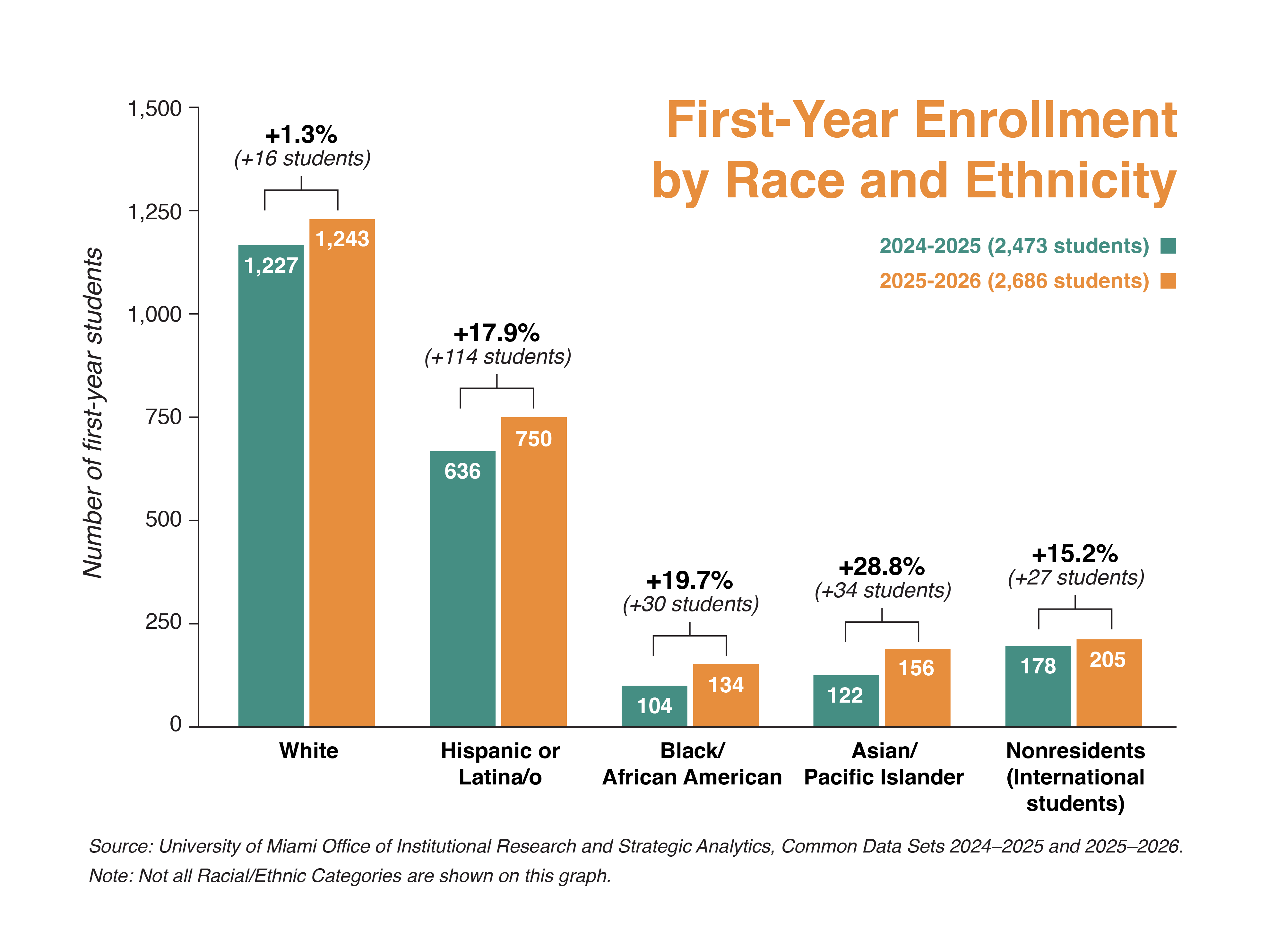
Enrollment at the University of Miami increased for Hispanic, African American and Asian first-year students in the 2025-2026 class, according to the First-Year Class Profile & Undergraduate Demographics report.
The incoming class grew from 2,473 students in 2024-2025 to 2,686 in 2025-2026, an 8.6% increase. This year, the racial and ethnic breakdown is 49% white (non-Hispanic), 29% Hispanic or Latina/o, 7% Black/African American, 6% Asian/Pacific Islander, 5% two or more races and 4% unknown.
Hispanic students saw the largest growth in first-year enrollment from 2024-2025 to 2025-2026, rising from 636 students to 750, a 17.9% increase.
Asian first-year enrollment increased from 4.9% to 5.8%, while African American admission rose from 4.2% to 5.0%. First-year international student registration also increased slightly, from 7.2% to 7.6%.
“I think the increase in incoming Black freshmen is amazing and the University of Miami does an amazing job of trying to keep Black freshmen engaged,” said Kaili Smith, a freshman and senator for the United Black Student organization.
White first-year enrollment increased from 1,227 to 1,243 students. Since other racial and ethnic groups grew faster, the percentage of white students in the freshman class declined from 49.6% to 46.3%.
While the incoming first-year class grew, overall degree-seeking undergraduate enrollment at UM slightly declined. This figure consists of all undergraduate students pursuing a degree, meaning freshmen, sophomores, juniors and seniors. Total enrollment dropped by 77 students, from 12,913 in 2024-2025 to 12,836 in 2025-2026.
“A modest year-over-year change in total enrollment is consistent with normal, minor fluctuations,” said UM in a statement to The Miami Hurricane. “Improved advising through Cane Navigators is assisting some students in graduating faster.”
Hispanic students did not only see the biggest increase in the freshman class; they also saw the largest growth in overall degree-seeking enrollment, up 258 students and raising their share of the undergraduate population from 24.3% to 25.5%.
In contrast, white degree-seeking undergraduate enrollment declined by 223 students. Their representation in the undergraduate population also decreased, from 48.5% to 47.1%.
Despite the increase in incoming African American first-year students, total African American degree-seeking undergraduate enrollment decreased by 73 students, compared with the previous academic year.
“I think that overall Black undergraduate enrollment decreased because of socioeconomic aspects,” said Smith.
Smith also pointed to UM’s tuition as another reason why enrollment has dropped.
The number of international undergraduate students enrolled decreased from 980 to 924, although the percentage of first-year international students increased slightly.
UM is one of the few private schools in Florida that has recently reinstated mandatory ACT and SAT test scores beginning with the 2026-2027 admissions cycle.
“In January 2025, the University announc[ed] that it would reinstate its standardized test score requirement for most applicants beginning with students entering in Fall 2026,” the University said. “The supplemental essay will be removed beginning with the Fall 2027 entering class.”
Although UM’s overall degree-seeking undergraduate population slightly decreased, the incoming first-year class reflects a shift toward greater racial and ethnic diversity.