


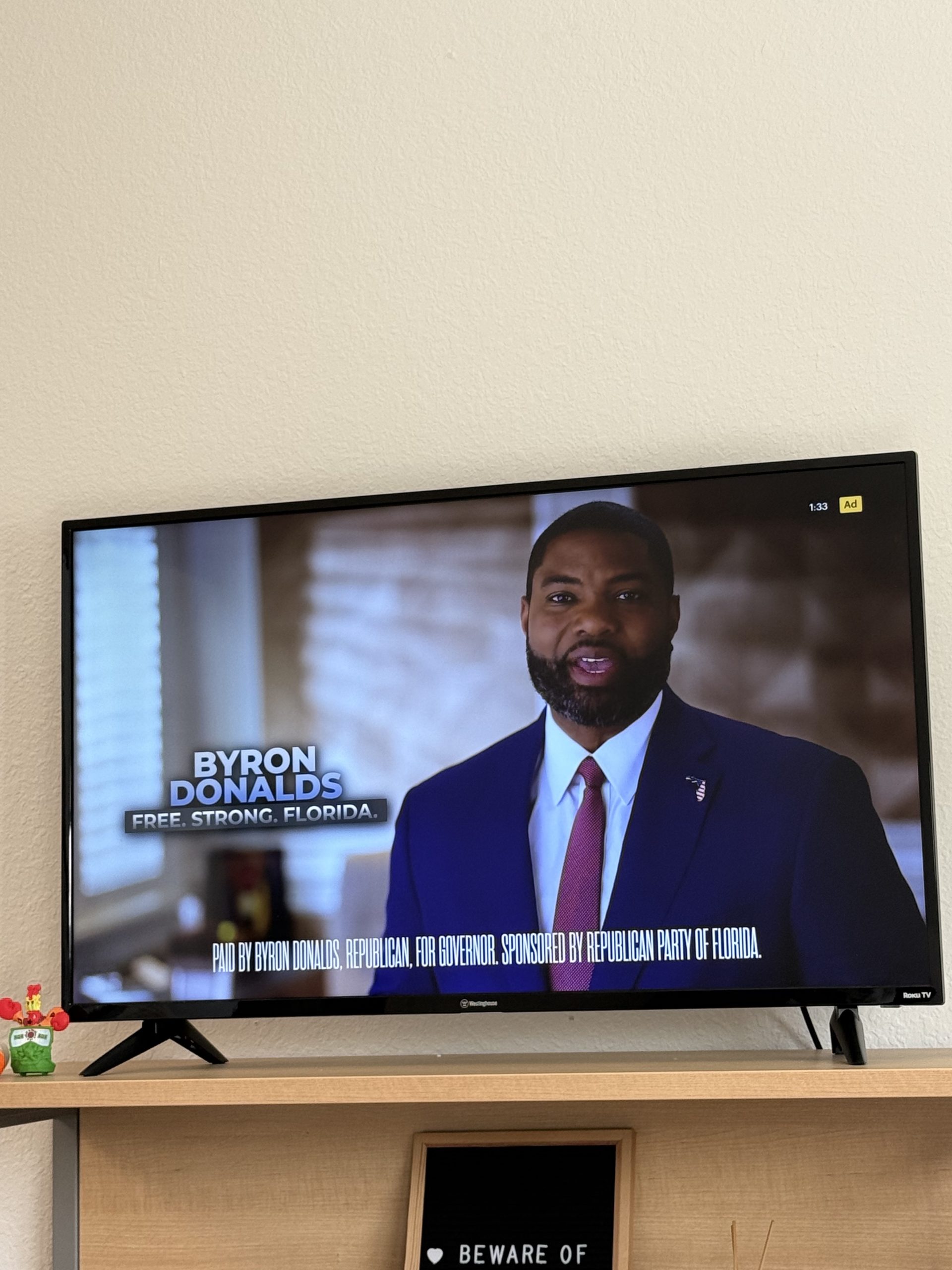
“I love my daughter but when I saw her lying about her opponent, it’s not easy for a mother to say this, but Amy has a serious problem. She is a liar.”
Amy Acton’s estranged mother said this in a political ad for Vivek Ramaswamy, a Republican candidate for Ohio governor and Acton’s opponent.
As a result of the controversial ad, Ramaswamy is facing backlash from Democrats and some Republicans over its ethics. The controversy is because the ad leverages Acton’s mother, who lost custody after being deemed unfit when her husband was arrested for allegedly sexually assaulting 12-year-old Acton.
The online discourse, record-level spending and the use of artificial intelligence in campaign ads raises the question: What impact do these political campaigns, which sometimes rely on drama or inflammatory language, actually have?
Voting influence
Professor Gregory Koger, a political science professor at the University of Miami, doesn’t think campaign ads have a significant impact in general elections.
“At the margins, they may influence whether or not a few people decide to vote — especially if the ads are negative — or may influence a few vote choices, but most voting in general elections is based on party identification or a holistic vote choice, combining information from friends, family, news, etc.,” Koger said.
He added that candidates have started exploring social media, paying influencers to promote their campaign or investing in voter turnout operations instead of relying on traditional television ads.
As a result, political campaign ads are nearly inescapable when surfing the internet or watching YouTube videos. Ads of senators bashing their opponents and criticisms of current incumbents are everywhere.
Canadian student Madeleine Ash described her shock at how viral these ads are.
“I feel like [in the U.S.], there’s a lot even on Instagram; I always get ads for the government,” Ash said. “I’ve seen some ads back home online but there’s definitely a big gap.”
UM College Republicans President Lazaro Chavez summarized the ultimate goal of these advertisements: “It’s about influence.”
He describes how political candidates in the U.S. are striving to gain as much attention as possible, as attention can overlap with power.
“That influence is important,” Chavez said. “They want to reach your ear, they want to reach my ear, they want to reach people over here’s ear, they want to reach everybody.”
Record-level spending
Political ad spending for the current midterms has already exceeded $10 billion, according to U.S. News, and is expected to exceed $12 billion by Election Day — a new national record. This increased level of spending is a key reason behind growing visibility.
As of this fall, political action committees and other groups are also said by U.S. News to have reserved more than $1.2 billion in airtime for these ads.
Ramaswamy’s ad cost $4 million alone, according to his campaign team.
Political ads are covering more than 300 races throughout the U.S., with the highest media output in states like Georgia, Ohio and Texas.
Despite the extensive focus on these advertisements, experts continue to question their long-term effectiveness, especially after candidates have made their stances known and made progress campaigning.
A study led by Brett Gordon, a marketing professor at Northwestern, revealed that increasing output of negative ads by 1% resulted in a 0.025% increase in votes for the candidate. Positive ads were linked to an increase of 0.016% — small impacts for the amount of money and work put in.
AI use and provocative language
In Texas, the James “Talafreako” ads have become a central part of the midterm campaign drama.
Democratic State Rep. James Talarico is running for U.S. Senate against Republican opponent Ken Paxton, Texas’ attorney general. Paxton released an AI-generated ad in early September that attacked many of the Democratic candidate’s beliefs.
In the ad, a man writes in a book titled “The King James Talarico Bible” with a crayon drawing of Talarico on the left and scribbles on the Genesis chapter, including “let there be six genders” written in crayon across the page.
Yaira Sanchez, a UM student from Texas, thinks that language like this makes political ads less professional.
“I find it amusing that they’re using these types of words, especially with such a serious matter like politics,” she said. “We’re over here calling a man a ‘freako’ because of his political ideals.”
The bottom of the ad reads, “James Talarico is weaponizing faith to sell a radical agenda and he even brags about hating Christianity.”
Paxton coined and began using the name “Talafreako” in speeches about Talarico’s policies and faith. President Donald Trump has adopted the nickname as well.
Sanchez said she expects more maturity from these campaigners.
“It makes me deem the other side as less serious.”
She highlighted how she prefers to do her own research rather than relying on these ads for information; she sees them purely as entertainment.
“It’s definitely going to continue to increase because campaign advertising now is just getting started,” said Briana Castillo, the treasurer for the UM College Republicans. “Especially with social media and what’s yet to come that we don’t even know of yet.”
Campaign ads are likely here to stay. With the growth of digital platforms and increased spending in regards to campaigning, we can only anticipate more advertising in years to come.