


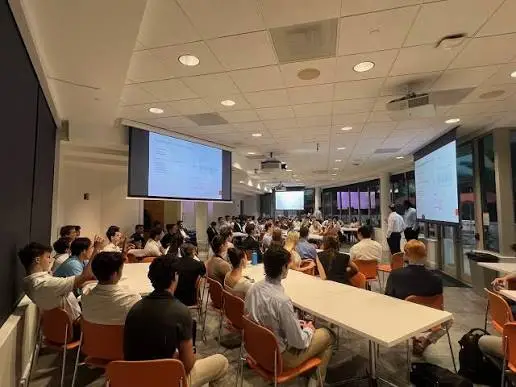
Joining student organizations can help guide students toward future success. The Real Estate & Finance Association (REFA), focuses on guiding and providing students with resources who are interested in the real estate industry.
Working towards a degree and gaining hands-on experience as an undergraduate can sometimes be complicated. REFA eases that transition by helping students understand the industry and build experience before graduation or during their junior summer.
The group is student‑led and open to all majors, with the goal of broadening interest in real estate beyond the business school.
Part of making this happen is connecting students with professionals, alumni and fostering relationships that could lead to mentorships.
Zander Iancono, President of REFA, was originally a Marine Biology student at the University of Miami. After his first year in Marine Biology, he quickly realized that field was not for him.
Having a background in real estate through family, he decided to switch to the business school and give it a chance. He immediately jumped into doing his own research and joined REFA as a sophomore with no prior experience.
“I was always interested in debt with commercial real estate,” Iancono said, explaining how his curiosity sharpened once he got involved.
He recalled that one of his real estate classes “became super easy” compared to peers who were struggling, simply because “I had this background because I was going to these events with people and taking that educational side of things.”
The organization’s programming helped guide Iancono as he moved into leadership. REFA hosts structured intake events for new members, where students learn internship timelines and receive an overview of major industry sectors like debt, equity, development and capital markets to help them identify which path fits their interests.
The group also offers interview preparation and résumé workshops designed for students who have not yet taken real estate coursework, but are already expected to apply for internships.
Guest speaker events are a core part of REFA’s calendar, including an annual visit from Brian Horner of Bridge Invest, who discusses bridge lending—the same niche Iancono explored during his freshman and sophomore summers.
At the end of each fall semester, REFA hosts its State of the Market panel, which brings together five to six professionals from across South Florida’s commercial real estate landscape. Speakers from debt, development, brokerage and capital markets share their outlook on where the market is headed and what students should be paying attention to.
For students unsure of where to start, Iancono’s advice is simple. “Go to a lot of events. Get involved early. That’s probably the first thing,” he said. “Talk to a lot of people.”
He stresses how getting involved quickly can clarify a student’s direction. “Within that first month of REFA, I’ll have a conversation with a student like, ‘Yeah, we had XYZ speakers you guys brought in. I really want to do development now,'” he said.
A single event can spark someone’s interest in a specific part of the industry.
This is what REFA offers, according to Iancono: turning an unstructured, word-of-mouth process into an accessible community of like-minded peers. For students who feel behind or unsure of their path, the learning curve doesn’t have to be climbed alone.
“Just listening to people, getting involved, I think that’s the first step if you don’t know where to go,” Iancono said. “And then, after that, you get to really branch out, you do your own research, you start keeping up with the news on things.”
For those who resonate with REFA’s mission, the organization offers a way to explore the industry through speaker events, structured intake sessions, interview prep and direct access to professionals across real estate.
The exposure can help students understand the industry and determine what fits them best. As Iancono put it, the first step is simple: get involved. REFA was built to make sure students don’t have to figure it out alone.