



Ashley Johnson closed the hotel room door behind her client and took a seat at the desk. It was noon on a Sunday, and sunlight poured through the open curtains of the four-star hotel room.
Johnson typically avoids mid-level hotels, she explained, as they’re where many prostitution stings are targeted in Broward County.
“The staff leave me alone, I’m more comfortable and my clients are more comfortable,” Johnson added.
In her line of work, privacy, anonymity and comfort are more than just integral. They’re means of survival.
She’s laid back, passionate and remarkably easy to talk to. Within a few minutes, it’s easy to see why someone might want to pay her for sex. At 43, she’s vibrant, chatty and well-versed in the South Florida sex industry, having been part of it for roughly 20 years.
For Johnson, sex work is simply a job. There’s a normalcy to it. Johnson explained how she grew up driving to school on the Dixie Highway, passing sun-worn prostitutes looking for clients.
“It always had this perception of ‘this is how I end up,’” she said.
Johnson was raised by a pious mother and a Freemason father, two influences that sometimes seemed at odds. From one, she learned to fear God and embrace traditional gender roles. From the other came an emphasis on education and individuality.
Years later, Johnson’s last “normal job,” as she calls it, was waitressing at The Cheesecake Factory. After her shift one night, she was approached by a well-dressed man in a nice car who offered her $200 for oral sex.
It was the first time she accepted money in exchange for sex. At 22, Johnson says she was already sex-positive and comfortable with her sexuality, so the proposition presented a fairly simple calculation.
“I had done it before for free,” she laughed. “Why not get paid for it?”
Since then, her income has come from sex, whether from regulars or new clients who reach out through her online ads. Though her income is about $70,000 a year, money and a stable income isn’t the only thing keeping her in the industry. Her work gives her something she values just as much: the ability to decide when and where, what and with whom.
“People talk about ethics or morality or empowerment, [but] having my own business, I feel more empowered than I did working for anyone else.”
But morality looks different depending on who gets to define it.
Johnson reached for a book she always keeps with her — a copy of The Ethiopian Bible — and shrugged. “Believe in the supernatural stuff or don’t,” Johnson laughed.
“I just like how Jesus encouraged his friends to be kind and sympathetic.”
She’s taken that to heart and is currently studying to get her master’s in social work to support the sex worker community in South Florida. At night, she leads group meetings for a non-profit.
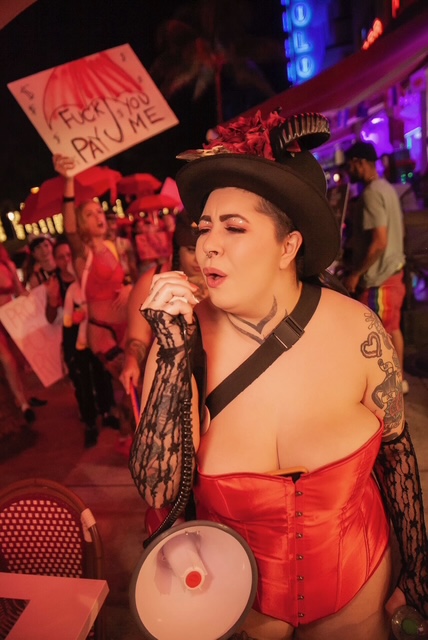
“I want these kids to know the truth, [because] the social stigma is so negative, so fast, and so visceral that people will probably never say anything about it.”
On the other side of town, Mei-Lan Diaz, 34, slips some condoms and a box of emergency contraception into a large black envelope.
“This is what goes into a care package we send out,” she explained before adding Narcan, STI and HIV testing kits to the package before sealing it shut. It was then placed into a pile of other care packages that would be sent out to sex workers servicing the Miami community.
In the same room where she films her own content, Diaz answers emails and calls with sex workers in need of support, packing as much aid as she can. Sex toys are stationed throughout the room, as are stickers from various companies like PornHub and Chaturbate.
Diaz currently works as a travel dancer and as an adult entertainer — or a porn star, as she plainly puts it.
But over the past 19 years, she’s worked in most avenues of the sex industry, including escorting and camming. After she was assaulted by a client in 2021, she founded Decrim Miami — a non-profit advocating for the decriminalization of sex work in Florida and greater protections for people working in the industry.
“I like how low-barrier it is. No matter what stage of life I’m in, it’s easy to go in and it’s easy to come out,” she explains. “It doesn’t require a lot of education, and if you need a bag quickly, there’s always money in it.”
While many individuals who are anti-sex work cite that the industry takes advantage of young women in need, Diaz believes it’s actually the opposite.
“People talk about rescuing sex workers, but sex work rescued a lot of us,” Diaz countered.
While working as an adult film actor, Diaz’s current work is technically legal. But for workers who sell in-person sexual services, the legal landscape looks very different.
“Most prostitution stings, before taking the TPS [Temporary Status Protections] from Haitians, were at massage parlors under the guise of targeting trafficking,” Diaz explained. “But they typically only targeted black and brown people. Immigrants.”
“These people are just trying to feed their kids,” she added. “They always test the waters on sex workers.”
For Johnson and Diaz, danger doesn’t come solely from clients. They argue the legal system surrounding the transaction can create its own risks.
“Because we spend so much money to ‘get the bad guys’ at any cost possible, we don’t get them for their worst crimes,” Diaz explained.
She points to one woman on Decrim Miami’s staff, a trafficking survivor who still carries a felony conviction from the same operation that brought down her trafficker.
“They arrested him for credit card fraud,” Diaz said.
But human trafficking and credit card fraud carry very different sentences. And sometimes, Diaz argues, the survivors pay the highest cost.
“Trafficking victims are getting arrested and prosecuted the same way as traffickers,” she said. “The woman on my staff is a trafficking victim. When her pimp was taken down for credit card fraud, she was also charged — even though she was a victim.”
Diaz doesn’t deny that exploitation exists within the sex industry. Her own assault is part of the reason Decrim Miami exists. But she questions whether criminalization protects the right people — particularly when victims can leave an operation with criminal records of their own.
“She has three kids, and she still works in the sex industry because no one else will hire her,” Diaz said. “Who wants to hire a felon?”
She sat still for a moment.
“He’s still out there working, you know,” she added. “He controls lots of girls.”
For Diaz and Johnson, decriminalization offers an alternative — one they argue would allow sex workers greater control over their safety without forcing them out of the industry entirely.
It is a perspective that complicates the conventional narrative surrounding sex work: that the people selling sex need to be rescued from the people buying it. For Johnson and Diaz, the truth is considerably messier.
And sometimes, uncomfortable — if you’re willing to listen.
“The truth will set you free,” Johnson said. “But first, it’ll piss you off.”