


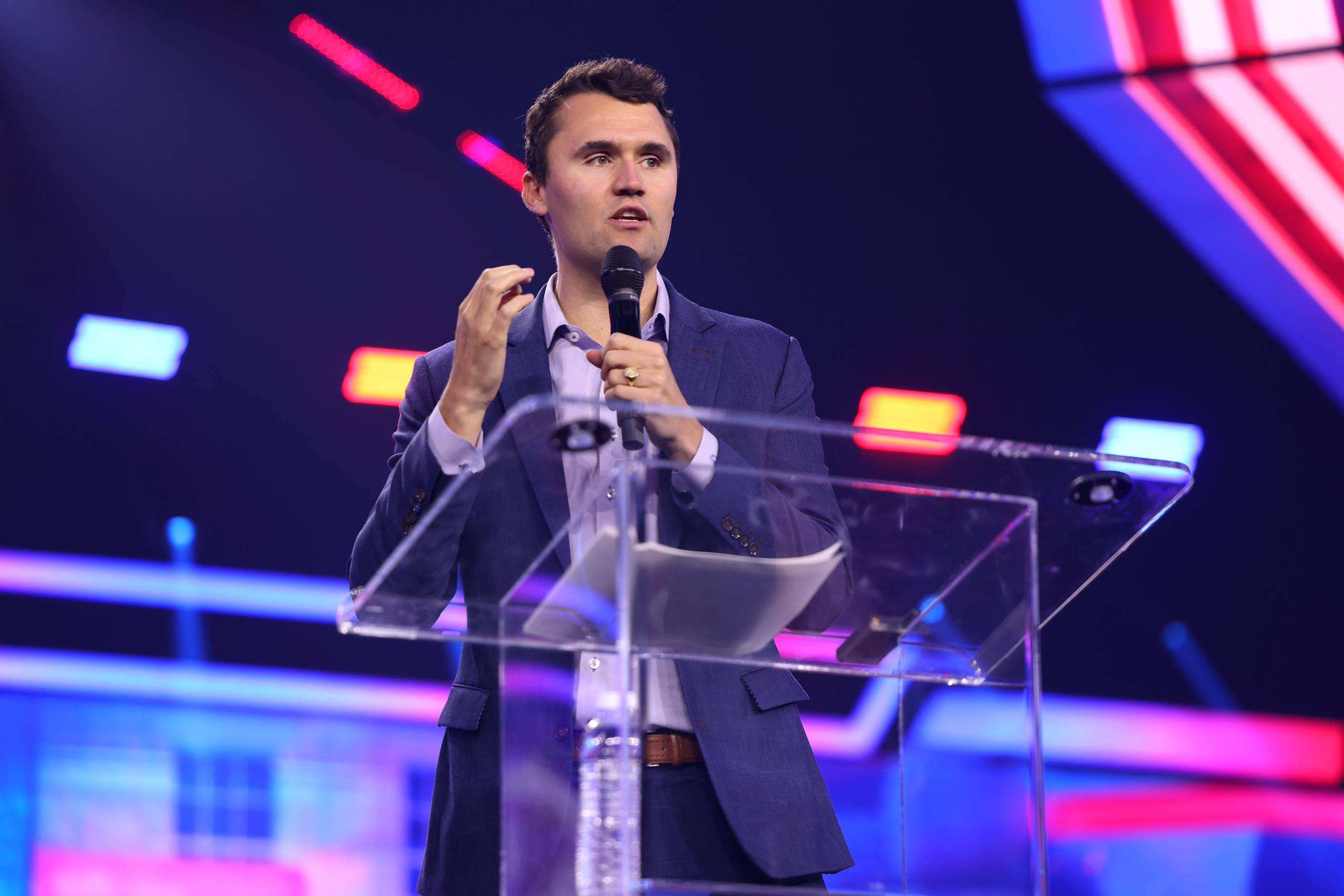
Charlie Kirk went to Utah Valley University on Sept. 10, 2025, with a microphone and an invitation: Debate me.
A gunshot ended the conversation.
One year later, Kirk’s assassination should prompt reflection on something bigger than one activist or one political movement. It raises a question that’s becoming increasingly important to American democracy: Can we still disagree without treating one another as enemies?
Politics can be loud. Debate can be uncomfortable. Arguments can get heated.
But they should not become lethal.
Kirk’s death didn’t just spark a reflection, his assassination has also been the fodder for internet content.
At Georgetown University, an anonymous post on the student app Fizz advertised a “Charlie Kirk look-alike contest” on Sept. 10, the first anniversary of his assassination. The post received about 2,200 upvotes.
Georgetown said it had seen no activity connected to the post and knew of no student organization planning such an event. The original poster later said there were no plans to actually hold one.
A similar controversy surfaced at the University of Miami. An anonymous source provided The Hurricane with a screenshot from a Lambda Chi Alpha member’s private Instagram “Close Friends” story appearing to reference a Kirk-themed gathering at the fraternity house.
The student disputed that Lambda organized any event, calling the post satirical and saying the screenshot was never intended to be public. The Hurricane does not believe a party ended up occurring.
A joke is not a threat. A meme is not an act of violence. Those distinctions matter.
But context matters, too.
Political violence has become an increasingly visible aspect of American public life. Princeton University’s Bridging Divides Initiative reported that targeted political violence increased by more than 30% from 2024 to 2025. It also recorded its largest monthly spike in threats and harassment against local political officials in September 2025 following Kirk’s assassination.
The encouraging news is that political violence remains deeply unpopular.
The Polarization Research Lab found that after Kirk’s assassination, about 1% of Americans supported partisan murder, while 93% to 97% of partisans considered political violence a major problem.
But even when few people support violence, the fear of it can still shape political behavior. 31% of Americans said fear of violence could cause them to avoid political expression.
That fear is not abstract. In the past two years, Americans have watched two assassination attempts against Donald Trump during the 2024 presidential campaign, the targeted shootings of two Minnesota lawmakers and their spouses and an arson attack on Pennsylvania Gov. Josh Shapiro’s residence.
Political violence does more than threaten individual leaders. It can make ordinary Americans wonder whether expressing a political belief is still worth it. That’s why the microphone matters.
Kirk built much of his campus presence around political confrontation. Students approached him, challenged his positions and argued back. His events could be heated, but the contest was conducted with words. More than 3,000 people attended the Utah Valley University event where he was killed.
Evidence suggests conversation itself can help. A 2023 study published in Nature Human Behaviour put Republicans and Democrats in conversation about contentious issues. Researchers found substantial decreases in polarization among those who participated in cross-party conversations, with more civil conversations associated with stronger depolarizing effects.
That does not mean everyone walks away agreeing. They should not have to.
Disagreement is not a defect of democracy. The inability to disagree peacefully is.
Kirk’s death has also reshaped campus political organizing. The Washington Post reported that new Turning Point USA college chapters increased by 64% during the past academic year compared to the year before. UM now has a chapter.
Sephora Cremone, president of Turning Point USA at UM, said the chapter advocates for conservative ideas while keeping political disagreement open.
“It is okay to disagree,” Cremone said. “As a nation, we have lost the art of civil discourse, but it is something our TPUSA chapter at the University of Miami strives to promote.”
Universities are supposed to be places where students encounter things they did not arrive with. Debate teams formalize disagreement. Classrooms examine it. Student newspapers publish it. Civic deliberation programs put people around the same table and ask them to work through it.
There should be space at UM for conservatives, liberals, independents and students still figuring out what they believe in. There should be room for an unpopular argument and there should be room to challenge it, always with a second microphone.
Political violence ends the conversation. Debate keeps it going.
Dylan Long is the Student Director of the George P. Hanley Democracy Center. He is also the President of the University of Miami Debate Team.