


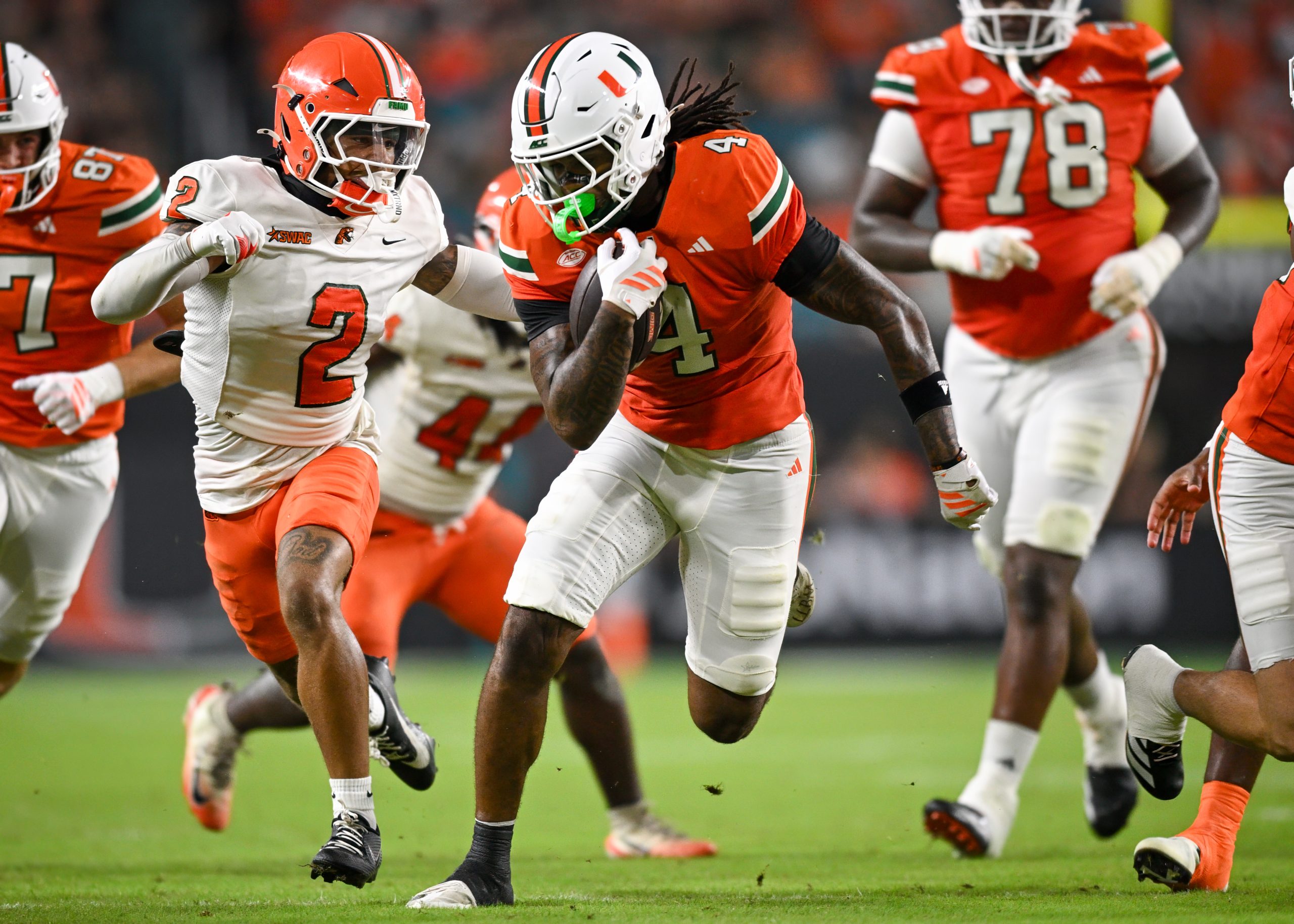
The matchup against the now No. 6-ranked Miami Hurricanes and the Florida A&M Rattlers on Sep. 10 was a sight to behold. For the Rattlers, the game was perhaps one to forget.
The 77-7 scoreline highlights an ever-growing gap in college football, specifically between the Football Bowl Subdivision and the Football Championship Subdivision.
Each tier reflects a team’s ability to operate at a specific intensity, with the FBS home to the most competitive and heavily resource-backed programs. Often, these divisions face off in “buy games” where major FBS programs pay smaller schools to travel to their stadiums as a tune-up game for the bigger program.
FCS teams — like FAMU — shouldn’t stop playing Power Four opponents. That money is invaluable, and the exposure and experience matter, but teams should consider the disparity before scheduling these games.
Miami paid FAMU $760,000 for its Week 2 matchup at Hard Rock Stadium, with $720,000 going to the athletic department and another $40,000 to the Marching 100 — FAMU’s award-winning marching band.
For these FCS programs, the appeal is clear.
“There’s a need for us financially,” said FAMU Head Coach Quinn Gray in a press conference on Sep. 14. “And until we’re able to financially get to where we want to go from a budgetary standpoint, then these are the types of games that we have to play.”
One night facing off against a powerhouse program can bring program-changing funds into an athletic department and a chance to make history against top schools.
“I think it’s a win-win scenario,” said Ashton Weissman, a senior at UM. “Big football programs get easy scheduled wins and small FCS schools get to build their program and invest in their schools. If both teams agree to play, they know what they’re getting themselves into.”
Nobody expected the Rattlers to win, but a 77-7 loss was something else entirely.
Offensively, the Rattlers were critically outmatched as Miami recorded 42 first downs to FAMU’s four and 856 yards of offense compared to 107.
The game was so lopsided that both head coaches agreed to shorten the fourth quarter from the standard 15 minutes to 10.
But, to some degree, that should bother football fans.
If the disparity between teams is so great that everyone involved decides the most reasonable option is to stop playing entirely, we should all question why the matchup was scheduled in the first place.

The answer, of course, is money. FAMU, like all FCS schools, is not incorrect for wanting it.
Miami wasn’t the only school with a “buy game” in Week 2. Six ACC schools scheduled FCS opponents — all winning with a combined scoreline of 359-36, an average scoreline of 60-6.
The next question becomes whether that payday is worth what players may be asked in exchange for it — an injury.
A blowout eventually disappears from the record books. A season-ending injury, not so much.
Football is a violent sport, and injuries happen, but when FCS programs deliberately send athletes against bigger, deeper and better-funded FBS rosters in exchange for a check, that physical inequity can’t be ignored.
Sure, the athletic department cashes the check. But it’s the athletes who pay the price.
Accepting guaranteed games does not mean accepting any proposed guaranteed game.
FCS athletic departments should be more selective about the Power Four programs they play and prioritize matchups where their athletes have a reasonable opportunity to compete.
While there is value in challenging yourself against someone bigger and perhaps more experienced, there is significantly less value in being paid to serve as someone’s punching bag.