


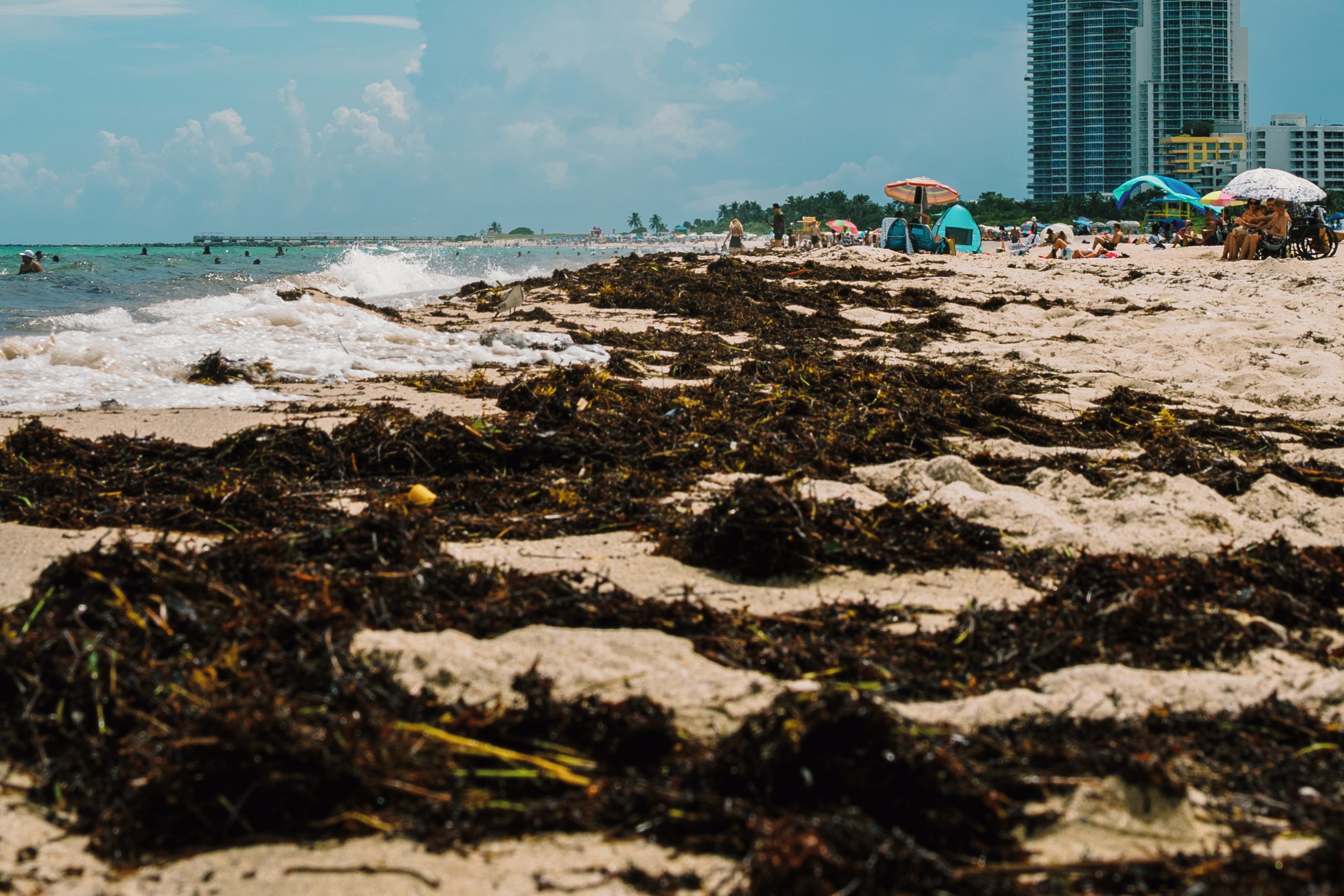
Beaches across Miami-Dade are seeing piles of seaweed stack up faster and thicker than usual, and scientists at the University of South Florida say this season is one of the worst on record.
Sargassum is a brown seaweed covered in small, berry-like air bladders that float in large mats across the open ocean. In moderate amounts, it plays a useful role by providing fish and other marine life with places to feed and hide.
The increase in sargassum mats has been building for more than a decade, but this year’s was especially severe.
Researchers at the University of South Florida traced the influx of the seaweed back to 2010 and 2011, when sargassum was pushed out of its usual home in the Sargasso Sea and into tropical waters. It then found what it needed to thrive: warm water, high nutrients and year-round sunlight.
The problem isn’t that sargassum exists, but how much of it is now piling up on shore.
“There was a big line right in front of the beach and it stinks,” said freshman Edward Reed. “It discouraged me from going in the water”
Reed is not the only one who was affected by this trend. Global News reported that the smell and unsightly buildup are a real problem for a city that depends on its beaches. Large-scale sargassum events are known to damage coastal tourism and air quality along the shore.
Rose Flannery, a UM architecture student researching the water systems tied to sargassum growth, put the damage in blunt terms.
“It reduces the amount of light coming into the ocean… plants and marine life aren’t getting light,” Flannery said. “It’s also consuming a lot of the oxygen going into the water, so it actually drowns the fish.”
Rather than clearing it; Flannery’s team focuses on the water systems that feed sargassum growth in the first place — namely stormwater runoff. Farm and urban pollution, carried by cars, pesticides and rainwater, builds up nitrogen and phosphorus in local waterways that eventually reach the ocean and becomes one of the nutrient sources feeding the algae’s expansion.
Her team is working on a solution: permeable concrete designed to let stormwater filter through rather than run straight into storm drains and out to sea. Her team is exploring how to take collected sargassum, heat it and mix it into the concrete itself.
Flannery and the team have been doing their research in the Advanced Materials Research Lab. With the help of the University and Dr. Ali Ghahremaninezhad the research won the VISTA award, a competitive 25,000 dollar grant created by the VoLo Foundation that honors graduate student research.
“We are hoping to use that problem as a solution,” Flannery said.
So now the question isn’t whether sargassum will keep showing up — it’s whether solutions like Flannery’s can scale up fast enough to meet it.