


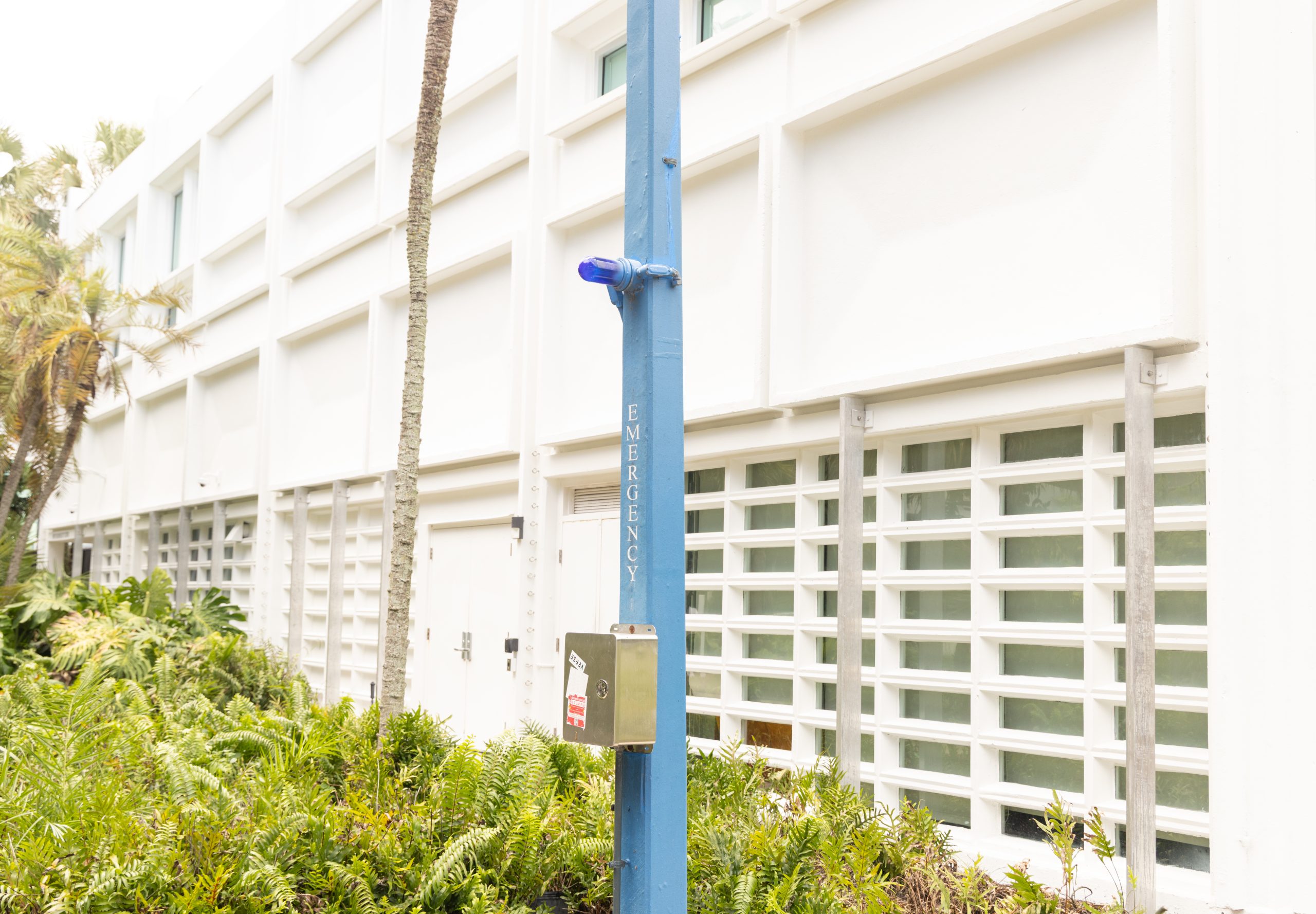
Scattered across campus, those tall, glowing blue poles do far more than light up the night. The Blue Light Emergency Phones serve as an immediate lifeline to campus police at the press of a button.
Blue Light Phones have been on college campuses across the country since the 1990s. They are designed to ensure student safety by providing access to the local police department and emergency services. According to the U.S. Department of Justice’s Special Report on campus law enforcement, 100% of private universities have implemented them.
And, although you may not have needed to use one, the Blue Light phones have a real impact on keeping students safe.
Last year, sophomore Joseph Sollitto was walking back to his dorm in Mahoney Residential Hall after visiting his friend’s apartment. While walking back from the metro, he noticed a tall figure keeping a rigid, uncomfortable distance behind him.
As Sollitto sped up, the footsteps behind him matched his pace, turning what felt like a paranoid hunch into an unmistakable threat.
“My heart was absolutely pounding because every time I changed direction, he kept following me,” said Sollitto.
Spotting the familiar glow of a Blue Light phone near the metro, Sollitto said he made a decisive turn, hit the emergency button, and stood under the illuminated fixture. His follower fled as soon as the blue light began flashing and the dispatcher’s voice broadcasted across the speaker.
“The dispatcher stayed on the line with me the entire time, making me feel safe,” he said.
The phones can be identified by their tall blue poles or wall-mounted boxes with glowing blue lights on top. All a student has to do is press the red emergency button, and they will be connected with the University of Miami Police Department in a matter of seconds.
According to Lorena Urgelles, a crime prevention specialist, students should use a Blue Light phone in situations like their phone dying, if they are lost, or if they need a safety escort.
The Blue Light phones not only connect students with a police officer but also capture the student’s exact location, so that help can arrive as soon as possible. The location-tracking feature is especially helpful in an emergency where a student is unable to speak.
However, if a student is in immediate danger and cannot stop to talk, Urgelles advises calling 911 so they can run with their phone.
You can find the locations of the Blue Light phones on campus here.