


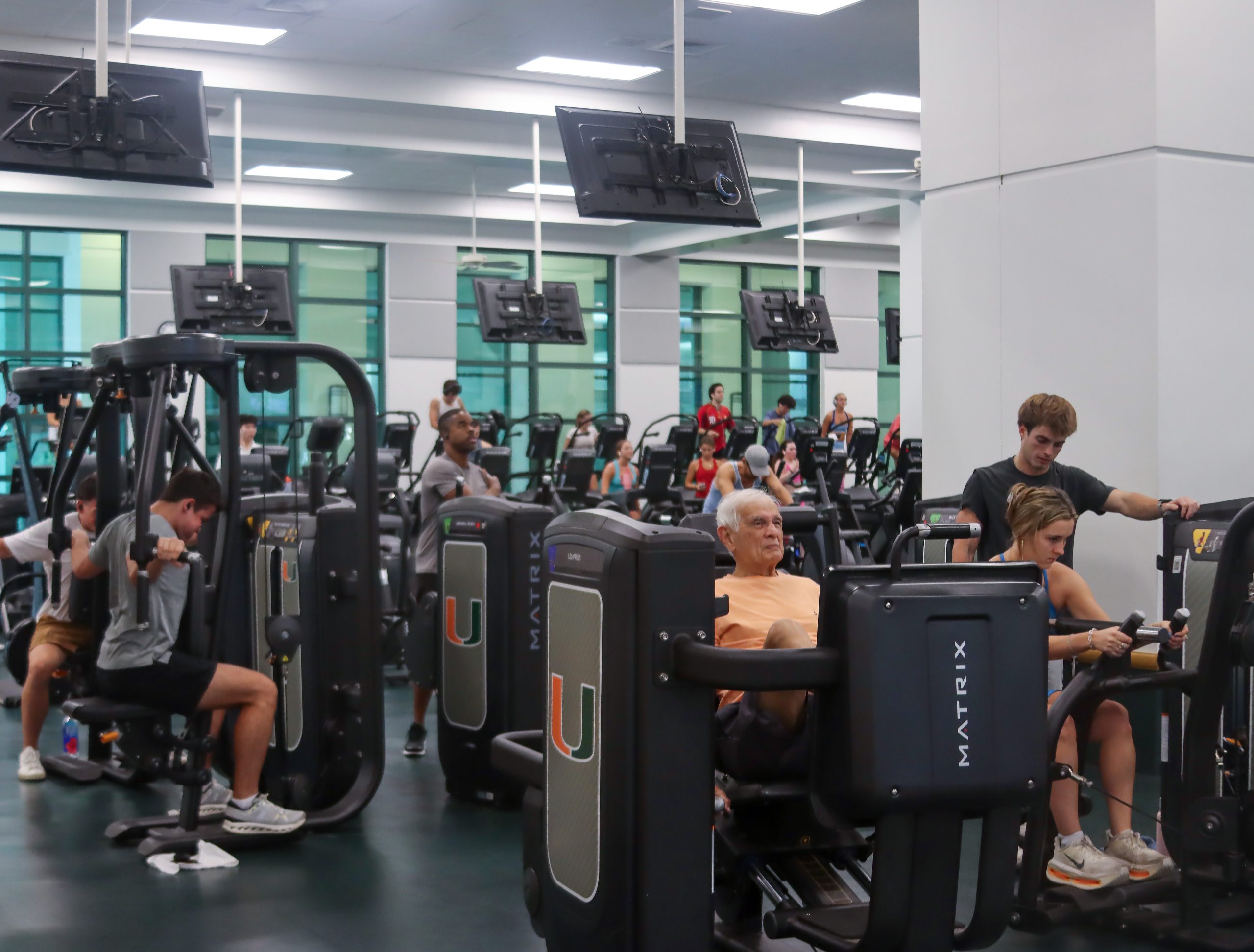
Fitness is a major part of life in Miami, ranked the second-most wellness-obsessed city in the U.S. That culture is especially visible at the University of Miami, where working out is a priority for students.
Within the Herbert Wellness Center, the growing number of gym users — with access now including faculty and the general public since 1996 — has led to overcrowding, making exercise difficult.
With new freshmen and faculty members on campus alongside returning students and regular gym-goers, the 18,000-square-foot facility has been packed. Open from 6 a.m. to midnight, Monday through Friday, the Herbert Wellness Center has consistently seen high attendance throughout the day.
“The difference between summer and the school year is pretty significant,” said junior Savannah Flanigan, a personal trainer at the Wellness Center. “ It was very rare that the gym was even at 50% capacity [during the summer], but once students came back, there was a very noticeable increase in attendance.”
The increase in attendance is most noticeable during peak workout hours, when students fill the equipment area and wait for machines to become available. What may normally be a quick stop at the gym can turn into a longer commitment as students move from one machine to another, searching for an open space.
Nearly every machine has been occupied, and the gym has been packed with lines of people waiting for their turn. For students, trying to fit in a workout with classes, work and other commitments, the added wait time can make it difficult to complete their routine.
“It is very crowded usually with at least one person or even a line for most machines,” said senior Aaron Joe. “It can take two to two and a half hours for a workout that should take one and a half hours.”
For Joe, the long wait times have turned normal workouts into much longer time commitments. Depending on schedules, some people do not have the time to wait for each machine they want to use and either have to shorten their exercise plans or skip the gym entirely.
“I typically have a rule of thumb; the more crowded it is, the less I stay,” said senior Sierra Stiff. “It is absolutely crowded … I feel stuck when I’m standing around waiting for a machine, as this is the part of my day I can put some music on and flow into a workout.”
To see how busy the gym is, the Wellness Center uses an app called “Waitz.” The mobile app displays real-time occupancy and capacity data from sensors that detect Bluetooth and Wi-Fi signals emitted by cellular devices in the area. It then translates the signal activity into a percentage to show how crowded the area is. The app also compares the previous week’s numbers to the current week.
Although many hope the crowds will die down after the first few weeks of the semester, the Wellness Center struggles to accommodate during peak workout times. As UM’s undergraduate program steadily grows, so does the demand for campus facilities, making overcrowding an issue beyond the initial wave of new students.
As of fall 2026, the school admitted 11,961 students out of 54,218 applications, raising the acceptance rate to 22%. In 2025, the school only admitted 10,205 students. This increase in student enrollment means basic facilities like dining halls and the gym will start to see greater demand.
“I just think that the square footage of the equipment area on the first floor is not sufficient to as many students as our University contains and is growing beyond,” said Stiff.
For Flanigan, who works at the gym and sees the demand firsthand, the solution needs to involve increasing the number of fitness spaces and equipment rather than just rearranging what is already there, which does not solve the problem.
The gym’s solution to the high number of students is to raise the price of guest passes and offer more exercise classes, but these are only temporary fixes. Long-term solutions are needed to accommodate the flow of people, and one option could be to open earlier.
“Opening earlier could help spread demand across a longer period of the day,” said Flanigan. “There is already a rush of people waiting when the doors open at 6 a.m., and I personally started using an off-campus gym partly because the Wellness Center doesn’t open early enough for me to work out before my clients.”
Another idea is to expand the exercise space within the Herbert Wellness Center. In 2011, the center added an 8,000-square-foot expansion to the main gym and exercise area. The cycling and Pilates studios were added as part of the growth, along with two more multi-purpose rooms, bringing the total to four. Yet those major additions were made 15 years ago, when the number of admitted students was 10,157; now it is 11,961, a 17.8% increase.
While the Wellness Center has added programming and made adjustments to accommodate more users, the physical space available for students to exercise has remained largely unchanged since the 2011 expansion. With more students now competing for the same equipment and workout space, some students believe another expansion may be necessary to meet the University’s growing demand.
“I think building a bigger building would be the best way to go,” said Stiff. “Adding onto the existing space might be one solution but to accommodate everyone, I believe it would be best to build another building towards the other side of campus if space allows.”
As the number of students on campus continues to grow, the gym is not the only facility facing increased demand. Dining halls, on-campus housing, outdoor seating areas and classrooms will eventually have to accommodate the growing student population. The crowded gym can be an early warning of what happens when the student population outpaces the spaces built to serve it.