


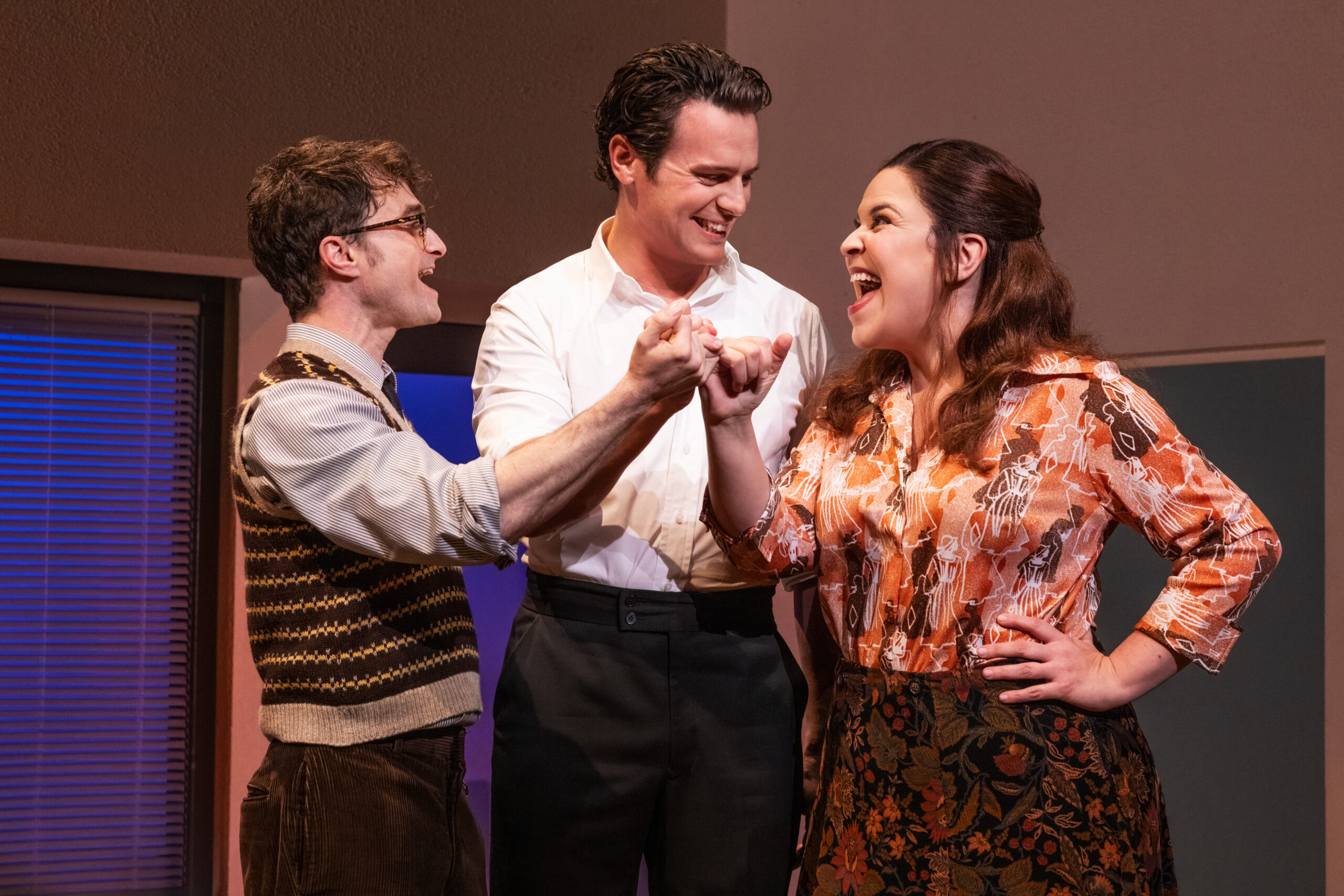
Filmed live from Broadway’s Hudson Theatre, the late Stephen Sondheim’s “Merrily We Roll Along” takes audiences backward through a 20-year-long friendship – all the way from its end to its beginning.
In 2023, a star-studded cast led by Jonathan Groff (“Frozen” films, “Hamilton,” “Glee”), Daniel Radcliffe (“Harry Potter” films, “How to Succeed in Business Without Really Trying,” “Equus”) and Lindsay Mendez (“Grease,” “Dogfight,” “35MM”) brought new life to what was once considered Sondheim’s most notorious flop.
The original 1981 production closed after only 16 performances and 52 previews; no one could have predicted the 2023 revival would go on to break the Hudson Theatre’s house record in its first week of previews, win four Tony Awards including Best Revival of a Musical and be named the highest-grossing Sondheim musical in Broadway history.
“Merrily” was ahead of its time — that much is clear. It defied every convention of the musical theatre genre. Franklin Shephard (Groff), our protagonist, may be the antagonist in his own story, but there is not one character in the main cast that isn’t deeply flawed. There isn’t a typical “love story,” but we find ourselves experiencing heartbreak several times over, nonetheless.
Of course, the story is told in reverse-chronological order. We see a friendship once it’s already fallen apart. Then we first meet Frank, he’s seemingly at the top of the world as he celebrates the success of his latest film.
In the first 20 minutes of the production, however, we learn Frank is not nearly as happy as he appears. His best friend, Mary Flynn (Mendez), has grown into a cynical alcoholic after watching Frank give up his dreams of composing musical theatre in exchange for the more lucrative filmmaking industry.
We also learn Frank is cheating on his second wife with the young star of his film, and he no longer speaks to Charles Kringus (Radcliffe) — the man he grew up with and the playwright for his earliest successes.
Telling the story reverse-chronologically was a risky device, as clear in its original failure, but it’s hard to imagine “Merrily We Roll Along” being told any other way.
Sondheim relies on dramatic irony to keep the audience engaged: As we travel back in time through failed marriages, betrayals between friends and career wins and losses, we watch with bated breath knowing what the characters do not.
Act I, for example, is tracked by tragedy after tragedy, while Act II finds our trio at their most hopeful, by which point we as an audience are utterly hopeless.
After two hours of heartache and humor, we finally reach the finale. “Our Time” is an uplifting, starry-eyed track sung by best friends Charles and Frank on the rooftop of their post-college apartment when they first decide to become a composer/writer duo.
There, they meet Mary, and the three watch Sputnik pass and conclude that anything could happen, deeming the world their oyster.
It’s one of those musicals that you just want to watch again and again, because “Merrily” rewards its rewatchers. Several times while watching the pro-shot — and even while I was sitting in the Hudson Theatre back in March of 2024 — you can hear audiences gasp when an 11th-hour turn of phrase plucks at a heartstring.
Now with the Netflix film right at my fingertips, I can watch the production again and again, and I find something new every time — a clue of what’s to come, mirrored lyrics between acts or an emotional beat.
All the while, the scene changes are bookmarked by ensemble-led transitions, where the cast asks the pivotal question, “How did you get to be here?” all while warning, “Dreams don’t die, so keep an eye on your dream.”
It’s through these repeated phrases that we realize what Sondheim is asking us to consider as the musical’s theme: When you abandon your dream, you abandon yourself.
The filmed adaptation additionally offers closeups that allow viewers an intimate taste of the leads’ true starpower. Groff and Radcliffe both won Tony Awards — Best Performance By a Leading Actor in a Musical and Best Performance By a Featured Actor in a Musical, respectively — for their work in the performance, and it’s clear to see why.
Radcliffe in particular accomplishes the difficult feat of hitting his emotional peak only 30 minutes into the musical. He makes his grand entrance in the second scene, jumping right into an impossibly fast explanatory track (“Franklin Shephard, Inc.”) where he directly confronts the failing friendship between himself and Frank.
Through the performance, Radcliffe teaches a masterclass in acting through the song. He never loses the pace or momentum even while having an emotional breakdown.
Then, the scene ends and within seconds, he must transport himself to the Charles of yesteryear, the Charles who has not yet reached the point of no return with his best friend, the Charles who still believes they might prevail.
Groff and Mendez aren’t off the hook either. Their task is less immediate but equally demanding. They work backwards from characters that are, by the end of their arcs, essentially shells of themselves.
There’s Frank — who has reached the top, but left everything that mattered at the bottom — who must return to a youthful, sentimental visionary. He’s complemented by Mary — a heartbroken misanthrope who achieved her dream of being a writer, but watched her friends crumble and thus turned to alcohol — who must return to a naive, awkward young woman who’s slowly falling in love with the man we know will never grow to love her back.
“Merrily We Roll Along” will go down in history as theatre’s greatest comeback. When considering why it failed so miserably at first, it’s important to consider the nearly 50-year gap between productions.
Modern audiences are far more comfortable with antiheroes, and nonlinear storytelling is slowly transcending into the mainstream. The central cynicism surrounding success in the arts resonates in today’s society.
And the time for “Merrily” is just beginning. Director Richard Linklater is producing a highly ambitious retelling starring Paul Mescal, Ben Platt and Beanie Feldstein. Production began in 2019, though scenes will be filmed intermittently over 20 years to capture the characters aging authentically.
Ultimately, the musical didn’t change — the audience did. “Merrily” simply needed to bide its time, ironically reflecting the main storyline to a tee.
The penultimate number entitled “Opening Doors” follows the trio through various failures in their respective careers, all while they remain defiantly dedicated: “We’re banging on doors, shouting, ‘Here again!’ / We’re risking it all on a dime / That faraway shore’s looking near again.”
Just as Frank, Charles and Mary promise to push forward past rejection, “Merrily” did the same, though, thankfully, with better luck than its characters. It waited its turn and didn’t take no for an answer.
Something is stirring, shifting ground. For “Merrily,” it’s just begun.