


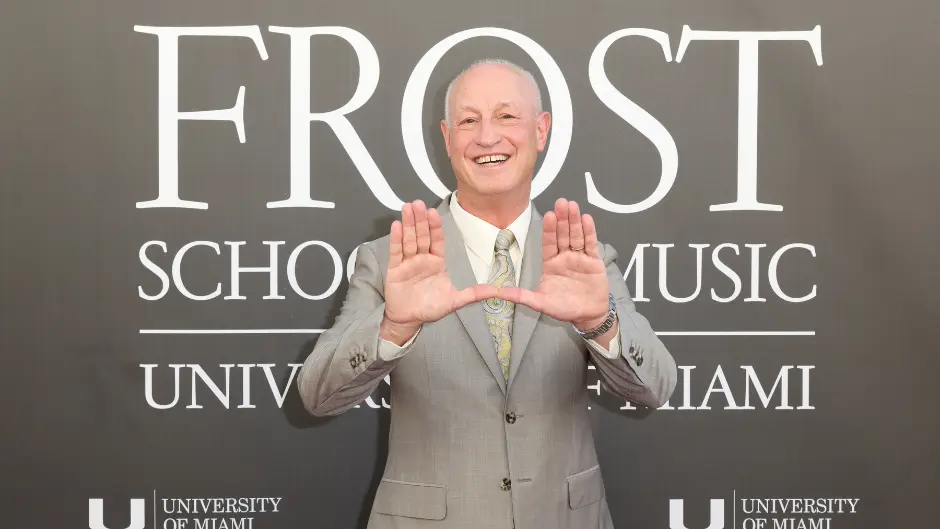
For nearly two decades, Shelton “Shelly” Berg has helped redefine what it means to study music.
Now, the five-time Grammy-nominated musician and longtime dean of the Frost School of Music is stepping away.
Berg will retire this spring after 19 years leading Frost School of Music. He leaves behind a legacy not just of growth, but of transformation that reshaped how young musicians are trained for an industry that no longer fits into a single lane.
“We really have changed the conversation, the landscape about what a music school can and should do,” Berg said. “More importantly, it’s helped our students feel better prepared for the world.”
When Berg arrived in 2007, music education largely followed a traditional model focused on specialization and performance. But the industry was already shifting, and Berg saw what was coming.
The result was the Frost Method, also known as the Experimental Music Curriculum, which prioritizes hands-on, experiential learning over traditional lecture-based instruction.
“We’re giving students the skills rather than just the theoretical knowledge,” Berg said. “The Frost Method is all about being well-rounded, being good in more than just the thing you came here to do.”
The approach reflects a broader shift in the music industry, where musicians are expected to understand not only performance, but also business, technology and communication. Under Berg’s leadership, students are trained to market themselves, collaborate across genres and adapt to evolving demands.
Despite these achievements, Berg emphasized that the school’s success was built through collaboration.
“No dean makes something happen. Everything is a collaborative effort,” Berg said. “The end result might not be exactly what I would have done, but I have to trust that it’s better in some way because more smart people were involved.”
It was a shift that mirrored Berg’s own career.
A classically trained pianist who began playing at age four and performed professionally by 13, Berg built a life in music that never stayed confined to one genre. That same versatility became the foundation of his vision for Frost, where students leave not just as musicians, but as adaptable artists ready for a constantly evolving industry.
Berg said his decision to step down comes at a natural turning point, both personally and professionally. At 70 years old, he hopes to dedicate more time to music and his family.
“I don’t want to just take it for granted,” he said. “I want to dedicate my primary energy to music, the thing I’ve always made secondary.”
He also acknowledged that the future of music education will bring new challenges, particularly with the rise of artificial intelligence.
“AI is upending the way we live,” Berg said. “But I believe new things expand opportunities. They do not contract them.”
Looking ahead, Berg hopes to spend more time practicing, composing and performing, and less time in meetings.
“I’m not going to say I wish I had been in a thousand more meetings,” he said. “But I hope I’ll say we had some great times.”
For students, his advice is simple.
“Say yes,” Berg said. “Who you will be is a result of the acceptance and rejection of influences. Either it opens a new pathway or shows you what you do not want. Either way, it shapes your future.”
Though he is stepping down, Berg’s impact – on Frost students and on future generations of musicians – will last long after his retirement.