


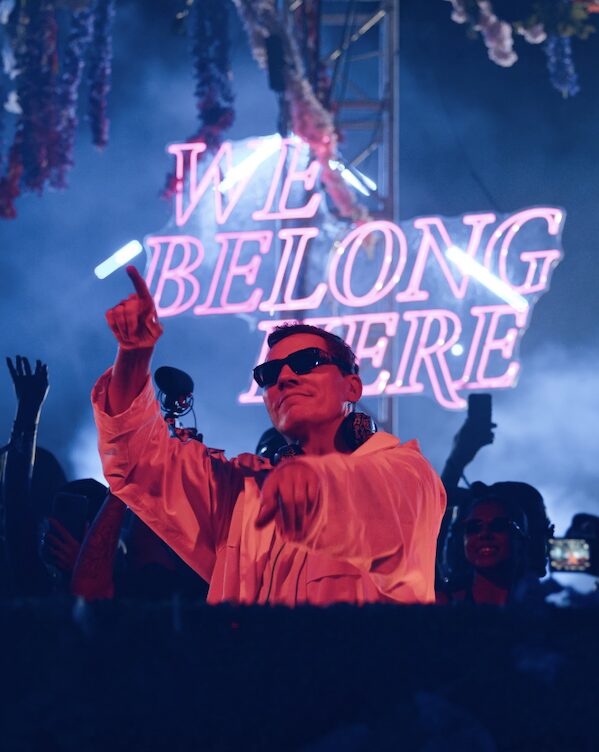
The landmark fifth edition of We Belong Here Miami took over Virginia Key Beach Park from Feb. 27 to March 1 and turned it into something that felt less like a festival and more like a temporary beach civilization built on music.
From the moment you walk through the gates, the shift is immediate. You smell the salt water before you see the stages. The sand works its way into your shoes. The melodies drift through the ocean air instead of punching through concrete. It doesn’t feel industrial. It feels coastal and alive.
Friday carried the signature We Belong Here tone — melodic, warm, polished. Artists Bakermat, Lost Frequencies and Elderbrook built the main stage steadily as the sun dipped lower, before Kaskade closed with his Redux sound.
There’s something about hearing them by the water that makes it hit differently—less like a club set, more like a shared exhale.
What separates this festival from most is the freedom to choose how you experience it. You can dance hard at the 360 main stage, wander to the smaller stages, or dip your toes into the Atlantic mid-set. It’s amazing to feel like you’re at a rave and on vacation at the same time.
The Beach Stage, positioned maybe fifteen feet from the shoreline, leaned more vocal-heavy and pop-adjacent when I stopped by. I caught Benjamin Lloyd dropping edits of “Where Have You Been” and “The Less I Know The Better,” and the energy felt light, singable and euphoric.
In contrast, the Lost Village felt like a side quest — wooden structures framing a tucked-away dance floor with a slightly darker, more mysterious tone. It was the kind of place you wander into and end up staying for half an hour.
The decor across the grounds struck a careful balance — not overdone, not bare. Just enough to feel like its own secluded beach world without competing with the ocean itself.
Lane 8 delivered one of the weekend’s most transportive sets, stretching time the way he always does, letting melodies breathe into the sunset. RØZ might have been the most electric surprise of the weekend. He warmed up with Latin-infused edits — “Sexy Movimiento,” Young Miko flips — before dropping Bad Bunny’s “NuevaYol.”
Expected? Sure. But then he dove straight into a speed-house edit of “Salgo Pa La Calle,” keeping the iconic intro intact and sending the Latino crowd into a frenzy. Following that immediately with “MONACO” should be illegal. It was energetic and it flowed.
Sunday’s weather delay tested everyone’s patience. Gates were pushed from 3 p.m. to 4 p.m., and a long line formed across the Key as puddles collected and barriers shifted. But once the skies cleared, everything snapped back into place in time for Nimino and then Tiësto’s set. If anything, the delay added tension to the release.
Tiësto was exactly what you’d expect — polished, commanding, consistent. You know what you’re getting, and he delivers it. Chris Lake, on the other hand, felt long and repetitive. There was visible frustration in the crowd when he teased but didn’t fully commit to his remix of “Opalite” by Taylor Swift, cutting key vocal sections that give the track its lift.
For a headlining slot, it lacked the spark the moment demanded but he did close out with a great remix of Tame Impala’s “Dracula.” Sunday closer Gorgon City was solid andclean.
Logistically, the festival ran smoothly overall. There were plenty of food stands and beverage options — Beatbox seemed to be everywhere — and the layout made navigation easy. One water station felt sufficient for the crowd size, though adding another near the back of the main stage would’ve been appreciated during peak hours.
VIP had solid bar access and clean bathrooms, though adding food options within that area would elevate the experience. If there’s one creative tweak for the future, bringing back the fourth stage from 2024 would deepen the exploration factor.
After hours rotating between two smaller stages and one large main stage, the rhythm can feel slightly repetitive. Another lane would keep discovery alive.
We Belong Here is the kind of beach festival Miami should be doubling down on. For a city so defined by its coastline — we should have more than one significant waterfront gathering each year.
Right now, We Belong Here holds that crown. It’s well put together, immersive without being overwhelming, functional and fun. But Miami crowds evolve quickly, and to keep growing, innovation will matter.
Not just bigger DJs, but new concepts, fresh staging ideas and unexpected collaborations — something that pushes the format forward rather than simply refreshing it.
Still, for three days on Virginia Key, the music met the ocean, and the ocean answered back. And for a moment, it felt like nowhere else in Miami existed.