


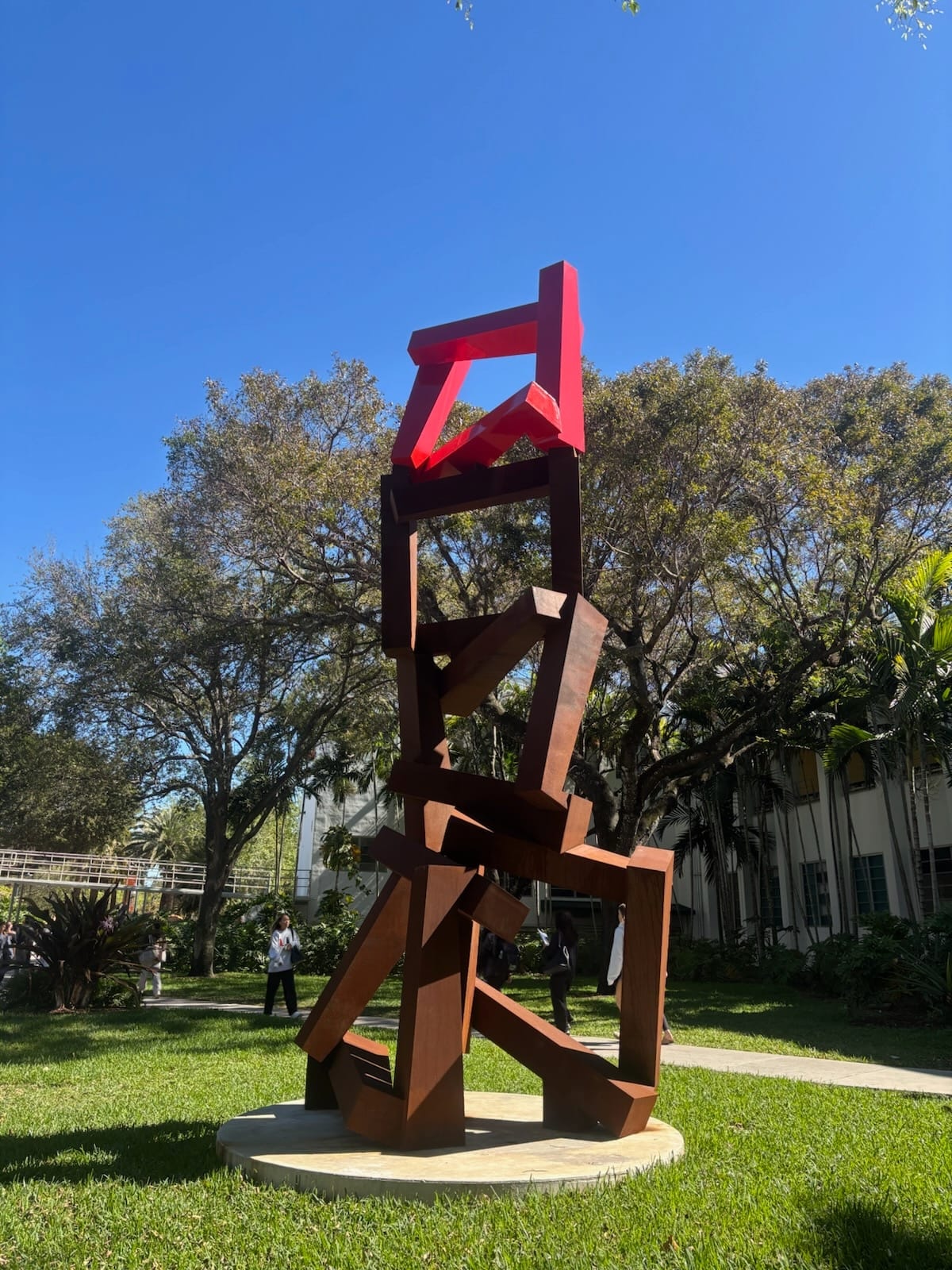
Students walking past the Merrick Building may have noticed something towering above the lawn.
A seven-meter steel sculpture titled “Chaos Herrirako Atea” by American sculptor Jedd Novatt has quietly appeared behind Merrick, becoming the newest addition to the University of Miami’s public art collection.
Novatt is an American sculptor whose sculptures have been exhibited around the world. His sculptures, which often explore geometric forms and spatial tension, create structures that appear both balanced and precarious.
According to a representative from Novatt’s studio, Novatt does not explain the meaning behind his titles or attempt to verbalize the interpretation of his work. Instead, he believes that the artwork should be experienced directly by viewers.
The representative said Novatt feels “the work speaks for itself” and encourages viewers to spend time with the sculpture, observing it at different times of day and in different lighting conditions to gain new perspectives.
The sculpture was gifted to the University by a private foundation and installed as part of the University’s broader public art initiative.
The University of Miami formalized its Public Sculpture Collection in 2001 to expand artwork beyond the grounds of the Lowe Art Museum. The collection now includes more than 30 sculptures by local, national and international artists placed throughout the Coral Gables campus.
Tola Porter, director of the Lowe Art Museum, said public art plays an important role in campus life.
“The University of Miami and the Lowe Art Museum are proud to host a vibrant sculpture park comprising works by leading sculptors from around the world,” Porter said. “Public art democratizes artistic creativity by bringing art outside for all to enjoy and supports student learning, research and wellbeing.”
Alice Corral, director of Campus Development Regulations, says the sculptures are meant to capture interest, stimulate imagination and enrich the daily experience of students and visitors. The works are installed in public locations which make them accessible to the community.
Corral also said the collection “meets the requirements of the City’s Art in Public Places ordinance and exempts the University from ongoing costs related to the construction of new buildings.”
The Coral Gables Art in Public Places program requires certain development projects valued at $1 million or more to dedicate at least 1 percent of their costs toward public art installations that enhance the city’s cultural landscape.
For students passing behind Merrick, “Chaos Herrirako Atea” may appear sudden and imposing. But as the newest addition to the campus landscape, the sculpture invites viewers to pause, observe and interpret it in their own way.