


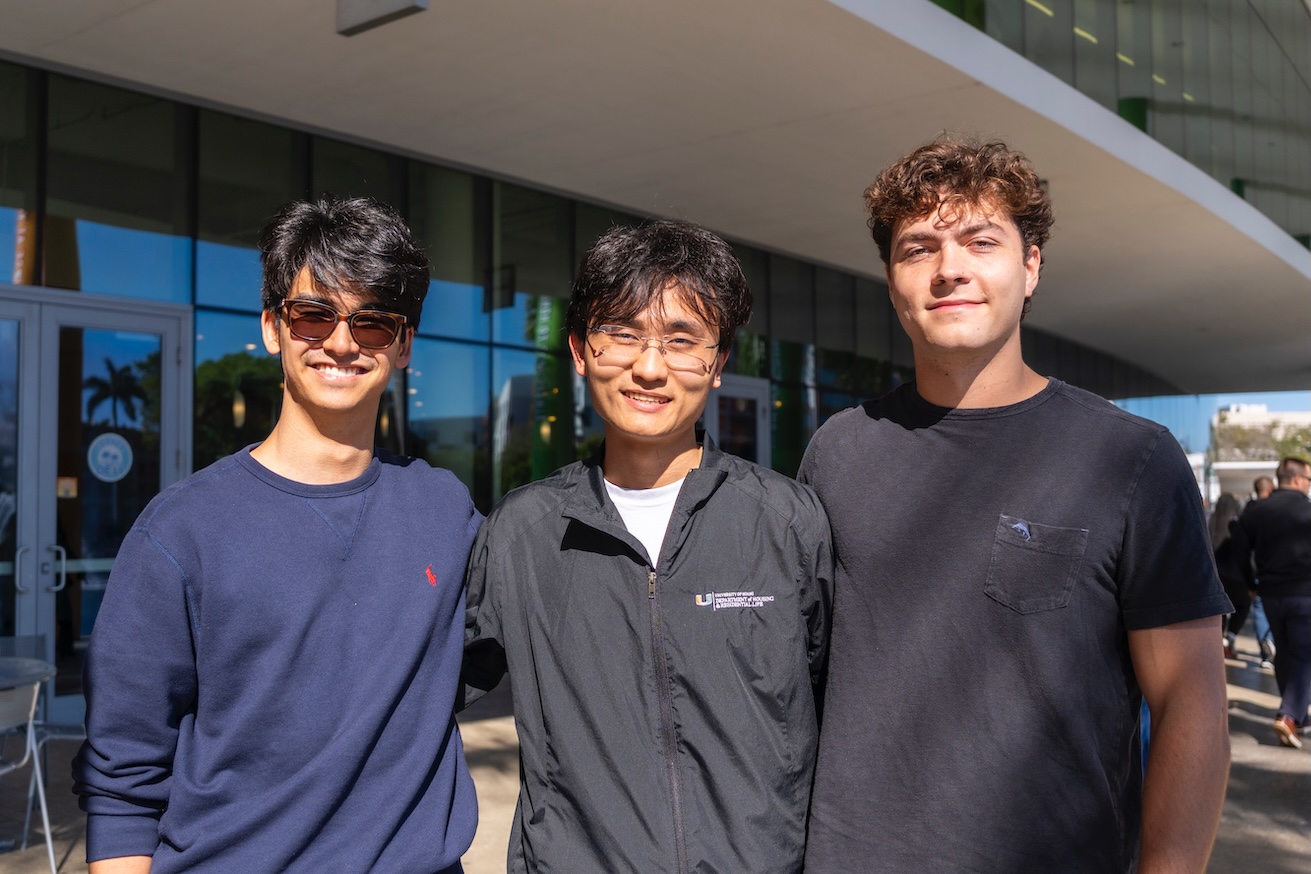
It was a regular day at the Lakeside Village ping pong tables, two UM freshmen were just trying to win a game. They began talking casually about a problem they both saw in storing private information on computers and they began listing off all the ways they could do it better than the current systems.
Alexander Kim and Ethan Tieu had come into the University together through the Stamps Scholarship program. A “serendipitous set of events,” as Kim described it, made them roommates.
It didn’t take long for them to realize they shared the same frustration: UM had plenty of talented computer science students, but no real structure to connect them with the research problems happening across campus. So, they built a solution to their frustration.
Kim and Tieu co-founded an applied computer science research group, open to interested students, designed to bridge that gap. They decided not to release the name of the organization to keep focus on Textile.
“You can think of it like a consulting organization,” Tieu said. Professors, labs and local companies bring the group their data or computational ideas. Then, the student-research group organizes student engineers to build the solutions.
Kim said the scale of the group surprised even them.
“So, after all things told, we worked probably throughout the course of the three years of that organization, which we still run, probably like 80 of the top computer science, electrical engineering, computer engineering, mathematics, and ITD students.”
They’ve delivered more than 27 projects, including diagnostic tools for Alzheimer’s and Parkinson’s, collaborations with the medical campus, and work with the business school and astrophysics department. But as the organization grew, so did its chaos.
“We started drowning in our own information,” Kim said. Years of research files, documents and project histories were scattered across drives and folders. Even the most organized students had systems no one else could inherit. They needed a tool — a tool that didn’t exist yet.
Tieu saw the same problem outside the lab.
“People create systems that only make sense to them,” Tieu said. “And when something happens, no one else knows where anything is.”
So, once again, the team built a solution.
Within the organization, Kim and Tieu began developing a tool that could store important documents in one place and let users retrieve information in plain language without having to remember file names or folder paths. It was meant to help future team leaders understand the group’s history.
That internal tool eventually became Textile. The first prototype came together last March, when the team entered the College of Engineering’s Innovation Challenge. They won first place — a win publicly celebrated by the College of Engineering.
That early funding helped send the team to New York for the summer, where they built out the prototype and pitched to investors. They printed posters and taped them to police barricades around places like Madison Square Park, putting them on when officers turned away.
By then, they had already chosen the name “Textile.” Only later did they realize their office was in Manhattan’s garment district surrounded by textile retailers.
“We were literally in the textile retail center,” Kim said. “Textile founded in textile.”
Back in Miami, the student organization continued as a research group. Textile became something else entirely: brand new technology.
They began their ambitious journey within the research group, “Textile is what was born out of it.” Kim said.
The problem Textile is trying to solve is universal: digging through 20 years of paperwork in a manila folder and still not finding what you need.
Michael Mastando, a senior computer science major, joined the team after hearing about the idea from a mutual friend. He immediately understood the need for Textile.
“When my grandpa passed away, my parents and their siblings were dealing with all these documents,” Mastando said. “My dad told me that was a nightmare.”
When he told his dad about Textile, the response was simple.
“We could have used that a year ago,” his dad said.
To see if other families felt the same way, the team surveyed 200 people. 93% said they would find a tool like this “very useful” to “extremely useful.”
Today, Textile has 10 student team members and an advisory board of seven senior industry figures. The student run- research group, has more than 40 members and runs 10 projects at a time.
Tieu leads the machine learning and AI. Other students focus on software development, design, debugging, marketing and outreach. Mastando leads business development, reaching out to firms and companies to secure early partnerships.
“It’s really helped me build a lot of real‑world skills,” Mastando said. “Sales, talking to people, cold calling.”
The team didn’t name the investors, but they emphasized that the overall $200,000 investment came from “the local Miami community,” senior advisors in California and academic networks on the East Coast.
The product itself is in public beta and free to try. The major release is coming in the near future, and Textile already has pilot agreements with prominent wealth managers and law firms — partnerships the team expects to turn into full contracts.
For all the technical work, the team talks just as much about values as they do about code. They want Textile to feel “friendly” and “un‑frustrating.” They want answers to be “correct, authoritative and totally intuitive.”
Textile also believes in signing its work — literally — a nod to the original 1984 Macintosh, which hid its design team’s signatures inside the case.
If you say a certain phrase to the system, it reveals a “signature page” of the team and the story of how the name came to be.
After graduation, Kim and Tieu plan to move to New York City to keep building Textile.
“Everybody who we can afford on the team we’ll bring over,” Kim said. Three of the ten are confirmed to be working from New York, while others will stay involved part-time or remotely.
Tieu describes their journey with a phrase Kim repeats often: “Increase the surface area of your luck.”
Say yes to strange meetings. Show up to competitions. Talk to people you don’t expect to meet.
“The universe works together in special ways to make that stuff happen,” Tieu said. “I want to work on this until the problem is solved.”