


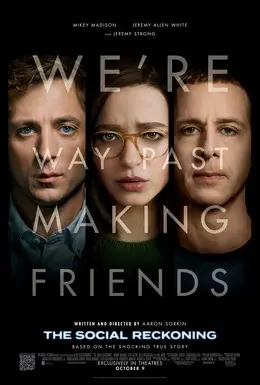
Aaron Sorkin’s “The Social Reckoning” hit movie theaters across the country on Oct. 9, 2026. As the credits rolled, my sister turned to me and said, “Everyone should be seeing this movie,” while my mother added, “I’m deleting Facebook when I get home.”
Despite its criticism, “The Social Reckoning” does not feel like a critique of Facebook, now known as Meta. As the film acknowledges, connecting people across the globe is inherently a “virtuous system.”
Instead, the movie shines a light on the already preposterous harms social media inflicts on both children and adults, specifically political polarization and mental health.
The true story centers on Frances Haugen, a former Facebook data scientist who became a whistleblower after watching a close friend become radicalized online.
Haugen realized that Facebook’s core algorithms, specifically its “Meaningful Social Interactions” (MSI) metric, were actively harming users and driving them toward extremism. With internal documents as evidence, she reached out to Wall Street Journal reporter Jeff Horwitz to expose the truth.
Using Haugen’s documents, Horwitz published “The Facebook Files,” revealing the truth about Facebook’s algorithm. The platform’s engagement algorithm prioritized rage-inducing content, creating an outrage economy that stoked societal division.
The reporting also exposed that Meta was fully aware of Instagram’s toxic effect on teens’ mental health, as well as how human traffickers and extremist networks exploited the platform without oversight.
Jeremy Strong, who portrayed Mark Zuckerberg in the film, contacted the Meta CEO while preparing for the role. “I feel an enormous sense of weight and responsibility,” Strong said in an interview. “My job is to understand and defend his point of view and fight his fight.”
Strong executed Zuckerberg’s point of view brilliantly. His portrayal highlights Zuckerberg’s significant views on free speech. When public pressure mounted on Meta to fact-check political ads, the platform doubled down on its hands-off policy, with Zuckerberg arguing, “Facebook is not the ref, it’s the public square” and “We’re a cork board, we don’t control what people put on it.”
Yet, as the movie demonstrates, Meta could control it — they simply choose not to. 86% of users don’t fact-check news they find on social media, and one in three users are unaware of misinformation spotted online.
The film also centered around Section 230 of the 1996 Communications Decency Act, which protects social media platforms from legal liability that could result from content posted by users because they are not deemed to be publishers.
But other people felt that these companies need to still be held accountable at some rate with what is posted and what the viewers are seeing. The late Senator Linsdsey Graham even sponsored a bill last December which would repeal Section 230 completely.
“They [Facebook] want you to believe in false choices,” Haugen said in her testimony before Congress in 2021. “They want you to believe you must choose between connecting with those you love online and your personal privacy… I am here to tell you today that’s not true.”
The film also captures the tension surrounding the Jan. 6 Capitol riots and Meta’s subsequent decision to block then-President Donald Trump from posting.
This was a rare moment where the company acknowledged the real-world harms it could cause. Sorkin uses this event as a buildup of tension in the film, stating in an interview in 2024 that Meta was responsible for the insurrection.
At the end of the movie, Haugen says before Congress, “I implore you. Take action.” In the years since The Facebook Files, Congress has held numerous hearings and introduced bipartisan bills like the Kids Online Safety Act (KOSA) that protects minors from social media harms.
Meaningful, comprehensive legislative regulation of algorithmic feeds remains largely stalled, however, as the bill has not passed in the Senate and only parts of it passed the House.
The Social Reckoning serves as a reminder that if lawmakers won’t hold big tech accountable, the responsibility will fall back on the users to decide when to finally log off.