


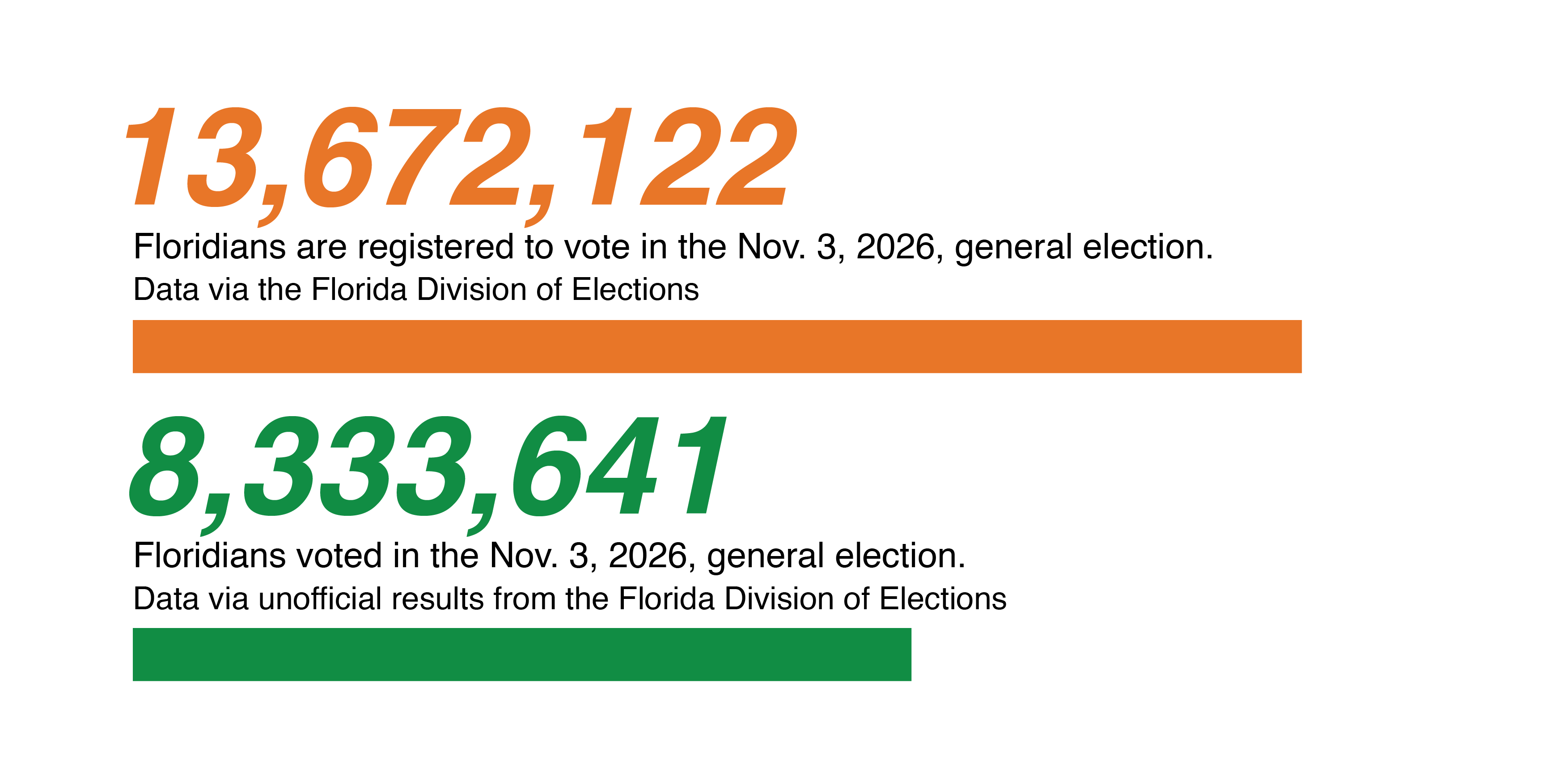
13,672,122 people are registered to vote in Florida, but only about 60.81% cast a ballot in the Nov. 3, 2026, general election. That’s more than five million people who did not exercise their constitutional right, forfeiting the opportunity to have their voice heard.
It’s easy to say that you “stay out of” or “don’t like” politics. It’s understandable not to want to debate your beliefs all the time.
But when a little more than 60% of eligible voters are actually showing up, it’s time to recognize that voting is more than just a personal choice. It’s our civic duty, and choosing not to participate means giving up your opportunity to have a say in the decisions that affect you.
In the 2024 presidential election, nearly 90 million people didn’t vote, according to the University of Florida’s election lab. That election had the second-largest voter turnout in history, yet millions of Americans still didn’t participate.
If people can’t even be motivated to vote in a presidential election, what will it take to get them to the polls for the midterms?
This problem also extends to our own campus. In the University of Miami’s fall 2026 Student Government Senate election, just 687 students voted, and with more than 12,000 full time undergraduates, that number only represents approximately 5.7% of the undergraduate student body.
“I think students might not vote in SG elections because they aren’t aware elections are happening or don’t fully know about what or who they are voting for,” said Ava Stroshane, student government’s elections commission chair. “This past semester we really tried to increase voter turnout by addressing this first reason.”
In the weeks leading up to the election, Stroshane worked to educate students, including through reaching out to several departments and organizations — like Orientation and Commuter Student Involvement — to share flyers and blurbs about voting. She and the elections commission also hosted tabling events where students could pick up free cookies and pizza.
Her outreach coincided with a 50% increase in turnout from the previous fall. Still, the overwhelming majority of undergraduates didn’t participate.
Abigail Lara, public relations chair of Get Out the Vote — UM’s nonpartisan, student-led political organization that promotes civic engagement and political efficacy — said people do not vote in larger elections for many of the same reasons.
For young voters, navigating the registration process and understanding what is on the ballot can make participating feel more difficult.
“One of the main barriers is a lack of accessible information regarding the voting process and what is actually on the ballot,” Lara said. “Our goal is to ensure that every student feels informed and empowered to use their voice at the ballot box.”
On campus, GOTV works to address these barriers by educating students about upcoming elections, registration deadlines and early voting schedules. The organization also helps students understand how to register to vote in Florida, making the process more accessible.
But access to information is only part of the problem. Even when students understand how to vote, some question whether their participation will actually make a difference.
“Many students believe that a single vote will not make a meaningful difference, so they choose to not engage in the process at all,” Lara said.
Not wanting to engage with politics does not mean political decisions stop affecting you. Elected officials make decisions about political issues ranging from education to health care and the economy — issues that Gen Z consistently identifies as most important to them. Choosing not to vote means giving up an opportunity to influence who makes those decisions.
You don’t have to agree with everything a political party stands for to vote. No candidate is perfect, and voting does not require agreeing with every position a candidate takes. It requires taking the time to understand the choices available and deciding who best represents your interests.
Democracy depends on more than having the right to vote. It depends on people who are willing and eager to exercise that right. Having a voice means nothing if we choose not to use it.