


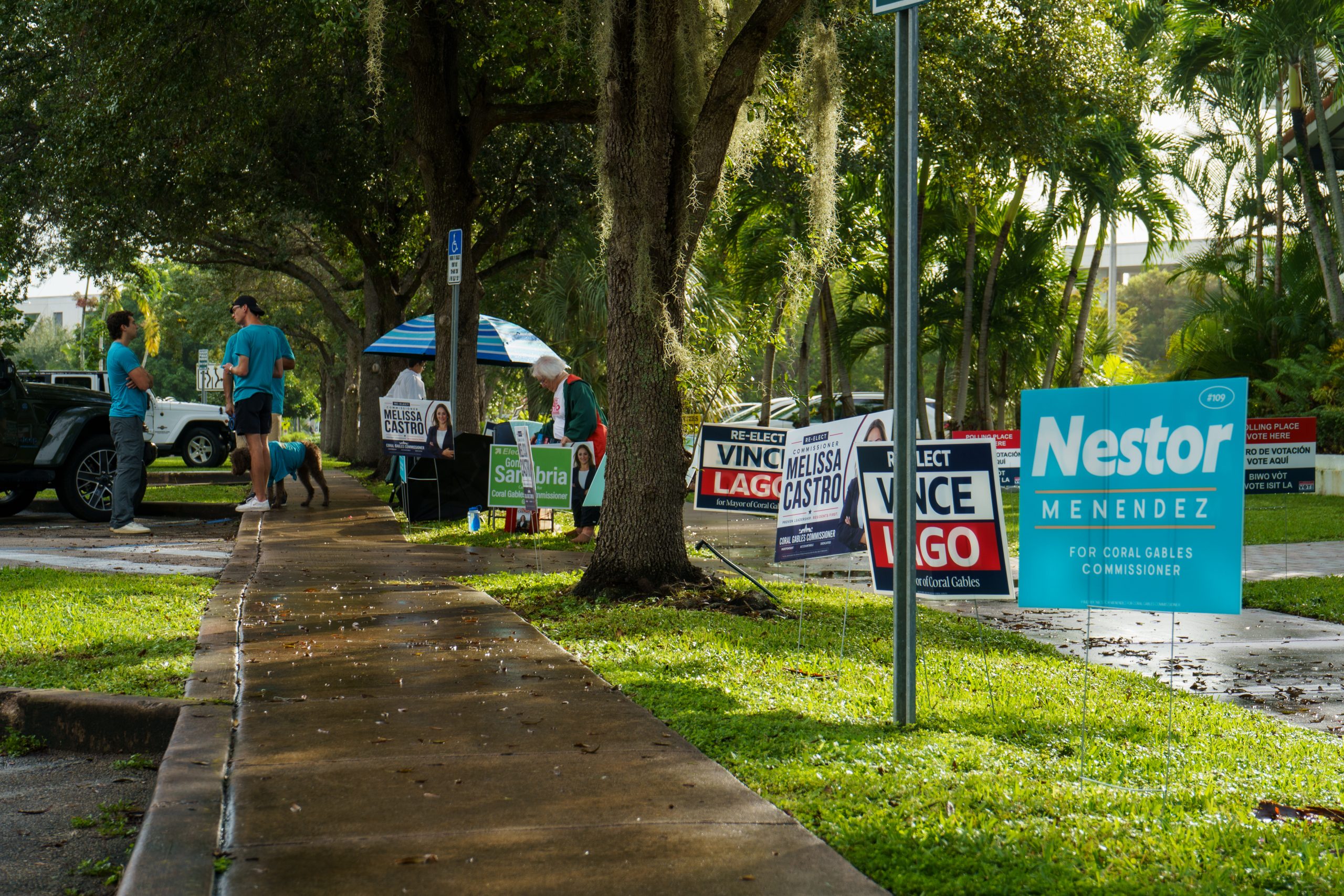
St. Augustine Catholic Church opened its doors on Tuesday, Nov. 3, as one of 14 polling locations that served Coral Gables for the 2026 midterm elections.
Open from 7 a.m. to 7 p.m. on Election Day, the church has served as a polling location for more than a decade, with county election records listing back to 2011 in subsequent municipal elections.
Nicholas Campbell, a 30-year-old Coral Gables resident, said that local politics was the main reason he came to St. Augustine to cast his vote.
“Local politics is very important to me, I would actually even say more important than the federal elections,” Campbell said. “This is what sets your budget, what public works, and how they get funded.”
Many voters came to the polls with one priority: supporting change on certain issues they believe need improvement.
“One of the major issues we are facing is healthcare,” said UM alum Janice Muller. “There is absolutely no reason that we shouldn’t have better healthcare, and I am dedicated to electing people who are at least willing to try to make it better.”
For first-time voter and UM freshman Anne Marie Cummings, rising costs were another priority. She expressed her concern with price increases for not only herself, but the greater Miami community, emphasizing how important youth votes are in this election
“The more people that think they can’t [vote], the less people there are to really make a change,” said Cummings.
Although each individual ballot likely looked different, voters at St. Augustine all agreed on one thing: Civic engagement and showing up to vote are crucial to the community.
Matthew D. Nelsen, a political science professor at UM, said older Americans generally participate in elections at higher rates because they have had more opportunities to establish voting as a routine.
“The more times that you vote, there is a likelihood that you vote in a subsequent election,” Nelsen said. “However, voter participation is only one indicator of political participation, and it’s only one form of democratic health. So just because voter turnout is high, that doesn’t really mean that everyone is super engaged, and vice versa.”
For college voters, the process of participating can come with additional challenges like navigating voter registration requirements and voting out of state.
“Some of the biggest barriers to political participation among college-age students is just bureaucracy,” Nelsen said.