


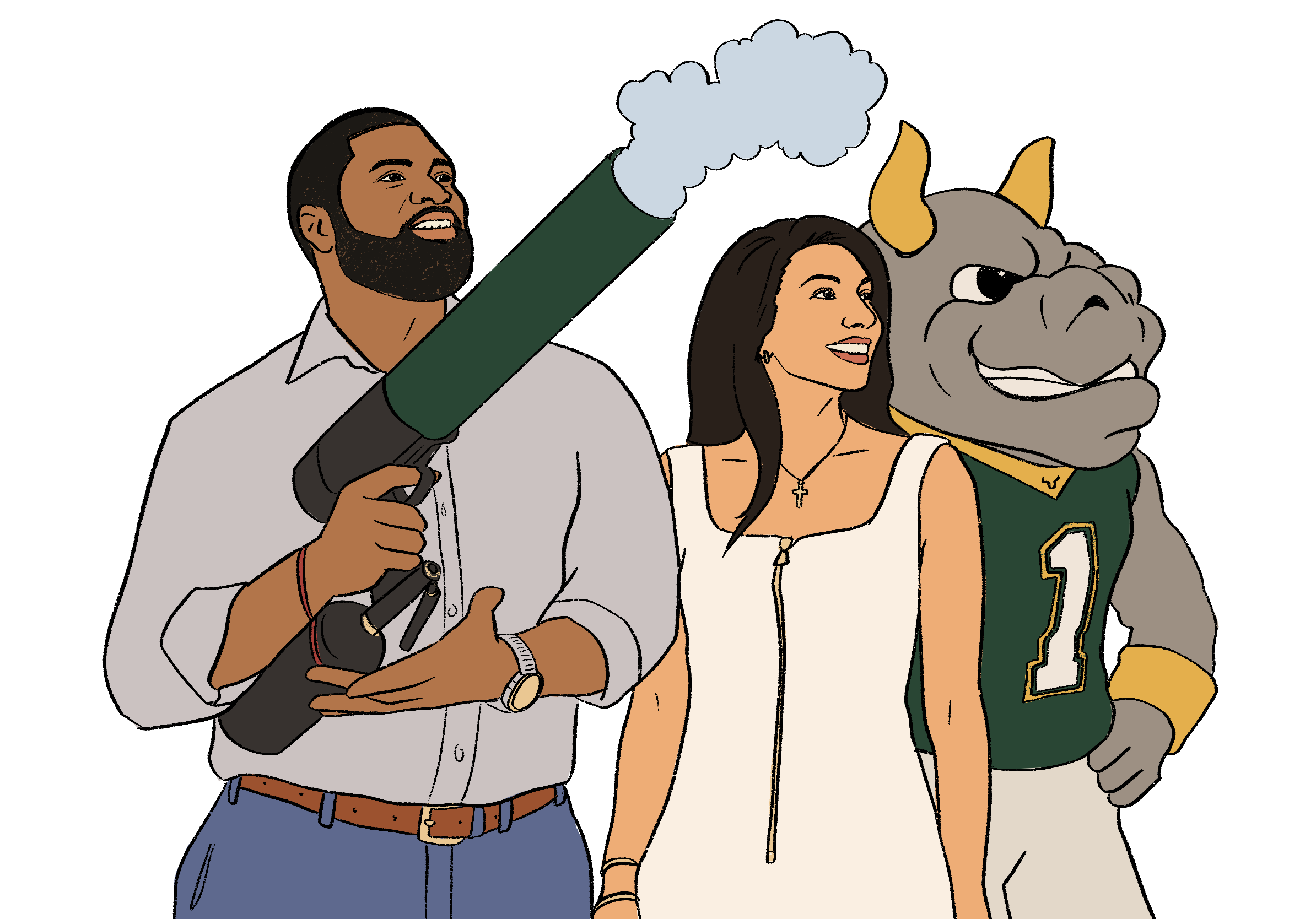
After rushing to get a seat at the game versus Florida State University on Oct. 17, I was surprised to see Florida Senate incumbent candidate Ashley Moody and governor candidate and Rep. Byron Donalds on the field.
Moody was hyping up the crowd as she rang the “Hurricane Siren” at the start of the game and Donalds was on the other side of the field hosting the coin toss. Both are republican candidates in contentious Florida midterm elections.
I pointed out both candidates by name to my friend. My friend, an engineering student, had no idea who I was talking about.
Now, both candidates have won their elections in closely contested races that could’ve been overturned.
The lack of candidate awareness on campus isn’t just a student problem. It mirrors a dangerous national trend where voters across America cast ballots along strict party lines without understanding the policies or principles of the leaders they elect.
Many Americans admit they will vote for candidates regardless of controversy or platform, just because it’s within their party. It’s rare that both sides cross over, and only a few voters will pause to research the names on both ballots.
This raises a crucial question: Are college students doing their research before entering the voting booth, or are they simply checking off boxes based on whether a candidate wears red or blue?
A number of UM organizations hosted congressional and state candidates in the weeks leading up to the election.
UDems hosted 27th congressional district democrat candidate Eliott Rodriguez in the classroom. Rodriguez is running against Incumbent Maria Elvira Salazar in what could be a contentious election based on immigration issues surrounding President Trump.
UM’s Turning Point USA chapter also hosted right-wing political commentator Benny Johnson and was scheduled to host Former United States Director of National Intelligence Tulsi Gabbard during their “Love it or Leave it” tour.
Student organizations have tried to fill the gap to educate students on candidates and provide genuine opportunities for political engagement.
But, Donalds and Moody’s appearance on the football field didn’t offer any opportunity for students to meet the candidates. At a recent panel on the 2026 elections hosted by the School of Communication, NBC 6 anchor Jackie Nespral noted that candidate Ashley Moody repeatedly ducked interview requests and declined to debate her opponent, Angie Nixon.
Nina D’Ambrosio, a sophomore studying computer engineering, made participating in the democratic process a priority and cast her ballot in early voting.
“Voting went very smoothly, I went to Coral Gables Library and everyone was super nice and helpful,” D’Ambrosio said. “I researched [the candidates] a little. I mostly just copied endorsement lists from a couple organizations I follow.”
It’s not just D’Ambrosio who votes along party lines and endorsement lists. The practice reflects a habit shared by voters nationwide.
According to Pew Research Center, only about 53% of adults aged 18 to 29 report following candidate news fairly closely, compared to 85% of adults aged 65 and older. Only 12% of young adults follow election news very closely.
“Most of us, regardless of age, do not [research candidates],” Professor Casey Klofstad explained. Klofstad is the chair of the Political Science Department and teaches POL 401, a class focused on the election. “We tend to vote our partisanship and reward or punish the party currently in power based on how things are currently going in the country.”
Voting is fundamental to holding leaders accountable, making our voices heard, and maintaining a free and fair society.
To protect that rule of law, voters must understand the principles and policies of the people they elect. In the 2022 midterm election, New York’s 3rd Congressional District voted in Republican George Santos believing he was qualified.
Barely a year later, Santos was expelled from the House of Representatives following a House Ethics Committee investigation and federal indictments, then pleaded guilty to wire fraud and aggravated identity theft.
As the nation slowly prepares for the 2028 presidential election, hopefully students research candidates instead of voting blindly.