


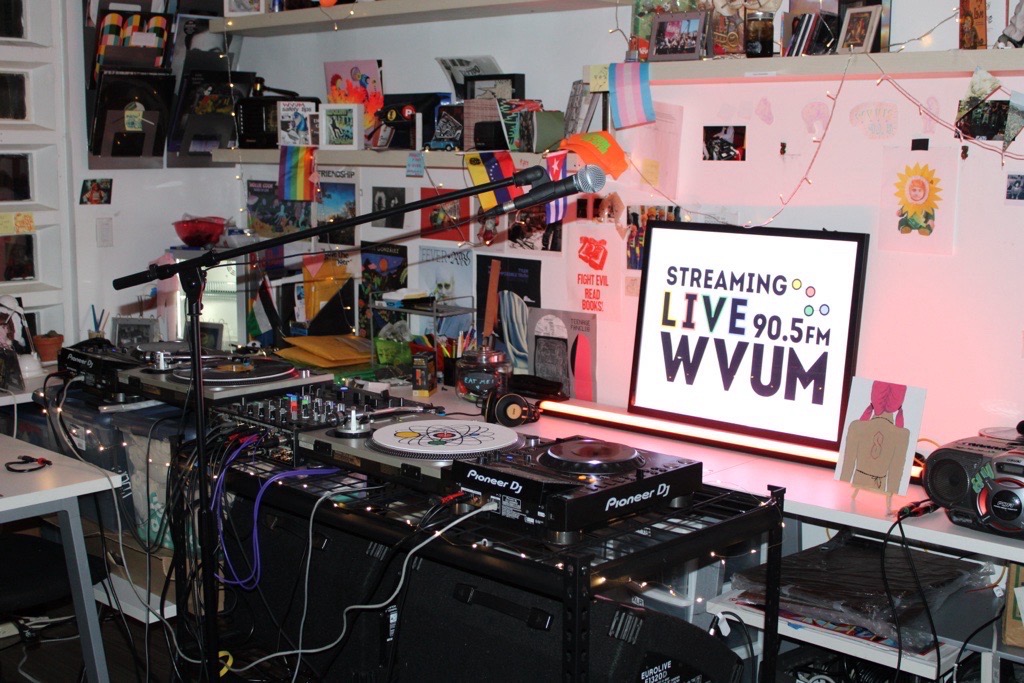
In a dim hallway next to Stanford Circle, the bright neon WVUM sign lights the entrance to University Center. The start of the latest Road to III Points interview plays underneath it.
“Are you excited for this year’s III Points?” Gabriel Izaguirre asked his guest Shinobi, a five-year III Points veteran. As Izaguirre adjusts his headphones, the tone in the WVUM studio is already set.
Instead of a backstage look with the crowd in the background, the WVUM audience gets a deeper, more intimate and casual conversation between the artist and interviewer.
Gabriel Izaguirre is the current host of Electric Kingdom Live (EKL), a WVUM specialty show that focuses on alternative, underground EDM.
Since around the 2000s, WVUM has had a relationship with Club Space, III Points and Ultra. Road to III Points started as a natural progression of the promo between WVUM and III Points, featuring artists such as Max Stern, Shinobi and, most recently, Saturnsarii, known for her collective Perreo Del Futuro.
Izaguirre purposely seeks out local, smaller artists, often Latinos, partly because of Miami’s main demographic, but also due to Road to III Points taking place during Hispanic Heritage Month.
His Road to III Points series invites artists performing at III Points onto WVUM; each appearance combines an interview with a live DJ set. This isn’t just festival promotion; Road to III Points acts as an intimate, down-to-earth conversation between artists.
It strengthens the relationship cultivated between UM, WVUM and the greater Miami area. It gives an inside look into artists, removing the barrier between celebrities, influencers and everyone outside the social media sphere.
EKL isn’t simply Izaguirre’s personal show. He maintains a piece of WVUM’s musical history. “Electric Kingdom Live” is WVUM’s longest-running specialty show, originally known as “Outlands,” which started in 1993.
Founded by Alex Caso, it originally showcased UK EDM and eventually transitioned to its current format, with live performances and post-show interviews. It followed the trend set by Mary’s House, another WVUM specialty show that interviewed artists back in the ’80s. EKL. has become a bridge between the Miami music scene and UM’s student community.
Even though WVUM has had a relationship with III Points for decades, the 2010s and the COVID-19 pandemic weakened the bond. Izaguirre was the one responsible for bringing Road to III Points back in 2025 on EKL’s 30th anniversary.
He likes to ask, “What can we as a community do for you?”
Izaguirre notes L3AN as one of his favorite interviews during a special Art Basel edition of EKL. “The conversation became bigger than music.” Izaguirre describes.
They had a great conversation and talked about the Latin diaspora in Miami, exploring how they have an advantage in Miami and should expand that privilege to help out fellow minorities.
He also mentions Pressure Point, who was brought on during Black History Month. They discussed the Black roots and history of EDM and how black artists and communities deserve proper recognition. As for the DJing performances, there are a few differences in their EKL sets compared to a regular one. They only perform for approximately an hour, and the guest must follow FCC radio guidelines, remaining family-friendly.
Izaguirre doesn’t believe these limits dramatically limit the artist’s creative freedom and feels he has learned so much more about DJing through his time as host.
“DJing is hard, I know everyone complains now that everyone is a DJ, but there’s a low ROI [return on investment].” He refers to the fact that DJing is an expensive hobby to get into, even more so if you’re trying to become a performer and might have to pay venues just for exposure.
He also mentions the WVUM to Club Space pipeline, referring to the fact that many WVUM alumni have gone on to become Club Space DJs. College radio actively chooses to participate in local music, and when artists choose to support WVUM, they continue to foster this relationship between both entities. Local radio can expose listeners to musicians before they encounter them on a major stage. Members of the local scene can all support each other’s growth.
Izaguirre hopes to continue to find more artists and keep the show alive. “Everyone wants to start a village; no one wants to be a villager,” he said.
He hopes more people choose to continue specialty shows and become legacy shows. The person behind the microphone will change. The DJs will change. Miami’s electronic scene will change. But the goal is that EKL stays there to document it. “Instead of building new houses, we need people to take care of the houses that are already there.”