


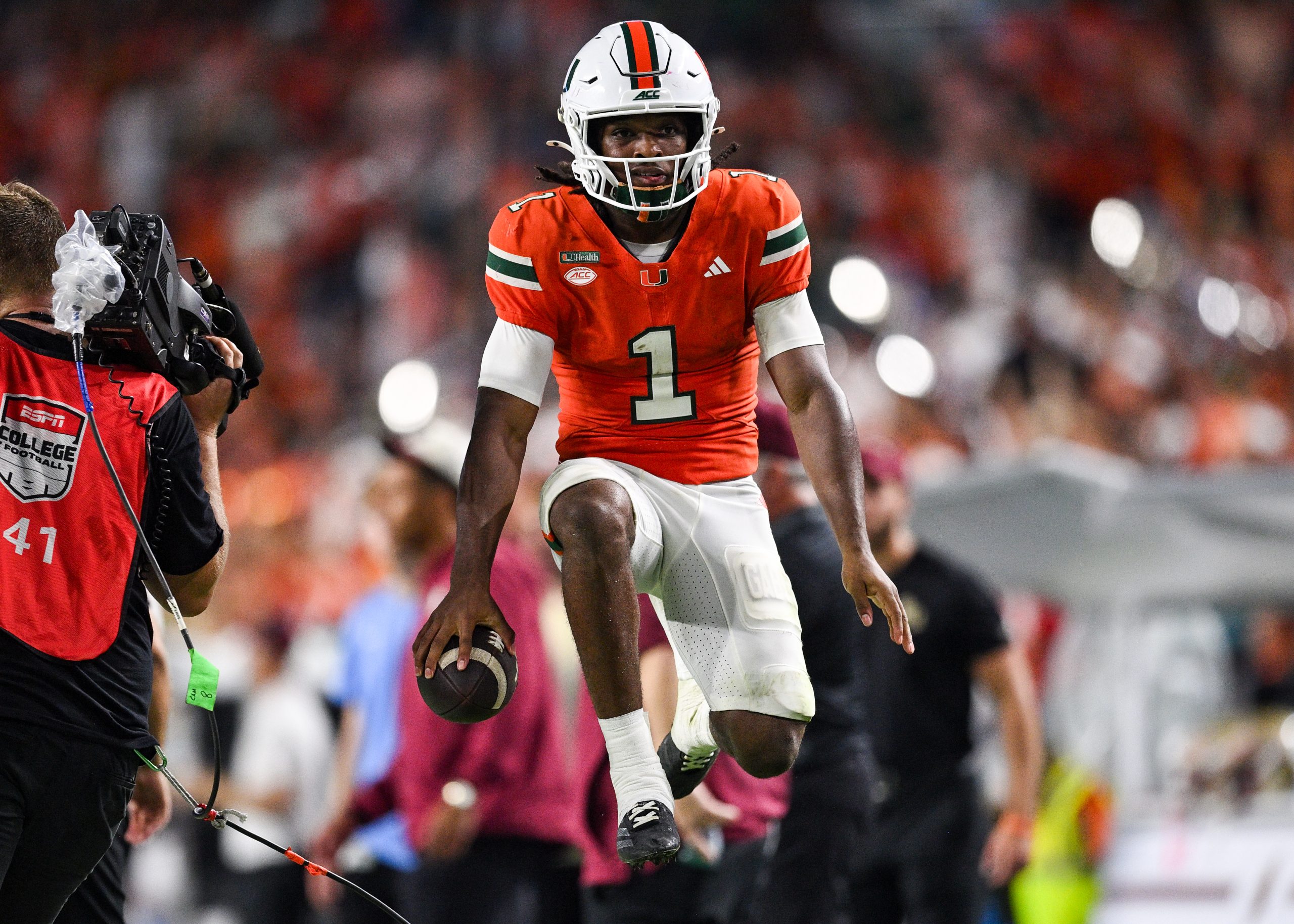
The last time Miami was No. 1 in the AP poll, the Hurricanes played football at the Orange Bowl, played basketball downtown at Miami Arena and played conference games in the Big East.
That was Dec. 8, 2002.
On Sunday, after a 43-35 double-overtime win over Florida State and one of the strangest Saturdays college football has ever had with five top-seven teams losing, Miami got the spot back. The Hurricanes (6-0, 4-0 ACC) jumped from No. 3 to No. 1 with 40 first-place votes in the Oct. 18 poll. It’s the first time the program has held the top spot in nearly 24 years.
A lot has changed since then. Not all of it is football.
Two different paths
The 2002 team never truly had to climb. Miami opened that season as the defending national champion and the preseason No. 1, and it stayed there for a record 21 straight polls before Oklahoma passed it in November. A week later, a 26-3 win at Tennessee put the Canes back on top, this time unanimously.
This team started at No. 7 and worked its way up. The last step came with help. Five of the AP’s top seven teams lost on Saturday, something that had never happened in the poll’s 90-year history, and that included Georgia and Notre Dame, the only two teams ranked ahead of Miami.
Mario Cristobal isn’t treating it like a trophy. He told reporters this season has shown rankings are “absolutely insignificant and irrelevant” from week to week.
Hard to argue. Two of the last three teams (Texas, Georgia) to hold No. 1 before Miami lost to unranked opponents.
There’s a familiar piece, too. The 2002 Canes nearly lost their ranking to Florida State, rallying from a 13-point fourth-quarter deficit to beat the No. 9 Seminoles 28-27 on Oct. 12, 2002.
This year’s team needed two overtimes against FSU just to get there, and the Seminoles’ 35 points and 443 yards were the most Miami has allowed this season.
The faces of the program
In 2002, Miami was Larry Coker’s team, and it ran through quarterback Ken Dorsey and running back Willis McGahee III. Dorsey was 38-1 as a starter heading into the national title game. McGahee, a sophomore who wasn’t supposed to start, piled up 2,108 all-purpose yards, still a school record. They finished fourth and fifth in the Heisman voting, and Dorsey had Andre Johnson and Kellen Winslow II to throw to.
Now it’s Cristobal leading the team, who played offensive tackle on Miami’s 1989 and 1991 national title teams, with quarterback Darian Mensah, receiver Malachi Toney and running back Javian Mallory.

The Fiesta Bowl connection
The 2002 run ended in Tempe, Ariz. Ohio State won 31-24 in double overtime on Jan. 3, 2003, ending Miami’s 34-game winning streak and its shot at back-to-back titles. McGahee was hurt in the fourth quarter.
Miami didn’t play for a national title again for 23 years, and the way back went through the same bowl. In January, the Hurricanes beat Ole Miss 31-27 in the College Football Playoff semifinal at the Fiesta Bowl when Carson Beck ran in a 3-yard touchdown with 18 seconds left.
The storybook ending fell short when Indiana triumphed over the Canes 27-21 on Jan. 19 at Hard Rock Stadium.
That’s the real difference between these two No. 1 teams. The 2002 team was trying to defend a title. This one is trying to finish what last season started.
Beyond football
In the fall of 2002, Miami basketball didn’t have a home on campus.
The men played their last game at Miami Arena on Dec. 30, 2002, a 68-62 win over Lehigh, then opened the $48 million Convocation Center five days later with a 64-61 overtime win over North Carolina. That building is now the Watsco Center.
Perry Clark was the coach then. Jai Lucas is in his second season now, after taking over a team that went 7-24 and going 26-9 with an NCAA Tournament trip in his first year.
Baseball was the other powerhouse. Jim Morris’ Hurricanes had won the 2001 College World Series, their second title in three seasons, and came within three outs of another Omaha trip in 2002.
Campus, then and now
Donna Shalala was in her second year as UM’s president in the fall of 2002. Joe Echevarria, a 1978 graduate, is now the university’s seventh president and the first alumnus to hold the job.
Then there’s the bill. Tuition for 2002-03 was $24,378, according to a February 2003 Miami Hurricane story. The university’s academic bulletin now lists flat-rate undergraduate tuition at $33,156 per semester, or $66,312 a year. That’s almost triple.
The players’ side changed even more. In 2002, NCAA rules barred athletes from being paid. Today’s Hurricanes sign NIL deals in the open.
Pitt, again
On Nov. 21, 2002, the top-ranked Hurricanes held on to beat No. 17 Pittsburgh 28-21 at the Orange Bowl.
On Saturday, No. 1 Miami hosts Pitt at noon at Hard Rock Stadium.