


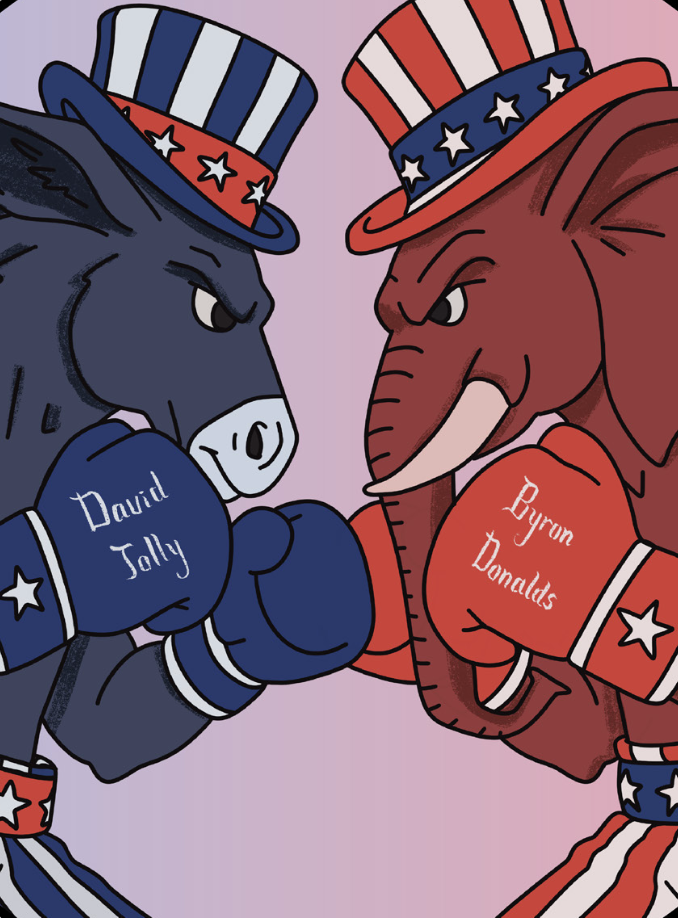
With incumbent Governor Ron DeSantis’s term coming to an end, Florida residents get to decide who his next successor will be this November.
Residents will choose between a diverse ticket and a party trying to reclaim the governor’s mansion after 30 years of defeat, determining what the future of the Sunshine State will look like.
The case for Byron Donalds
The Republican Party is often associated with a familiar stereotype: older, wealthy and predominantly white.
But the party did something interesting in Florida: it nominated Byron Donalds, a Black man, as its potential next governor.
In doing so, Donalds and his running mate have the opportunity to change many people’s view of the party — and give it a brighter future.
Donalds won the Republican primary with 47.8% of the vote, outpacing his opponents in both spending and support. Donalds added Florida State Sen. Bryan Avila as his running mate. Avila is Cuban-American, making this the first-ever completely non-white ticket for Florida Governor.
If Donalds wins, he will be the first Black governor in the state’s history, giving the party a high-profile example of a Black politician reaching the highest office in a deep red state.
This also reflects the slowly changing Republican coalition. Party dynamics shifted in 2024, including 47% of Latino men who helped to send Donald Trump back to the White House. This does not mean that the Republican Party has suddenly won over minority voters, but it does show the party is open to new and diverse voices.
A successful Donalds administration could add another name to the 2028 presidential conversation and show that the party’s future does not have to be represented by one demographic or one region. After all, Donalds was on the shortlist to be Trump’s running mate in 2024.
A Donalds and Avila win in November would give the Republican Party a powerful example of what its future leadership could look like: younger, more diverse and rooted in communities that have not historically been central to the party’s public image.
While a Donalds victory won’t erase the GOP’s diversity gap overnight, it could certainly help bridge it.
The case for David Jolly
David Jolly wants to flip Florida blue for the first time since the 1990s.
For almost 30 years, Republicans have held absolute control over the state’s political chambers, yet have been largely ineffective. Today, Florida struggles with a rising cost of living, an endangered environment, a weakened public education system and a culture war that gets in the way of real issues.
Jolly was the only candidate with enough name recognition and support to win the Democratic nomination. He might also be the only one who can win in Florida and start reversing the state’s rightward lean.
Jolly wants to solve the economic problems Floridians face today in ways Republicans have not been willing to do.
First, creating a state catastrophic fund would help Florida’s numerous coastal communities, as private insurers have left many homes across the state uninsured.
Jolly will address rising housing costs by building more affordable housing and supporting local renters and buyers, rather than capitulating to corporate landlords and institutional investors.
A pause on data centers will give Floridians time to figure out how to control the rise of artificial intelligence — especially in a state already dealing with high pollution and low water quality and supply following major droughts.
A vote for Jolly will also help Florida’s struggling education system. Republicans’ school voucher program has left school boards to deal with the fallout as enrollment collapses and many campuses close their doors — with 36 in Miami-Dade and Broward counties considering closures. Jolly will invest more money in public schools to improve them and raise teacher pay.
Jolly will give Florida a needed reset as governor, ending state-driven culture wars, keeping the government out of Floridians’ private lives and removing political appointees on day one, giving Florida a new — and better — look.