


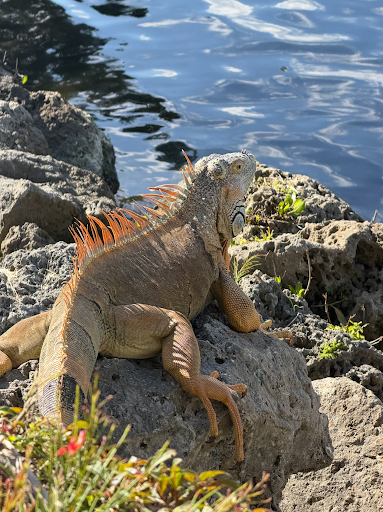
They’re green, scaly, peculiar creatures. It’s not uncommon to see these giant, dragon-like lizards roaming around Lake Osceola.
But what students may not realize is that these reptiles aren’t supposed to be here at all.
UM’s iguanas have become an ordinary part of campus life, making it easy to overlook the toll they take on our surrounding community. Iguanas threaten Miami’s native wildlife and infrastructure.
Preventing that damage from escalating starts with changing our own behavior. UM students can help by keeping food away from iguanas and avoiding interactions that encourage their presence on campus.
“I think they are super cool and nice to look at when walking to class. I do not think about their impact on our environment,” said a sophomore psychology major at UM.
With native ranges in Central America, parts of South America and some Caribbean islands, these iguanas are far outside their natural territory.
They’ve been well-established since 1964, when a pet dealer reportedly released more than 300 iguanas around Miami.
Today, iguanas are just one part of a much larger invasive species problem. South Florida is considered the region with the most invasive species in the world — including peacocks and Muscovy ducks — according to a 2023 study by researchers at UM.
Sidney Blumenfeld, the conservation ecology subcommittee chair for Student Government’s ECO Agency, spoke about the local impact of invasive species.
“A couple of on-campus examples would be the instance of green iguanas eating newly planted native firebush in one of our native gardens as well as the time they ate the mangrove propagules that were a part of the mangrove planting initiative,” Blumenfeld said. “My biggest concern about having a large population of green iguanas on UM’s campus is that it would make it even more difficult to maintain our gardens.”
Sharing the walk to class with an iguana or two can feel like a harmless part of the UM experience, but their natural behaviors come at the expense of Florida’s native wildlife.
As iguanas dig and take over burrows, they displace gopher tortoises and prey on their young. This predation compounds existing risks to gopher tortoises, a threatened species whose burrows provide shelter for more than 350 other animals.
Those involved in campus conservation efforts may see this damage firsthand, but it can go unnoticed by the average student.
“I typically never see them eating other animals or plants, so I guess I did not really think about their effect on the environment,” said junior Lauren McDonald.
For people living in Miami, the consequences of the expanding iguana population extend beyond wildlife and into the infrastructure beneath our feet. The burrows female iguanas dig to lay their eggs can weaken the ground beneath sidewalks and other structures students rely on every day.
Even after noticing an unstable sidewalk on the way to class, most people would never think to trace the issue back to the iguana roaming beside it.
“I did not realize they were negatively affecting infrastructure,” McDonald said.
She added that learning about the damage changed the way she saw their role in our environment’s ecosystem.
Iguanas are not inherently bad — they are just reptiles exhibiting their natural behaviors in an unnatural environment. Their introduction is not ours to undo, but its consequences are still ours to face. Students might not have to repair the infrastructure themselves, but surrounding communities pay the price.
Reducing that burden begins with understanding how everyday choices can contribute to their continued presence.
Yet recognizing that burden can depend on a person’s past experiences with the animals.
“There are some people whose experience with green iguanas consists of admiring them basking on rocks in the sun, bobbing their heads. In that situation, those people may not even think about the iguanas’ environmental impact,” Blumenfeld said.
For those who grew up in South Florida, familiarity can make them fade even further into the background.
“I don’t think much when I see them because I’m so used to them,” said senior Nicole Jahangani, who grew up in the area.
Managing iguanas at UM is not a task for students to take on alone, but this does not make them powerless.
They can help by avoiding behaviors that encourage iguanas to remain on campus, such as feeding them or leaving behind food and open snack bags.
Students can also keep their distance rather than encouraging interactions with the animals and report nonnative iguana sightings through the Florida Fish and Wildlife Conservation Commission’s IveGot1 reporting system.
These small choices can help students avoid contributing further to an existing problem.
However, the responsibility to prevent invasive species issues from worsening does not justify cruelty toward animals. Florida’s anti-cruelty laws still apply to iguanas, even though they are invasive and otherwise unprotected.
Feeding is one seemingly harmless interaction that can add to the problem. An animal lover might be tempted to toss an iguana a snack or capture the moment on camera, but doing so can attract additional wildlife and create unnatural concentrations.
Feeding an iguana might feel unique to life in Florida, but behaviors like this can encourage their populations to continue spreading. Not only can this threaten our own safety, but it can threaten theirs, too.
At UM, iguanas remind us how serious environmental problems can subtly blend into the scenery. After seeing them bask beside Lake Osceola day after day, it becomes easy to mistake familiarity for belonging.
Iguanas might be here to stay, but we do not have to normalize an environmentally destructive invader.
We cannot reverse their introduction, but we can stop feeding them, attracting them and treating their continued spread as inevitable. The longer we continue to sit back, the closer we inch toward making today’s damage tomorrow’s normal.