


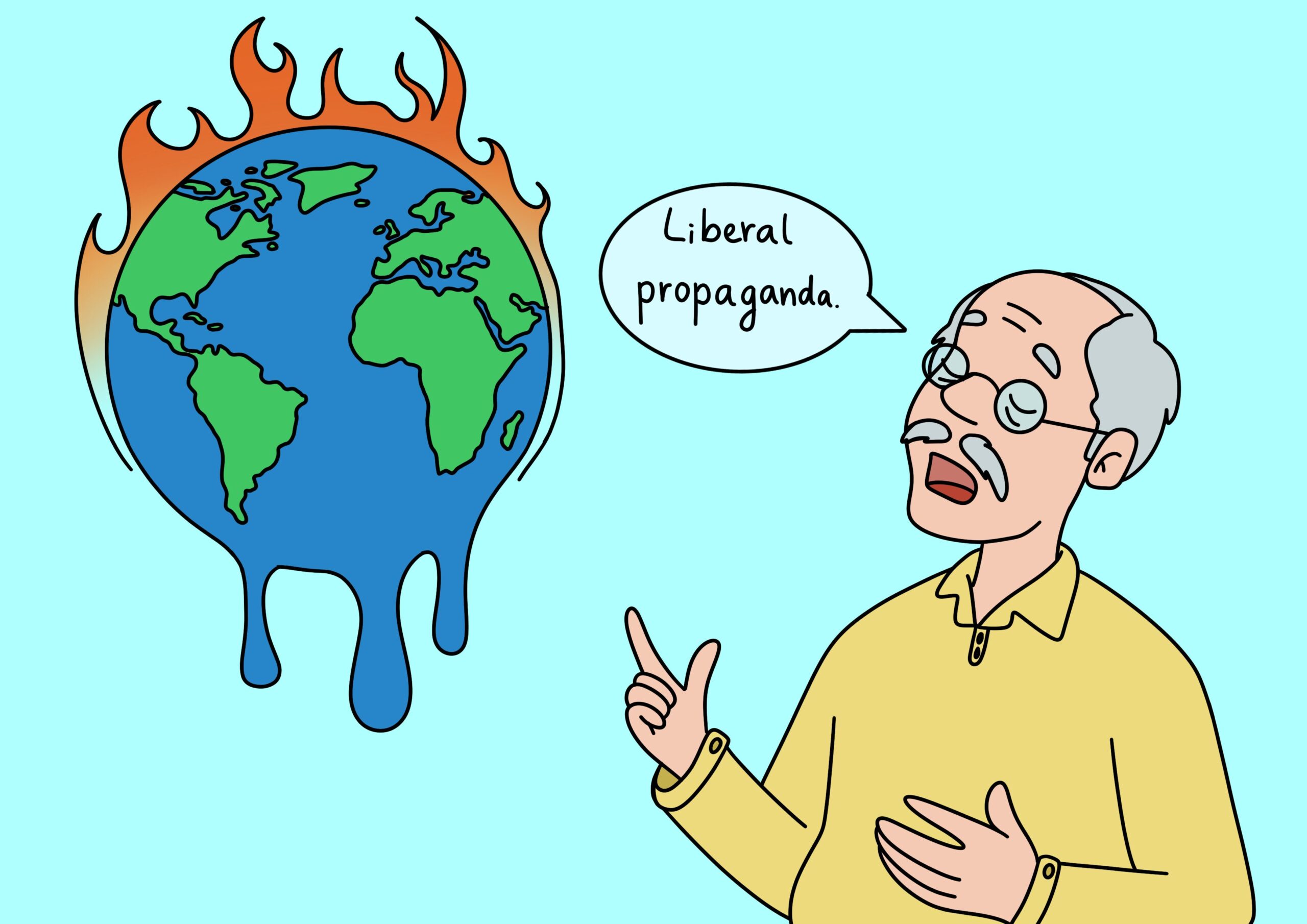
I recently sat down with my mother, grandparents and their friend for Shabbat dinner. My grandfather, whom I lovingly refer to as “Saba,” and I started a semi-peaceful discussion about whether or not global warming is really happening.
At 91 years old, my grandfather does not believe in the phenomenon.
I offered facts: California wildfires, melting glaciers and topsy-turvy weather conditions plaguing the world. He dismissed it all as “liberal propaganda.”
Oftentimes, when young progressives try to talk politics with their elders, they’re met with people who just won’t budge. Rather than open their minds to new beliefs, our grandparents close the door to the truth — because it is easier than admitting that what they’ve grown to see as fiction might be fact. It is easier to stand with what you know than to grapple with what you don’t.
Considering how rare a college degree was until recently, I find it probable that the main reason for ignorance among older generations is that most never received a proper education.
My grandfather was born in Belgium and served in the trenches of World War II. As a young Jewish boy living in Europe, he constantly fought for survival. I grew up hearing his stories of bartering for bread and watching his parents be taken by trains to concentration camps.
Saba has certainly lived a difficult life, and I’m proud to be his granddaughter. He’s been through many things I’ll never have to experience, and he knows many things I’ll never know.
But, the things he went through kept him from earning even a high school diploma, which I strongly believe is the cause of his negligence toward new ideas like global warming.
I know many things he’ll never know, and my world of knowledge will continue to expand, while his will remain relatively stagnant simply because he chooses for it to.
During our discussion, Saba asked me how I knew these things to be true, and I told him, plain and simple: I don’t know the scientific principles nor the mathematical formulas used to calculate the “climate clock.” I am a sophomore in college right now, and I study music and journalism, so admittedly, science is not my strong suit.
However, I don’t think the main point of education is to learn something specific: I think it’s to learn how to learn — and more importantly, how to keep learning.
So, while I don’t know everything about the climate, my education has given me the ability to teach myself as much as possible about global warming and to respect the findings of scientists far more educated than I am on this specific topic.
My mother received a bachelor’s degree in business before pursuing her law degree. She and I disagree on many things, but we agree on the fact that global warming, among other things, is something you cannot dispute. It is happening, whether you deny it or not.
Though my mother is long out of school, she hasn’t stopped learning. She has also tried to explain to her father that global warming is not a topic for debate, emphasizing that she saw the melting glaciers herself on a trip to Iceland.
Not everyone is so lucky as to receive an education. But, the world will keep changing. What I learn in college now will likely not be what my children or grandchildren learn several decades from now. Their worldview will expand, and I would hope that they learn more than I ever will.
However, if you go out of your way to learn in your early days, you will inherit the ability to keep learning as you age.