


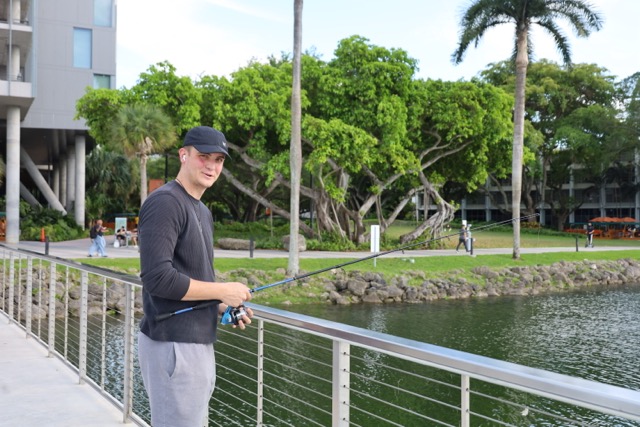
Fishing in Lake Osceola sounds like a typical afternoon activity. But, as the space sees heavier and more varied use, student concerns about cleanliness intensify.
This practice raises concern about both environmental damage and protection of the area.
While the University policy has historically prohibited swimming in Lake Osceola and surrounding waterways, current guidelines do not clearly address fishing.
This perception was reflected in an anonymous, non-scientific survey posted on The Miami Hurricane’s Instagram story.
55% of 53 respondents reported observing trash, 62% noticed a smell and 42% noted bait being left behind.
One student wrote, “Right after spring break, I noticed fishing bait left on the bridge for several days. It smelled really bad and there were flies around it for a few days before it was removed.”
Another added, “I’ve seen bait, severed fish and buckets left on the Fate Bridge that smell awful and take up space where people are walking,” pointing to signs of environmental neglect and unattended fishing equipment.
This debris may pose a threat to wildlife through ingestion and entanglement, according to environmental agencies such as the National Oceanic and Atmospheric Administration and the Florida Fish and Wildlife Conservation Commission.
Respondents also described seeing “little kids and older men fishing.” Another noted that “people that aren’t from the school (I can tell because it’s a parent with their kid) [are] taking up entire walkways,” adding that “they should be allowed to fish, not just on bridges where students walk, and they should get some sort of permit from the school,” suggesting a broader concern among students about how the lake is being used.
Although UM is a private campus, visitors are not uncommon, and they enjoy the natural surroundings. Lake Osceola is one of the most visible and frequently used areas, creating tension between maintaining an open campus and ensuring responsible use of these spaces.
However, not all students see this as a concern. Junior Amanda Fernandez believes that fishing should be permitted for non-students, provided they are respectful of the environment.
“I think the campus is an open space for anyone who lives nearby or visiting,” she said.
Other students, like freshman Caroline Garfield, think there should be clearer restrictions.
“No, I don’t think it should be allowed,” Garfield said. “And to further that, I think that this policy should also apply to children who ride their bikes around the Shalala area.”
While University administration and campus security are responsible for enforcing policies in shared spaces, it is also the duty of those using the lake to clean up after themselves and protect campus wildlife.
During Earth Month, UM aims to raise awareness of environmental concerns surrounding Lake Osceola, including the risks posed by unattended fishing equipment and trash to wildlife.
“There are elevated levels of phosphorus in Lake Osceola,” said Sidney Blumenfeld, a member of the Conservation Ecology subcommittee of UM’s ECO Agency. Based on his work monitoring nutrient conditions in the lake, he said these spikes are associated with fertilizer use and construction runoff.
In response, ECO is planning to install floating wetlands. Blumenfeld described these as “mats of wetland grasses and other vegetation planted on a floating platform that sits on the water surface.” The system is designed to absorb excess nutrients and improve water quality, with installation expected as early as next year.
Maintaining outdoor spaces like these depends just as much on individual behavior as on policy. The extent to which these actions can damage surrounding wildlife often goes unnoticed.
As areas on campus continue to be shared, we need to start questioning not just who can use the spaces, but who is willing to protect them.
The misuse of Lake Osceola ultimately comes down to accountability. Without stronger enforcement of guidelines, even well-intentioned shared spaces can be mistreated. L
As the lines between public and student spaces continue to blur, the future of the lake and the wildlife that live there depends not just on rules, but on our collective responsibility to protect it.