


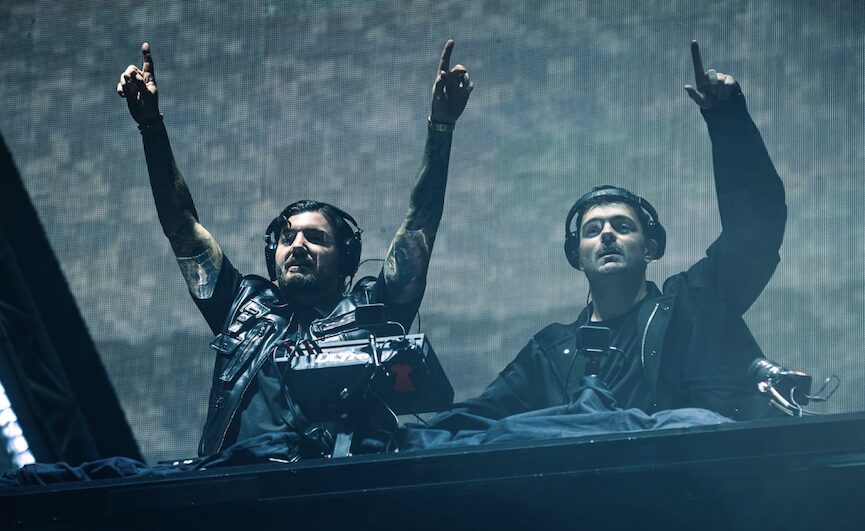
Ultra Music Festival was not always what it is today. Back in 1999, it was a single afternoon on Miami Beach — modest, local, still figuring out what it wanted to be.
Now it sprawls across three days at Bayfront Park, drawing crowds from nearly every corner of the globe. But the scale of it was not what stuck with me this year.
It was something harder to name — that feeling of moving through the grounds and noticing, almost by accident, how many entirely different worlds had found a way to exist inside the same weekend.
This year, that feeling was everywhere. Ultra still had the giant drops, oversized visuals and marquee names people expect, but the weekend felt bigger than spectacle. It felt like a crossroads.
Main stage EDM maximalism sat within walking distance of underground techno, bass chaos, internet-born experimentation and some of the strongest Latino representation the festival has seen in years. Bayfront Park became a place where global dance culture did not just perform itself, it mixed in real time.
That is what made the weekend feel like more than just another edition of Ultra. Right now, a lot of the world feels tense, divided and hard to read, and this festival somehow pushed back against that, if only for a few days.
Bayfront Park turned into a place where people from everywhere could lock into the same moment, move to the same set and feel some version of the same release. That kind of shared joy can sound a little dramatic on paper, but being there, it felt undeniable.
The programming had a lot to do with it. The Megastructure was delivering some of the sharpest techno of the weekend — precise, relentless, the kind of sets that pull you in and do not let go.
Walk ten minutes in any direction and the Worldwide Stage was swinging toward full-body bass, the kind you feel more than hear. Drift back toward the Main Stage and the mood shifted again entirely — big, open, built around moments people had been waiting months to experience together.
Three very different rooms, three very different feelings, all inside the same park. The boundaries between genres, crowds and moods kept bleeding into each other.
That was evident when it came to the Latino presence across the weekend, which felt impossible to ignore. Miami is one of the few cities where a global electronic festival can still sound local, and this year Ultra leaned into that more than usual.
BZRP’s debut on Friday did not feel like a side experiment or a novelty booking. It felt overdue. His set was one of the clearest examples all weekend of where electronic music and Latin popular music are meeting right now, and of how naturally that intersection belongs on a stage this big.
Ultra itself highlighted it as one of the weekend’s defining moments, noting that his Friday Main Stage debut featured surprise appearances from Skrillex and Daddy Yankee.
And honestly, that was exactly how it felt in the crowd. BZRP was easily the best set of my first day. He came in with this all-new visual identity, these huge tracks and this sense that the whole thing was designed to announce a new level.
The Daddy Yankee moment already would have been enough. Then mid-set he brings out Skrillex and the entire thing just erupts. It was one of those Ultra performances where you could feel the scale of the artist changing in real time.
In a city like Miami, with the kind of Latin American and international crowd Ultra pulls, it just made sense.
That thread kept showing up all weekend. Steve Aoki, who has always had an ear for Latin crossover, leaned into it again on Saturday. DJ Snake took things even further on Sunday when his Main Stage set turned into what honestly felt like a full-on Latino rave.
J Balvin came out. “Gasolina” dropped. The crowd lost its mind. Later that same night, John Summit brought out Feid and used the festival’s closing stretch to debut a new collaboration.
Ultra’s own post-festival recap also pointed to that momentum, noting appearances from J Balvin, Ryan Castro and Feid across the weekend.
That mattered. Not because festivals need to check a representation box, but because Ultra is a global festival hosted in Miami. This year, Miami actually sounded like Miami.
The range elsewhere across the lineup only made that feel stronger. One of the things Ultra still does better than most festivals at its scale is give people access to very different kinds of transcendence.
There was the emotional nostalgia hit of Alan Walker, which was one of my non-negotiables of the whole weekend. I got there day two just in time, and hearing “Faded” live finally felt like some weird little piece of younger me was getting released back into the air.
It was very real. It was very personal. And it reminded me that festivals are not just about new music or surprise guests. Sometimes they are about finally meeting a song where you needed it.
Then there was the full opposite end of the spectrum. On Saturday, Outlaw b2b Trym at Worldwide was absolute destruction in the best possible sense. Ultra’s official recap described it as an “unexpected mix of heavy sonics,” which is true, but being there it felt even less polite than that.
Those first 20 minutes were pure release. Hard, fast, punishing and deeply satisfying. It was one of those sets that completely reset your body. The kind where all you can really do is surrender to the pressure and let it rearrange your energy.
That same unpredictability showed up in a completely different way with ¥ØU$UK€ ¥UK1MAT$U. I had been wanting to see him ever since his Boiler Room set blew up, and he absolutely lived up to it.
The best part was never really knowing where he was about to go next. He would throw in pop bits, trap, strange transitions and combinations that really should not work on paper, but somehow, in his hands, they did.
He made the Worldwide Stage feel unstable in the best way. Not messy. Not random. Just truly free. Ultra’s recap pointed to him as part of the festival’s expanding global flavor, and that felt right.
He represented a different kind of dance music future, one less interested in clean genre lines than in what happens when you stop respecting them.Still, the emotional centerpiece of the weekend was Swedish House Mafia.
Ultra had already framed the Saturday closing takeover as a “festival within a festival,” with Eric Prydz joining the trio’s curated Main Stage event after a rare Steve Angello b2b Sebastian Ingrosso opening stretch.
That sounds huge on paper. In person, it felt even bigger. This was not just a headlining set. It felt like a gathering of lineage. Afrojack, Axwell and Prydz all orbiting the same closing moment gave the whole thing a kind of historical weight that very few festival sets can carry without collapsing under it.
And then there was the run of songs. “Don’t You Worry Child.” “Midnight City.” “Sweet Disposition.” “Wake Me Up.” Four tracks that somehow made the entire field feel suspended between different eras of dance music memory.
When the Avicii tribute hit, it stopped feeling like just a closing spectacle and started feeling like a reckoning with what this music has meant to so many people over time.
Ultra itself called it a “new chapter in dance music history.” That might sound grand, but honestly, from where I was standing, it did not feel exaggerated.
And then came John Summit, who had the hardest job of the weekend and somehow made it look easy.
Closing Ultra is not just a booking anymore. It is a test. It asks whether an artist can carry the emotional and physical weight of the entire weekend’s final release. And for me, Summit passed that test.
More than that, he made a serious case that he can wear that crown for a while. His set was not my single most shocking one of the weekend, but it may have been the most consistent. The energy never really dipped.
He knew exactly how to hold the field. He brought out Feid. He closed by jumping into the crowd and taking in the fireworks from inside the audience rather than above them. That gesture said a lot.
For all the discourse around him, there is still something very sincere about the way he approaches this whole thing. Love his music or not, he seems genuinely grateful to be in it.
That is part of why Ultra still works. It is still trying to evolve. One of the clearest examples of that this year was the RESISTANCE Cove, which became the first zero-emission, battery-powered stage at a major U.S. electronic music festival.
Ultra’s Mission: Home initiative says the battery setup at the Cove prevented nearly 19,000 pounds of carbon emissions from entering the atmosphere, the equivalent of an average car driving more than 22,000 miles.
That kind of detail matters because a festival of this scale should not only be asking how to get bigger. It should also be asking how to get smarter.
Ultra closed things out with some numbers worth noting — 165,000 attendees, 100 countries represented, a sold-out run, and Miami-Dade County officially putting March 28 on the books as Ultra Music Festival Day.
Milestones like that are easy to rattle off in a press release. What they cannot tell you is whether the weekend behind them actually had a pulse. This one did.
What I kept coming back to had nothing to do with crowd size or production scale or who showed up unannounced. It was something quieter than that — the sense that Ultra, for one weekend, managed to hold a genuinely mixed room without sanding everything down to the same thing.
EDM maximalists and techno heads. Bass freaks and Latin music fans. People chasing nostalgia and people who had never been to anything like this before. First-timers who came for one artist and left with a list of five more.
Getting all of those people to coexist inside the same festival, without any of them feeling like an afterthought, is not easy. This year, it worked. Ultra did it anyway.
And in a moment when so much of life feels fragmented, there was something genuinely meaningful about that. Not because festivals solve anything. They do not. But because for three days in Bayfront Park, a lot of different worlds moved together and that still counts for something.