


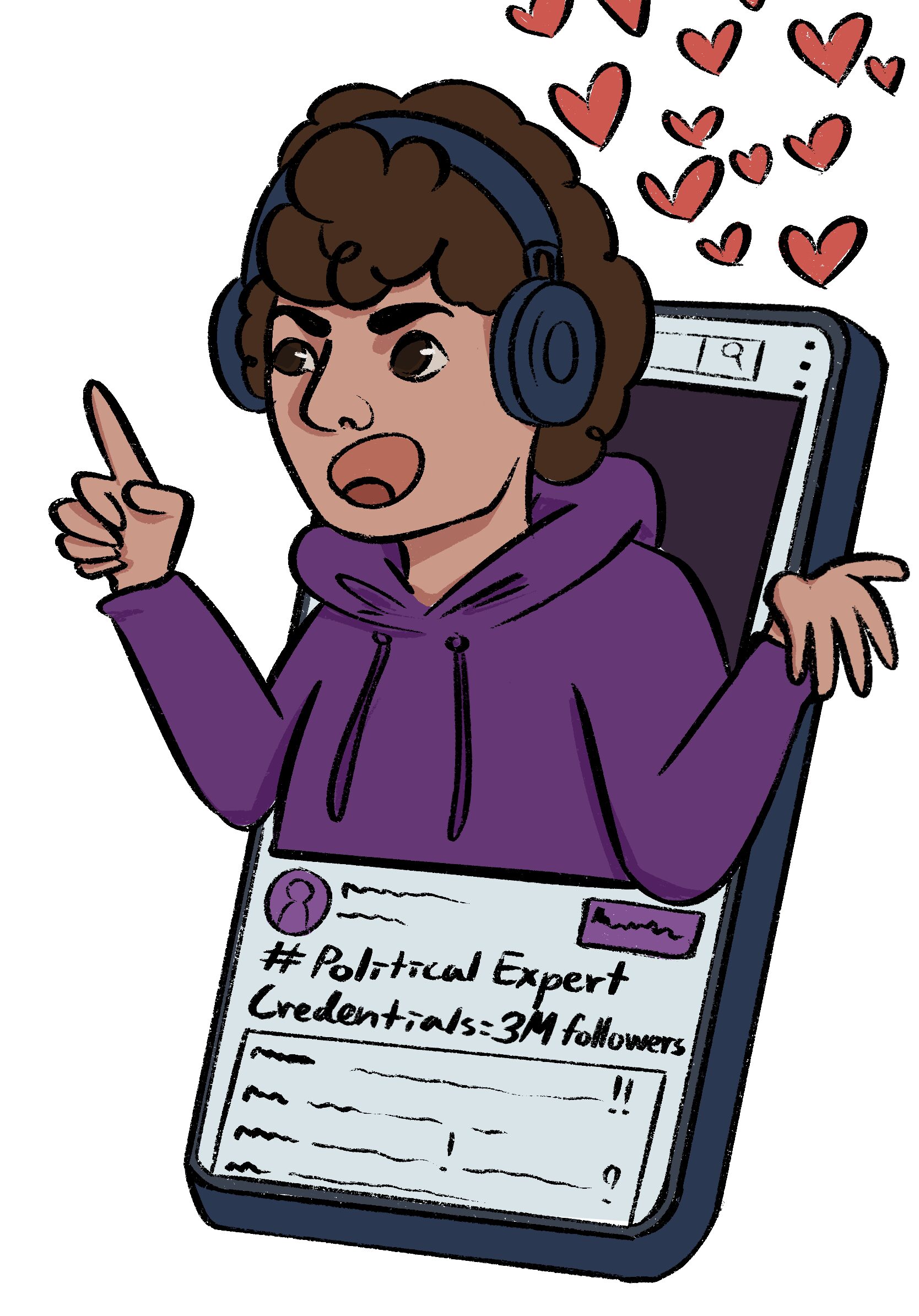
More and more young people are turning to internet live streamers for guidance on their political beliefs. In an era where information is just a click away, these creators are often seen as charismatic, funny and relatable, making them more appealing than traditional sources of media for younger generations.
For many younger viewers, watching a livestream feels like hanging out with a friend. But, while streamers may be entertaining, we shouldn’t let them shape our political beliefs.
The problem isn’t that these streamers are talking about politics, it’s that a lot of their information is often inaccurate. Viewers often accept everything their favorite content creator says as true instead of checking the facts themselves, which can promote the spreading of false information.
The main goal of internet personalities is to entertain their viewers. Content creators are incentivized to maximize their engagement and subscriptions because these metrics directly increase their income.
This dynamic means that streamers act overly dramatic in order to maximize their potential earnings. Online commentators like Hasan Piker and Nick Fuentes are purposefully controversial in order to get the most views for their content.
Peaceful, fact based discussions of policy and legislation are considered boring and don’t attract clicks, but hot takes and heated debates do. As a result, many extremely complicated topics are dumbed down to simple soundbites that are designed to keep audiences watching — hence putting more money into the streamer’s pocket — rather than actually informing viewers.
Another big issue is the lack of credibility and accountability these streamers have. Most streamers are not journalists, political scientists or policy experts. The majority of these internet personalities don’t have the credentials necessary to be an expert in the field.
Unlike actual media organizations, streamers are not held to any of the standards that a traditional journalist is.
When misinformation is broadcasted on a livestream, it can reach thousands of people who might simply accept it as fact because it came from a person that they trust. Entertainment platforms such as Youtube and Twitch were originally built to entertain, but not for viewers to treat everything they hear as fact.
Digital vloggers also contribute to the issue of echo chambers. As Joseph Udinski, professor of political science at the University of Miami puts it, “If someone is in an echo chamber, it’s because they choose to be there.”
Audiences gravitate towards people who have similar views as themselves. Instead of having meaningful debates with the other side, streamers often double down on the beliefs that their audiences already hold in an effort to not lose viewers — and the revenue that comes with them.
“Online political discourse is driven by tech platforms like Meta and Google, which profit from engagement,” said Parker Osth, a member of the Debate Team at University of Miami. “Their platforms amplify fear, anger and groupthink because it keeps the users clicking.”
This sort of reinforcement discourages critical thinking and limits people’s exposure to other diverse opinions. Politics becomes less about understanding why people believe in what they believe and more about cheering for one side like a sports team.
To be fair, many of these live streamers are accessible to the vast majority of people. These commentators are able to break down hard-to-digest political information into a few soundbites.
Internet personalities help people living in news deserts get information that might not otherwise be available in their area.
While accessibility is crucial for engaging a broad audience, accessibility without any facts or reason is not. Making politics entertaining should not come at the expense of facts or knowledge.
Policy-making decisions have a lasting impact on our society as a whole. The way we vote and view the world shapes the future of our communities and country. Online personalities may provide commentary on politics, but commentary cannot replace being educated with facts.
Political discourse deserves careful attention and informed engagement. If we want a healthier culture of politics in our country, we have to be intentional about where we get our information from. Entertainment should complement our understanding, not replace it.