


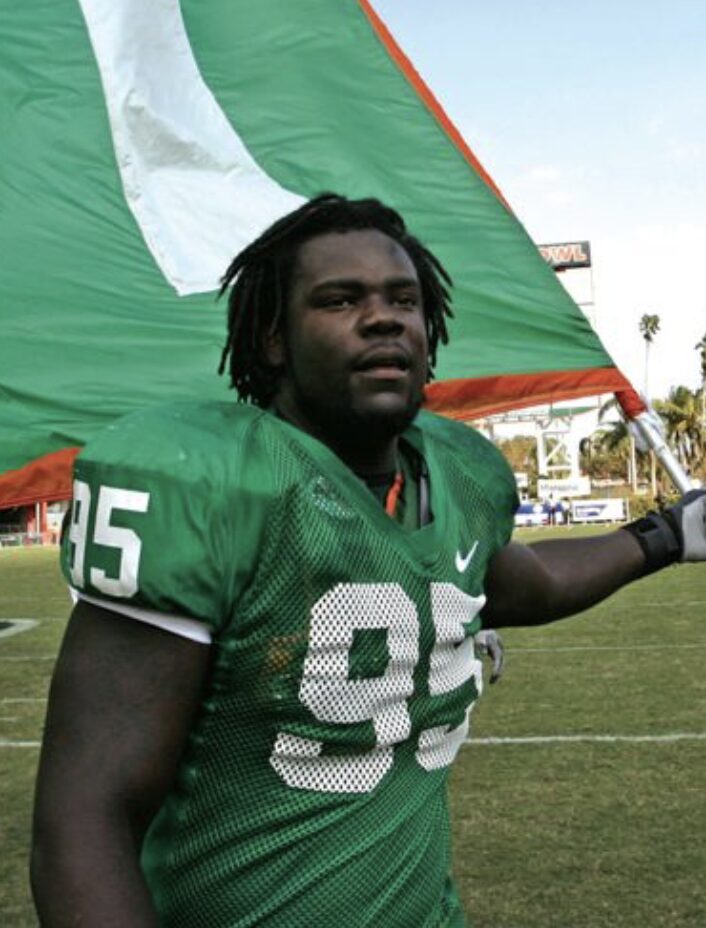
Bryan Pata bought a beige suit months before he was projected to enter the NFL Draft.
An expected mid-round pick who was named to the Ted Hendricks Award Watchlist, an award given to the nation’s top defensive end, Pata was the Miami Hurricanes starting edge rusher during the 2006 season.
Despite all his draft promise, he never had the opportunity to wear that suit to Radio City Music Hall for the NFL Draft.
Instead, Pata was buried in that suit at a cemetery in Kendall after being murdered on Nov. 6, 2006.
Pata was shot outside his off-campus Kendall apartment following a football practice, but with no camera surveillance footage, investigators were forced to rely on eyewitness accounts.
The murder case remained unsolved for 15 years, with multiple leads going cold.
That was until 2021, when Miami-Dade police arrested Rashaun Jones, Pata’s former UM teammate, on a second-degree murder charge. Jones’ trial began last week and is currently ongoing.
Pata’s story serves as a reminder on how the community can rally together behind the loss of a promising athlete.
While most collegiate athletes have the internal belief they will “make it to the league,” only 1.6% of NCAA football student-athletes ever make it to the professional level.
These statistics make the loss of young men like Pata even more saddening — one of the few with a true expectation of taking that next step in his career.
Family members and teammates were left wondering “what could’ve been” for Pata, who was taken away just before the final step of achieving his dreams.
A step that could have changed the lives of his family for generations.
Amid the heartache and frustration of losing a loved one, something beautiful arises — a motivation that rallies both a fanbase and young group of student-athletes.
In the immediate aftermath of Pata’s death, the entire UM community came together to honor him, inspired by his name.
“I’m going to play the beautiful game of football for myself and for Bryan,” teammate Dave Howell said at a memorial for Pata in 2006.
Pata should have been with them, alongside them in his final collegiate season, but that opportunity was taken from him — something his teammates recognized and took to heart.
And it wasn’t a fleeting moment of unity either. Teammates still carried his legacy every step they took in their professional careers.
“What’s up my boy almost there man, we did it … almost there; this is tough without you man but this weekend (NFL Draft) is what we wanted all our lives,” former teammate Tavares Gooden posted to Pata’s social media profile in 2008. “I know you are still with me every time I take the field.”
Pata’s story isn’t a tragedy limited to UM, but one that continually gets repeated across the country — draftable talent being taken before they can change the lives of their families forever.
The late Kyren Lacy, an LSU receiver who tallied 866 yards and nine touchdowns during his final season for the Tigers, tragically took his own life in 2025 while set to face a grand jury for negligent homicide. Like Pata, Lacy was projected to be a mid-round pick.
Even though both deaths took place nearly two decades apart, the support behind each was the same in their respective communities.
One of the main voices supporting Lacy was Miami Hurricanes receiver CJ Daniels, Lacy’s teammate at LSU in 2024. Daniels carried his legacy each game with his “LLK2” eye black he wore across the season, standing for “Long live K2.” Lacy’s collegiate number was two.
“All you wanted to do was get to the league to take care of the [family], and you were so close,” Daniels wrote in an instagram post honoring Lacy ahead of the 2025 season. “I will carry your legacy 2, and finish what we started.”
Daniels himself is preparing for that next step, invited to the NFL combine with the opportunity to be drafted come this April.
And when one looks at these tragic losses, the word “we” rings loudly from the communities they were a part of. Their loss devastated their community, but also sparked a rally behind their name.
Their stories extend beyond the game, reminding onlookers how humanity is at the core of sport.
It’s not the actions on the field that captivate billions across the world, it’s the emotional aspect players have in doing so — the raw feelings sport brings out both on the field and off it.
Pata won’t be forgotten, not because of the case itself, but because his legacy was carried by his teammates and the community he took the field for every week.