


“The city of Miami is so expensive that a minimum wage doesn’t cut it,” said Alana Ramos, a sophomore at the University of Miami who earns $15 an hour from an on-campus job.
Florida’s minimum wage reached $15 per hour this fall, but the rising costs of gas, groceries and rent raise the question of if it is covering the cost of living in South Florida.
History of Florida’s minimum wage
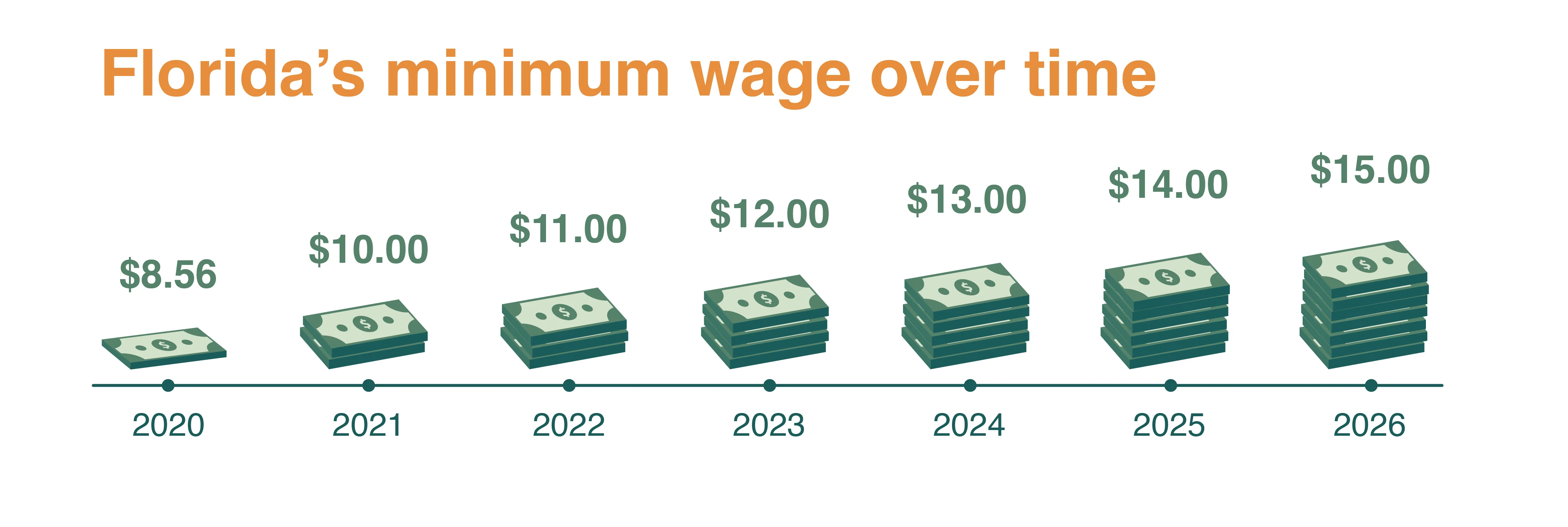
Florida voters approved a constitutional amendment in 2020 to increase minimum wage. The amendment set an annual $1 increase beginning in 2021 until the minimum wage reached $15 an hour in 2026.
Before the increases began, the Sunshine State’s minimum wage was $8.56 an hour.
Now, the state will adjust the minimum wage based on inflation rather than by $1 annually. The state will calculate the adjustment annually on Sept. 30 using the Consumer Price Index for Urban Wage Earners and Clerical Workers.
Average expenses in Miami-Dade
Although the minimum wage has increased by 50% since 2021, it still barely covers basic expenses in Miami-Dade County.
A full-time worker earning Florida’s minimum wage makes $31,200 a year before taxes, assuming 40 hours of work per week for 52 weeks. That is 1.9% less than the $31,812 annual cost of renting an average one-bedroom apartment in Miami, according to Zillow’s October 2026 rental data.
“The rising cost of living is definitely surpassing the rate of wage increases and undermining what Floridians — including members of organizations like the Miami Workers Center — fought so hard for by voting for $15 per hour in 2020,” said Lizzie Suarez-Smith, the communications director at the Miami Workers Center.
Beyond housing, a single adult in Miami-Dade County is estimated to spend about $400 a month on food, according to MIT’s Living Wage Calculator. That adds up to about $4,800 a year.
Transportation is another significant expense for Miami-Dade workers. MIT estimates that a single adult spends about $616 a month on transportation. For residents who rely on public transit, a regular monthly Miami-Dade Transit pass costs $112.50, according to the county’s transit fare information.
United Way Miami’s 2026 ALICE report found that 56% of Miami-Dade households live in poverty or earn less than what is needed to afford basic necessities.
Ramos said her parents pay for her dorm at UM, letting her use her salary to cover other expenses.
“As a college student, it’s hard to really see the drastic changes in my spending,” Ramos said. “I will say [having my parent’s support] helped me be able to pay my credit card quicker and overall be able to afford things that I may not necessarily need.”
Ramos said that if she had to pay for rent herself, earning $15 an hour would not be enough to cover the cost of living in Miami.
Politician’s approaches
Jose Antonio Stoute, a UM alumnus and Democratic candidate for Florida Senate District 40, said the cost of living is a major concern for South Florida residents.
“We definitely need to do more to bridge that gap and to incentivize businesses to pay more than the minimum wage to their workers so that they can make a living,” he said.
The issues extend beyond raising wages and protecting tenants. For Suarez-Smith, it is about how elected officials prioritize their communities’ needs. She believes it influences lawmakers’ decisions, potentially leaving their constituents without the support they need.
Although Florida’s minimum wage has increased to $15 an hour, the raise alone may not be enough for workers to support themselves in Miami-Dade County.
As housing, groceries, transportation and other necessities continue to take up a large share of household budgets, earning the minimum wage does not necessarily mean earning enough to live on.