


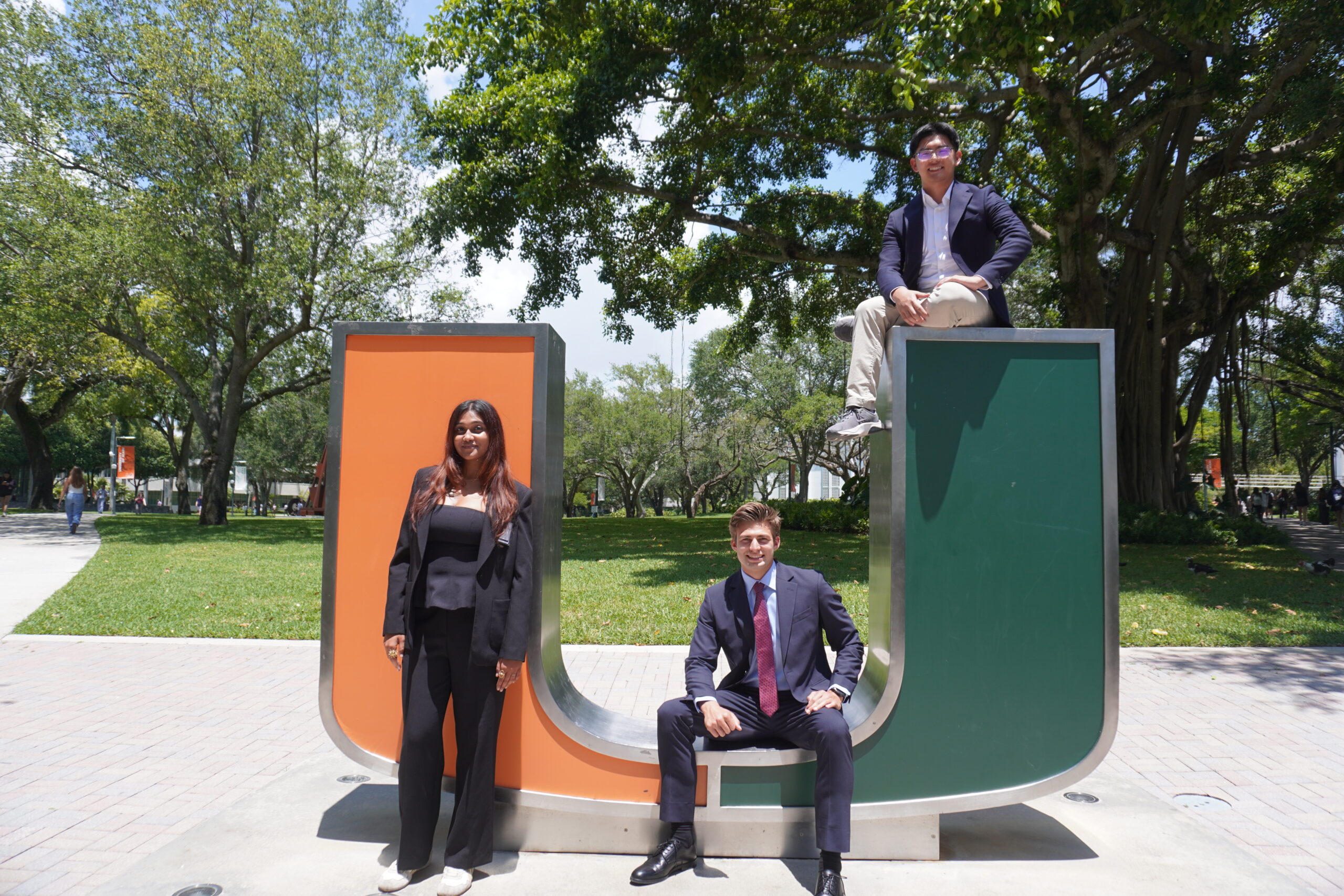
Three graduating seniors in the Rosenstiel School of Marine, Atmospheric and Earth Science analyzed a new way to measure coral growth and decay without setting foot in the water.
The passion for the one-year-long project began when Jakob Brown, Isaiah Wang and Nayonika Choudhury were presented with data and tasked with analyzing a new method of coral quantification.
Brown and Choudhury are majoring in marine affairs and Wang is majoring in marine science and computer science, making this type of work very important to them.
The two goals of the study were to monitor how the coral was changing and to figure out if the method was reasonable.
“Science is slow and all results are good results. At this point, we’re not looking for good results or bad results, we’re looking for a result of whether this method is viable,” said Choudhury.
Over the past year, the team has been analyzing data collected by drones equipped with Fluid Lensing technology — which enables us to see objects beneath the water that wouldn’t otherwise be visible.
The study took place at the Piti Bomb Holes Marine Preserve, which is located in a popular snorkeling spot in Piti Bay, Guam. The area is known for its natural, coral-filled holes that stretch several dozen feet deep and resemble bomb craters.
The images of the reef site in Guam were captured every 10-15 days by the Micronesian Area Geospatial Information Center, a lab partnered with NASA. UM’s ACES lab trains scientists to deploy these drones for research.
Brown, Wang and Choudhury took these images and analyzed them with a variety of tools designed specifically for coral.
One tool used for the study is the PICOGRAM, an AI-based image analysis software that processes drone images at the exact pixels that the coral corresponds to.
This way, the team can measure how the surface area of the corals are changing.
Not only is the project the first-ever long-term Fluid Lensing campaign, but it’s also one of the first-ever centimeter-scale coral quantifications using remote sensing.
“To me, this project highlighted the rapid pace of scientific and technological advancement. We demonstrate how emerging tools can already enhance the way we study coral ecosystems, with even greater potential as these methods continue to evolve and improve,” said Wang.
Although this exact technology is patented by NASA and the ACES lab, they hope to partner with labs all over the world to continue this research with coral reefs.
“The scalability of these new methods has global implications – helping us better understand the effects of climate change,” said Brown.
After graduation, all three students plan to continue their education.
Brown will be pursuing a masters of environment and international affairs at Georgetown. Choudhury is staying at RSMAS to earn her masters of climate and society through the professional science program. Wang is entering a PhD program for ocean engineering at the University of Rhode Island.
They express the necessity to continue this kind of work.
“We want results back quicker because in the face of anthropogenic climate change, we’re running out of time for sustainable solutions,” said Choudhury.
The three presented at the Research, Creativity, and Innovation Forum Symposium on Monday, April 27, to report their findings and further publicize their study.