


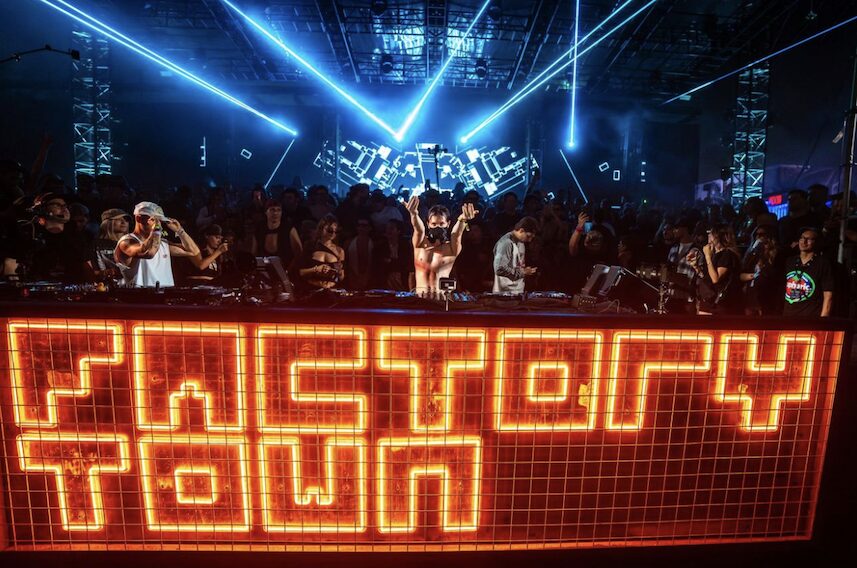
The best way to describe Factory Town during Miami Music Week is that you cannot do it all.
You stand in one room listening to some of the best music of your life, dancing the night away, and yet somewhere two stages over another set is peaking without you. You feel it in the back of your mind the entire time.
Not as regret exactly, but as pressure — the good kind. The kind that tells you the programming is working. Over five nights from March 25 through March 29, Factory Town was the gravitational center of Miami Music Week. It’s a place so stacked, so spacious, and so constantly alive that it made missing out feel like part of the experience.
For me, the week really did begin and end there. I did all five days at Factory Town, which meant my sleep schedule eventually stopped making any real sense. My entire week started revolving around how and when I could make it back to town and stay there until the early morning. I basically became nocturnal.
And once you are inside, that starts to feel normal. Time behaves differently there. One quick stop at the Chain Room turns into an hour. A plan to catch only half a set in Infinity Room becomes a full sunrise mission. You leave one stage with the intention of going somewhere specific and get swallowed by something else entirely.
Factory Town has a way of compressing time because there is always one more room, one more sound pulling you, one more reason to stay.
That is what made this year’s programming so strong. The lineup did not feel top-heavy or easy to game out in advance. It felt balanced in a way that made every decision feel costly. And that is a compliment.
There were epic sets happening all over the venue every night, and the range across the five-day run was as wide as I have seen at Factory Town yet. Minimal and tech house were obviously there in force, but so were acid house, drum and bass, hard techno, melodic crossover moments and stranger, more difficult sounds that still found a crowd.
You knew the curation was good because even while you were having a transcendent time, you were still hearing from everyone around you about what you had missed. That is not bad scheduling. That is abundance.
Factory Town’s physical design is what allows that abundance to actually work. Five stages is one thing on paper, but five stages with enough room to breathe, walk, reset and re-enter is something else entirely.
No other venue in Miami really offers that combination at this scale. You can spend a whole night in one room or drift between multiple worlds without ever feeling trapped inside one traffic pattern.
The art installations in the middle of the grounds help with that too, giving the venue real pockets of pause between intensity. Then there was the open-deck section at the Engine Shed, which added one of the week’s more genuine little surprises.
It had that improvised intimate energy where people could step up with their usb and shape the atmosphere themselves. The result was messy in the best way — immediate, unpredictable, human. The kind of connection that could only really happen in the heat of the moment.
Production stepped up again this year too, but what mattered most was how different each space felt from night to night. Factory Town was not static across the week. It kept changing identities.
The Infinity Room featured those wire-like illuminated cables wrapping around the main posts on the dance floor, which made the room feel like it was constantly pulsing from the inside. Chain Room had upgraded lighting and new CO2 cannons that gave the space a sharper, more aggressive edge.
The Park featured a massive cube suspended in the middle of the ceiling that kept lighting up into a rotating F and T, branding the entire room without feeling tacky.
The Warehouse had new lights stretching across the posts and overhead, creating tunnel-like patterns that made the room feel colder, more industrial and somehow even larger than before.
Some of the best transformations came through the label and brand takeovers. Planet X made its room feel like a fully formed environment, with a stage that looked like a flying saucer dropped into the middle of the party.
At Infinity Room, elrow closed the final night by bringing a carnival of confetti, dancers and pure overstimulation. Even the rain made sense there. It did not ruin the illusion. It intensified it.
The crowd was part of the architecture too. Factory Town during Music Week felt like one of the clearest examples of how dance music collapses social boundaries when it is working at its best.
There were locals, travelers, veterans, younger ravers, people in full fashion-week mode and people dressed like they had wandered in from a warehouse in another decade. There was visible international crossover everywhere.
You could hear different languages around you all night. There were older ravers still moving like they knew exactly what the room demanded.
There were younger crowds chasing their first real sunrise. That mix mattered. Factory Town did not feel like one scene occupying a venue. It felt like multiple scenes agreeing to share the same week.
That showed up most clearly in the sets themselves. Justice’s Factory Town debut carried the kind of prestige that automatically made it feel like an event before a single note played.
Seeing them take over the Infinity Room gave the venue a certain legitimacy that only a few acts can bring. It was not just one of the week’s biggest bookings. It was one of those performances that shifts the perceived ceiling of what a venue can hold.
Josh Baker, b2b Prospa and b2b Kettama felt a generational pulse of the week. Three artists with different energies converging at sunrise with loose, modern and chaotic energy. A great sunrise set can reorder your body.
They dropped a mix of “Sweet Disposition” as the sun came over the horizon. It was one of the best ways I have ever watched the sun come up. It just felt alive.
Then there was Ben Sterling, b2b Beltran and b2b Tiga at The Park during Planet X, which brought a totally different kind of satisfaction. The set was groovy in a way that felt effortless, the kind of dancefloor energy that does not need to overpower you to keep you locked in.
At one point they dropped a mix of “Heads Will Roll” that instantly changed the room and got the crowd really bumping. After so much running around between stages all week, that set felt like a reminder of how good it can be when a room finds its groove and just stays there.
“I HATE MODELS” brought one of the week’s most intense sets, but what made it work was that he did not just go hard for the sake of going hard. There were stretches where he eased the room in just enough before completely flipping the energy on its head.
That contrast is what kept the set unpredictable and alive. He’ll pull from places you do not expect — like dropping “Paleta” into the mix — and somehow make it all feel coherent. It was a reminder that the harsher side of Factory Town’s programming works best when it still leaves room for surprise.
Max Styler and b2b CamelPhat delivered a different kind of emotion. If any set belongs as the final image of the week, it is that one. By then it was pouring rain at Factory Town and people were still out there dancing all the way through it, not caring at all about wet socks.
This set reminds you how beautiful humanity can be when we let go together. This one had that feeling. That is maybe the simplest way to say what Factory Town did over those five days.
It made every path through it feel both complete and incomplete at the same time. You could have a perfect night there and still know you left something extraordinary unseen. But that was never a flaw.
That was the whole design. Factory Town succeeded because it gave everyone a different Music Week experience. By the end of the week, that was the real takeaway. Factory Town did not just host five nights of music. It distorted time, demanded choices and turned abundance into atmosphere.