


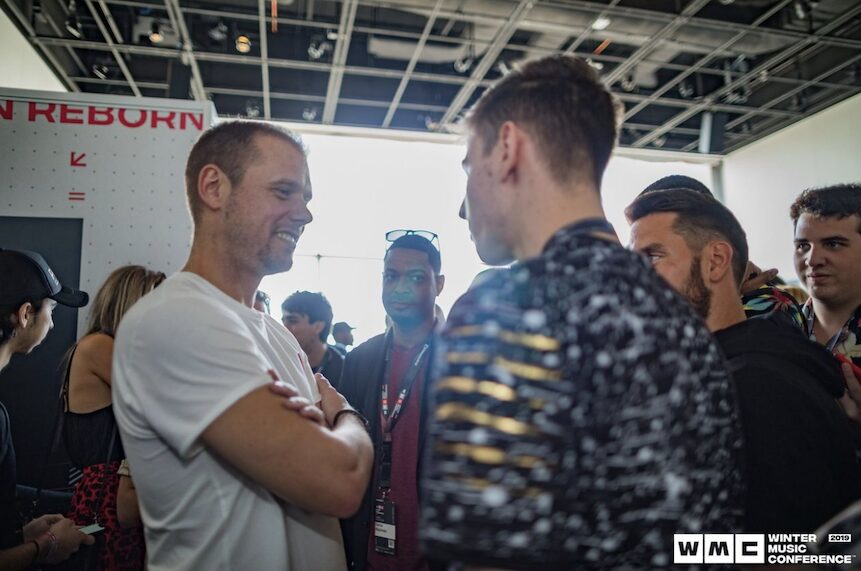
In its earliest years, the Miami Music Week wasn’t about massive crowds or viral moments—it was about business. But long before the citywide marathon of parties defined the week, there was a single event that brought the global dance music industry together in one place: Winter Music Conference.
DJs, label executives, radio programmers and journalists traveled to Miami not just to celebrate the culture, but to shape it.
“WMC in the beginning was all business, and the parties were really label showcases attended mostly by industry, press, artists, radio, etc.,” said conference director David Ireland.
Over time, however, the culture around electronic music exploded beyond the conference walls. As festivals grew and global fan culture took over, Miami Music Week expanded into a decentralized network of events stretching across the city.
Promoters began throwing larger fan-driven parties, and the industry slowly dispersed across dozens of showcases and activations. In that transformation, the conference that once anchored the entire week gradually faded from the center of the conversation.
Ireland has watched that evolution unfold firsthand. With more than three decades in music media and marketing — including helping relaunch WMC under Ultra Music Festival — he has seen electronic music shift from underground subculture to global industry.
His return to lead Winter Music Conference’s current chapter reflects an effort to reconnect the event with its original purpose.
But rebuilding the conference isn’t a solo effort. Much of the operational backbone behind WMC 2026 comes from Nick Morgan, CEO of the international event production collective We Group.
This year’s edition introduces pool parties at the Kimpton EPIC Hotel, adding a new experiential element for attendees—but also a logistical puzzle.
“We’ve added pool parties on premise which brings its own unique challenges such as permitting and rigging 16 floors up from the lobby,” Morgan said. The reward, he added, is worth it: attendees will experience events overlooking the Miami River and downtown skyline.
Despite logistical pressures, the conference’s leadership sees 2026 as an opportunity to redefine what Winter Music Conference can offer the electronic music ecosystem.
One of the key ideas shaping this year’s programming is accessibility across different levels of the industry. Ireland describes the conference as operating on a “two-track program”—one aimed at creators looking to build careers in electronic music, and another focused on professionals already working within the business.
For example, the conference is introducing a new A&R Pop-Up Lounge designed to give emerging artists and producers direct access to representatives from labels like Experts Only and Ultra Records.
For established professionals, panels and discussions tackle some of the most pressing topics shaping the industry today, including artificial intelligence, audience fragmentation, marketing strategies and data management.
“We always try to take the industry’s temperature and see what’s starting to bubble up,” Ireland said.
The goal is to ensure that attendees leave the conference not just with ideas, but with practical insights they can apply immediately.
The physical environment of the conference also plays an important role in shaping these conversations. Rather than spreading programming across disconnected venues or taking a digital approach, organizers have emphasized creating a central hub where networking, panels and social experiences intersect.
“For me it’s really important that the hub truly feels like the hub,” Morgan said. “People are staying at the hotel, interacting in common areas, attending sessions, and this year we’ve added pool parties as well—meaning there is something happening throughout the venue during the entire event.”
The setting itself is also part of the point. Instead of scattering programming across different venues or relying too heavily on digital access, organizers have focused on building one central hub where panels, networking and social events all happen in the same orbit.
Looking ahead, Ireland said the conference’s future depends on growing carefully without losing what makes it work in the first place.
Organizers are already thinking through a longer-term plan with the city of Miami, with the goal of expanding in a way that still keeps the event centered, manageable and true to its atmosphere.
“If you grow too much and spread everything out, you lose the magic,” Ireland said.
For him, the benchmark of success remains simple.
“If you don’t leave WMC inspired and more up to speed on things in our industry,” Ireland said, “then we are not doing our job.”
As Miami Music Week gets bigger, louder and more spread out across the city, Winter Music Conference is trying to hold onto something a little more grounded.
It still wants to be the place where artists, executives and newcomers can actually sit down, talk, exchange ideas and think about where electronic music is heading before all of it plays out onstage later that week.
This year’s conference runs March 24–26 at the Kimpton EPIC Hotel in Downtown Miami. More information on badges, programming and events is available on the official WMC website.
With its move downtown and a broader mix of sessions and networking opportunities, the conference is positioning itself once again as a meeting point in the middle of Miami Music Week’s usual chaos.