

Nobody talks about the awkward position you find yourself in when you study abroad.
I landed in Italy without a clear role to inhabit, no persona to slip into. I wasn’t an American tourist; I was living here for four months, but I was far from a local. I found myself suspended in an uneasy middle ground: a temporary local, with no rulebook to follow.
But what does it mean to be a temporary local, as opposed to an American tourist? Mostly, it feels like being a fraud.
I am constantly trying to assimilate, knowing that no matter how hard I try, I will always be seen as an American — an outsider.
I have no issue being the tacky American tourist when I travel elsewhere — snapping shameless selfies in front of landmarks, waiting in lines for over-hyped, Instagram-famous restaurants, fumbling through public transit, wasting money on souvenirs. That role is easy.
But in Italy, I feel incapable of taking it on. I feel less like I’m discovering a city and more like I’m lost inside it.
This is partly because connecting with the people around me is difficult. Because I can’t carry a sentence in Italian, my inability to communicate signals that I am here temporarily, not a true resident of Rome.
I feel embarrassed speaking English, even though most people accommodate me. I notice the subtle shift that happens when they realize I am American, the slight change in tone, like the way we switch between talking to an adult and to a toddler. When they turn to their coworkers, I can’t help but assume they’re talking about me.
Most of the time, I feel paranoid, disconnected and slightly out of place, because simply living in Italy doesn’t make me Italian. That takes years of work: learning the language well enough to think in it, absorbing cultural traditions and social norms, adjusting to different values and rhythms of daily life. It means adapting and sometimes sacrificing parts of yourself in the process.
Some of what you leave behind seems insignificant: oversized iced coffees, athleisure as a daily uniform, drive-thrus, the freedom of driving, and a fast-paced lifestyle — but those habits are tied to identity. Choosing to live as a temporary local rather than a tourist requires sacrifice. It asks you to be changed by the place, not just pass through it.
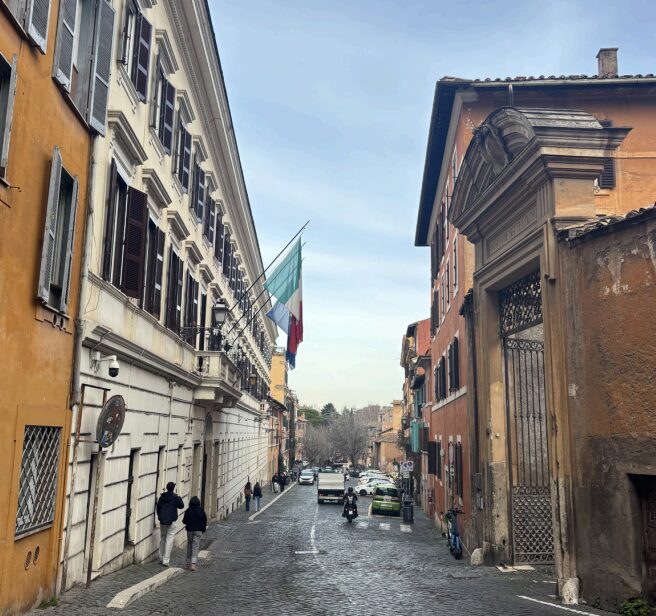
The place itself makes the role even harder. As a temporary local, you don’t stay in tourist districts; you live in neighborhoods shaped by long-time residents, where assimilation feels both necessary and impossible. In Trastevere, where I now live, Americans aren’t expected, making my presence feel intrusive, like I’m living in a space not meant for me.
In grocery stores, I wander aimlessly, too embarrassed to pull out my translation app and scan labels. I toss random items into my cart, hoping it’s yogurt and not porridge. I walk past cafes and delis, too afraid to go inside because I don’t know how to order, and go hungry instead. I can’t even walk more than a mile in my new hometown without pulling out my Google Maps.
And when I walk down the street, I’m met with shameless stares, as if my American-ness is visible from a mile away, infesting their streets. No matter what I wear, somehow the true locals always seem to catch it. No trench coat can conceal my blonde hair, an unmistakable signal that I am a “foreigner.”
In the role of the temporary local, you can’t fully embrace your own comforts and traditions, yet you also feel incapable of fully immersing yourself in theirs. It’s an impossible in-between — one that leaves you never completely at home. Just temporary.
But, nonetheless, I’m still trying to figure out how to exist in this space.
For now, that looks like slowly learning the language and trying to apply it, even if only for a sentence or two, and building the confidence to walk into a local pastry shop or deli. But also letting myself speak English without embarrassment in a room full of Italians, and dressing like an Italian without erasing my own individuality.
Navigating this uncertain identity takes balance, patience and a lot of discomfort. I can’t say I’ve figured it out yet, but to the study abroad students who feel like they’ve been dropped into a country that doesn’t quite want them, you aren’t alone. And, who knows? By the end of this experience, I may learn to accept this role. Or maybe I’ll leave with an entirely new identity I’ve made for myself.