


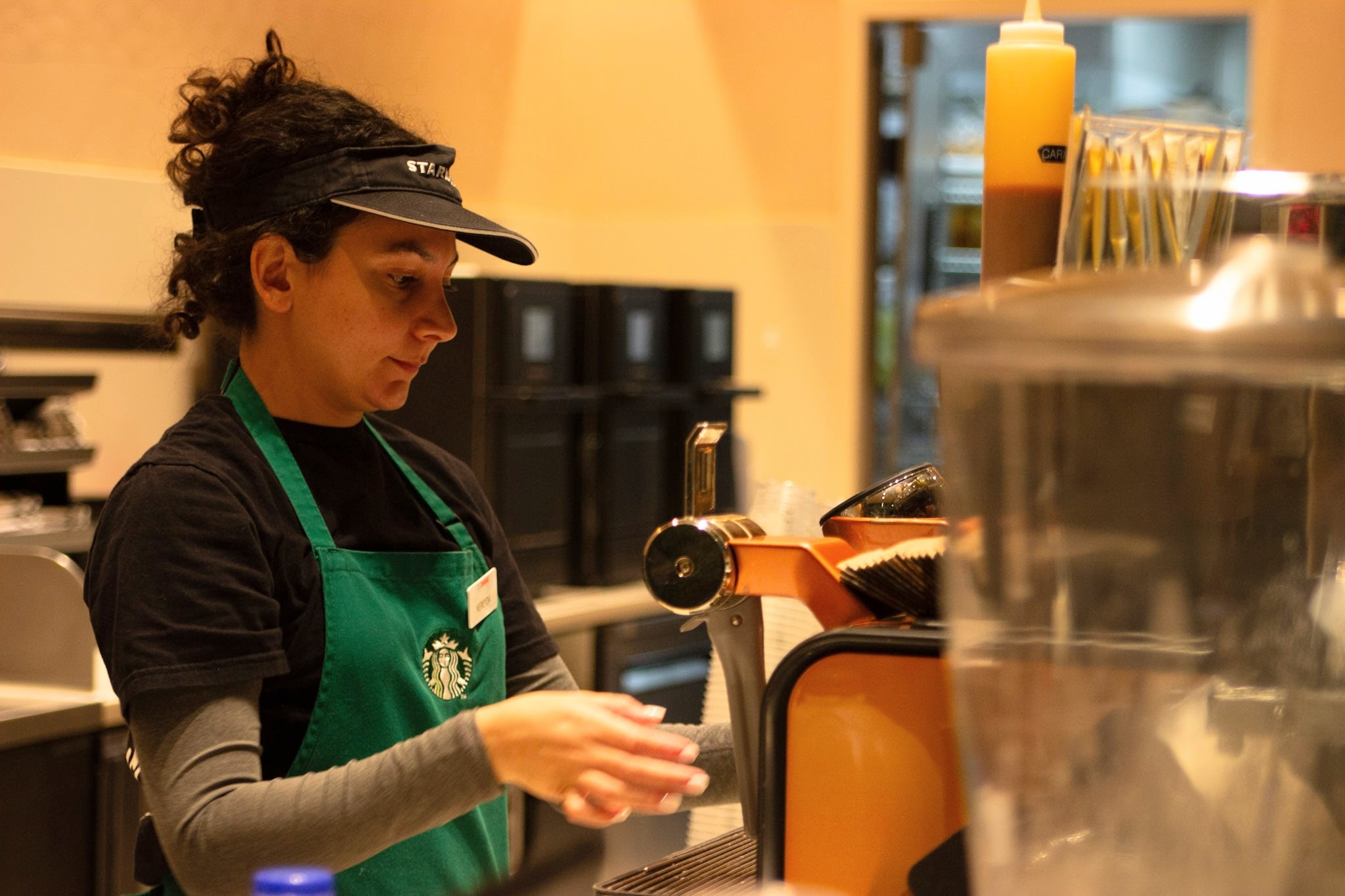
“Grande matcha latte with two pumps, scratch that, one pump of syrup … And would you like it iced or hot? … Have a good one. Next.”
And so the script repeats.
This is a typical day for Nereyda Gonzalez, a Starbucks barista at the University of Miami, who started working there two months ago.
Some students pick up their mobile order between classes, some cozy up to study and others fuel themselves with caffeine for their days ahead.
Visiting Starbucks is a part of many students’ and faculties’ days, but not many think about the lives of the baristas making their drinks behind the counter.
According to Gonzalez, the rush peaks between noon and 1 p.m. Lunch time, gaps between classes and midday pick-me-ups hit all at once, filling the campus Starbucks to the brim.
“Depending on how busy it is, we’ll often have a large group of people waiting on both mobile and café [in-person] orders at the same time,” she shares.
As names are called, customers weave through the crowd toward the counter, shrinking the space behind it. The room feels 10 times smaller to Gonzalez when there’s dozens of people huddled around the counter.
It can quickly get crowded for the customers, and it’s not any calmer on the other side for the baristas.
Gonzalez finds the store’s system helpful at times when things are at their busiest.
Chris Mendez, a former Starbucks employee of two years who worked at the UM location, recalls how the system of the on campus location helps baristas make products fast during rushes.
“If we have five or six people, there’s one person [at each product station], and then you both know what you’re doing,” Mendez said. “That way, you’re not worried about the crowd. You’re just making the drinks.”
Although a customer base of mostly rushing-students seems more stressful, Gonzalez and Mendez believe it’s the better option. Before transferring to the UM campus Starbucks, Mendez worked at a mall location.
“It was terrible. [The customers] don’t care.” Mendez said.
Mendez thinks UM customers have more respect for their baristas than her clientele at the mall.
“I think that it has to do a lot with the diversity on campus,” Gonzalez said. “There’s a lot of different ethnicities, countries and things of that nature.”
Mendez also notes that UM’s Starbucks being licensed rather than a part of corporate makes all the difference in the way the stores operate. Although his previous job at the mall’s corporate Starbucks came with more benefits, UM’s has a better work-atmosphere.
“I think that you have to learn the customer because depending on how they’re speaking to you, you’ll know how to respond to them,” Gonzalez said. “Just try to be adaptable.”
Like any job, being a Starbucks barista comes with its stressors. That’s why Mendez adapts a lighter outlook on life: to not let things get under his skin.
At the end of the day, Gonzalez appreciates her job. Day-to-day aspects like “being asked to surprise someone with a drink because they don’t know what to order, or knowing exactly what a regular is going to get before they even say it,” put a smile on her face.
In the long-run, it’s “the sense of familiarity and getting to know [her] regular customers” that make it all worth it.
“Over time, we build relationships that go beyond just barista and customer. It creates a really welcoming and connected environment,” she says with gratitude.