


The University of Miami is experiencing a growing social media presence, and according to a survey conducted by The Miami Hurricane, students have started calling UM the “influencer school.”
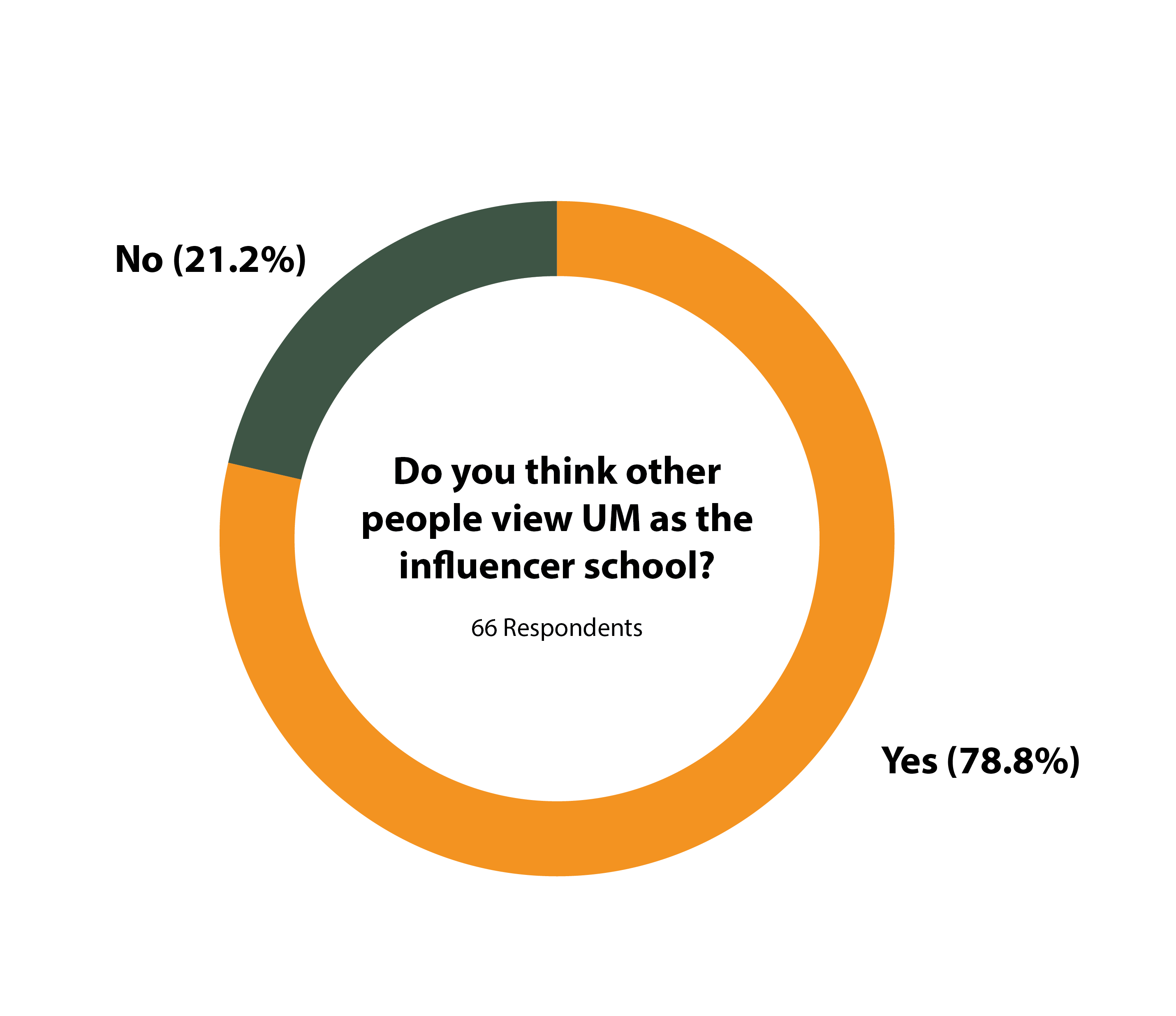
The survey, posted for 48 hours on The Hurricane’s Instagram story, showed that 78.8% of 66 student responders think the public views UM as “Influencer U.”
Anna Becker, a junior health sciences student, has seen the growing popularity of TikTok around campus during her time at the U.
“Sometimes by the dorms or walking to classes I’ll see people filming TikToks,” Becker said. “People post everything from Get Ready With Me’s, to day-in-the-life vlogs and dance videos with friends.”
Alix Earle, who now has 8.3 million followers on TikTok and 5.5 million followers on Instagram, graduated from UM in 2023. According to Parade and Celebrity Net Worth, Earle is now worth $20 million after competing in Dancing With The Stars season 34. She created the “Alix Earle Effect,” catapulting UM into the spotlight when her videos started going viral during her junior year.
Other influencers have grown their following during their time at UM, turning social media into their career.
Abby Gendell, a creator with 529,400 followers on TikTok, graduated from UM in 2024. She now works in New York City as a content creator thanks to her success on TikTok and Instagram.
“When I moved to New York, I continued growing, and a lot of people who followed me in college stayed,” Gendell said. “I figured if I could build my own brand, I could do that for a company someday, and if I ever applied for a marketing role, I could point to my platform.”
Current students at UM are finding success online, building a following that allows them to secure brand deals and receive PR packages.
Claire Mellin, a sophomore majoring in advertising management, has worked with brands like Edikted and Princess Polly.
“Most of my opportunities have come through Instagram, usually through brand outreach,” Mellin said. “My audience aligns with the college-aged demographic many brands target, which makes user generated content an effective way for them to connect with that market.”
Hosting brand trips is another way that popular brands connect with their audience. Some students had the opportunity to attend an influencer brand trip with the well-known makeup brand, Tarte, called “Trippin’ With Tarte.” The event was held in Key Largo in April of 2025.
Eva Free, a sophomore majoring in public relations and psychology, went on the trip thanks to her connection with Maureen Kelly’s son. Kelly is the CEO of Tarte Cosmetics and her son attends UM.
“There were a few other UM girls besides my friends and I, maybe three or four,” Free said. “I think that being at UMiami exposes you to these kinds of experiences even if you aren’t directly trying to get them.”
The University’s official social media account also reflects the influencer trend.
UM’s Instagram account has 318,000 followers as of March 4, 2026. Compared to another medium-sized, private institution like Tulane with 83,900 followers, it is clear that UM reaches a wide audience on social media.
Some classes even require students to make TikTok or Instagram accounts for projects, imitating real-world experiences where social media is used in everyday business practices.
Valentina Gomez, a junior studying creative advertising and marketing, created the “Table For Two” TikTok account in September 2025 as her final project for a digital marketing class. Gomez set students up on blind dates in the library to help people form connections.
The “Table For Two” account has gained about 30,000 likes and 1,232 followers as of March 4, 2026. Her most popular videos currently have tens of thousands of views, with one video reaching 238,200 views.
“I did expect it to do well on TikTok,” Gomez said. “I think it was a unique idea and I knew that I just had to commit to it.”
Commitment is key, but students and influencers also attributed part of their success to UM’s lifestyle and campus.
“Miami was a stepping stone. If I went to a random small school, people would still enjoy my content, but it wouldn’t be the same,” Gendell said.
Gendell’s content was centered around day-to-day life at UM and part of her success came from the school’s campus and recognizable brand.
“Being on a campus with palm trees and a lake made it so easy to film content. You’re inspired by everything around you all the time,” Gendell said. “I feel like Miami’s aesthetics made content creation really easy.”
Lauren Barnwell, a junior at UM, has accumulated more than 520,000 followers on TikTok by posting about her lifestyle in Miami, inspiring students to post content.
“I feel like all my friends at UM have some sort of following, even if it’s just 10,000 on TikTok, and it’s very normalized,” Gomez said. “Everyone at UM has something special to share and the lifestyle is super interesting.”
Staff members at UM also view the University’s growing social media presence as a positive reflection of the University’s online image.
Professor Catherine Schenquerman, a lecturer in strategic communication, teaches a course titled “Social Media Influencers.” She understands the advantage that UM students have by going to school here.
“All universities today benefit tremendously from social media visibility,” Schenquerman said. “Univerity of Miami in particular has a stunning campus that translates beautifully to visual platforms.”
But, social media growth has negative aspects too. Students have said that the media attention has created a stereotype that all students are interested in social media.
“I think that people feel UM fits into this one mold, when it has so much more to offer aside from popularity and influencers,” Becker said.
Media attention can also hinder the University’s image among news outlets. The Washington Post published an article on Nov. 12, 2025, describing the “vicious turf war” among influencers at UM.
The New York Post published an article on Nov. 4, 2025, saying that UM “campus influencers are in tears” and the world of social media “is ruining their college experience.”
This attention has only amplified UM’s reputation as the “influencer school.”
According to the student survey, 72.7% of students said they do not like or are unsure about the media attention that UM has received.
“I strongly dislike the influencer culture that is growing at UM,” said an anonymous responder.
Other students say that the University is not respected as an academic institution.
“It is strictly viewed as a party school with a side of education, and I really don’t like how this school has turned into that,” said another anonymous responder.
Whether the influencer stereotype is embraced or rejected, students agree that social media has become an unavoidable part of campus life.
Talia Gorelick contributed to the reporting of this article