


The University of Miami was my dream school.
I grew up in Broward County, and, like anyone raised in the Miami metropolitan area, I was born a Hurricanes fan.
Attending UM was my dream, what I worked for my whole life. But when I got my acceptance letter from UM, I did not feel the joy I had imagined. Instead, I felt dread: “How am I going to pay for this?”
The cost of attendance at UM, according to the Office of Undergraduate Financial Assistance and Employment website, is $98,118. $63,456 of that estimate is tuition. The cost may decrease by about $10,000, depending on whether you are an on-campus student or a commuter.
I worked hard throughout high school and was a likely candidate for full-ride scholarships at other Florida universities. At UM, my efforts paid off with three quarters of tuition covered by scholarships, yet the remaining quarter is still hard to pay for.
Now, in my fourth semester at UM, I am preparing to graduate in just two-and-a-half years, much to my mother’s despair — I think.
I’m not finishing early because I want to. I’m doing it because I can’t afford to stay at UM for the traditional four years.
And I’m not alone.
In a survey conducted by The Hurricane on Instagram, 59% of student respondents said they are graduating early. We live in an era of education where fast-tracked degrees might be the only way to afford college.
“My Cane Navigator seemed offended that I even proposed the idea of graduating early,” an anonymous survey responder wrote. “From then on I realized how much of a business this university is. In that meeting I didn’t feel like a student, I felt like a customer.”
I was fortunate. As an in-state student, I am eligible for Florida’s generous grants and scholarships. I also came into college with about 40 high school credits, which made me a sophomore in my first year.
“I’m technically a sophomore but I don’t feel like a sophomore at all, I’m still figuring out all that UM has to offer,” a survey respondent said. “I’m the youngest in most of my classes and I have to remind myself that everyone else has had more time to find their organizations and community. It feels like playing catch-up even though I’m doing more than the average freshman.”
Throughout the past 20 years, tuition and fees at private national universities have increased by about 32% after adjusting for inflation. These increases have outpaced those at public universities by three percentage points for in-state students and eight points for out-of-state students.
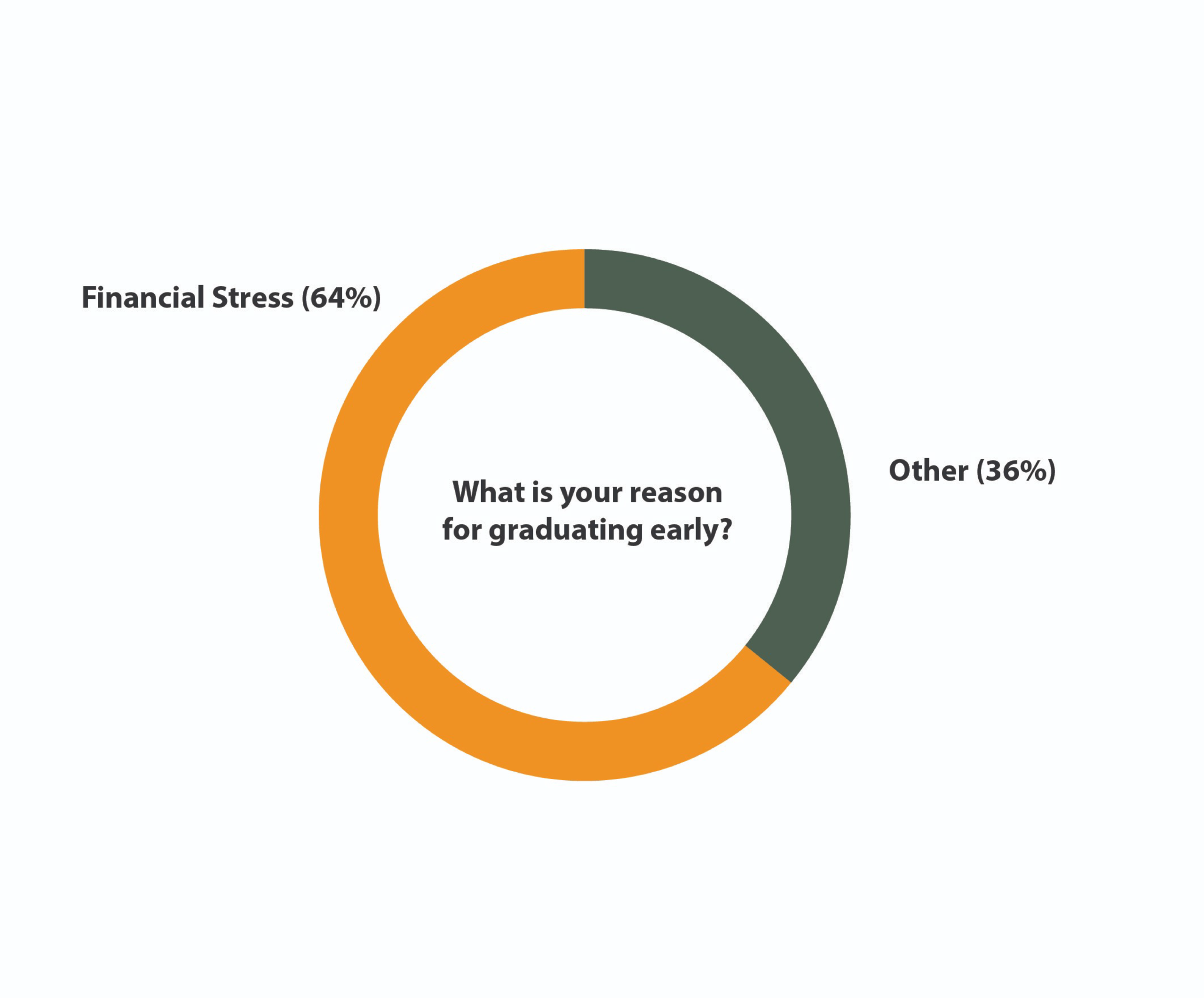
Rising costs are pushing students who are already struggling to pay for college to graduate early. Of the students who said they were graduating early, 64% cited “financial stress” as a reason.
“I took several APs in high school, so I came in with 30+ credits,” another anonymous survey responder said. “It is a bit stressful having to cram the ‘college experience’ into three years but it saves time and money.”
If tuition hadn’t skyrocketed by the time I came to UM, I would love to stay for three more semesters. It’s my dream school — but the price of being here is turning that dream into a nightmare.
The need to graduate early also comes with academic and personal costs. Only 20% of students who said they’d graduate early chose “strongly disagree” regarding the prompt, “Has your fast-tracked education caused you any problems?”
Some of these problems include being forced to switch majors, limited involvement in extracurriculars and leadership, stress about networking and limited time to prepare for the LSAT. All of these school and career-related issues come as early graduates also deal with limited social lives and stress about what to do after graduation. I also deal with many of these issues.
One solution to this problem might be to pursue a graduate degree. Of the students who said they were graduating early, 68% said they were “probably” or “definitely” going to graduate school. Only 24% of those disagreed with the question, “Has your fast-tracked education been a factor in that decision?”
However, this poses another problem for students who already struggle to afford undergraduate education. Though there are scholarships and employer tuition reimbursement programs, early graduates will be hard-pressed to find time to utilize these resources and form their graduate plans.
The best solution would be to address rising college education costs for students across the country. Until the 1970s and 80s, many universities across the country charged no tuition. Today, the most expensive university, the University of Southern California, charges $75,162 in tuition, only $11,706 more than UM. The cost of attendance at UM, however, is only $1,021 less than USC’s.
Florida has taken steps to reduce tuition costs for in-state students through scholarships and grants, but it barely makes a dent at private universities. If Florida really wants to attract and retain the best human talent, it should invest more in all its students.