


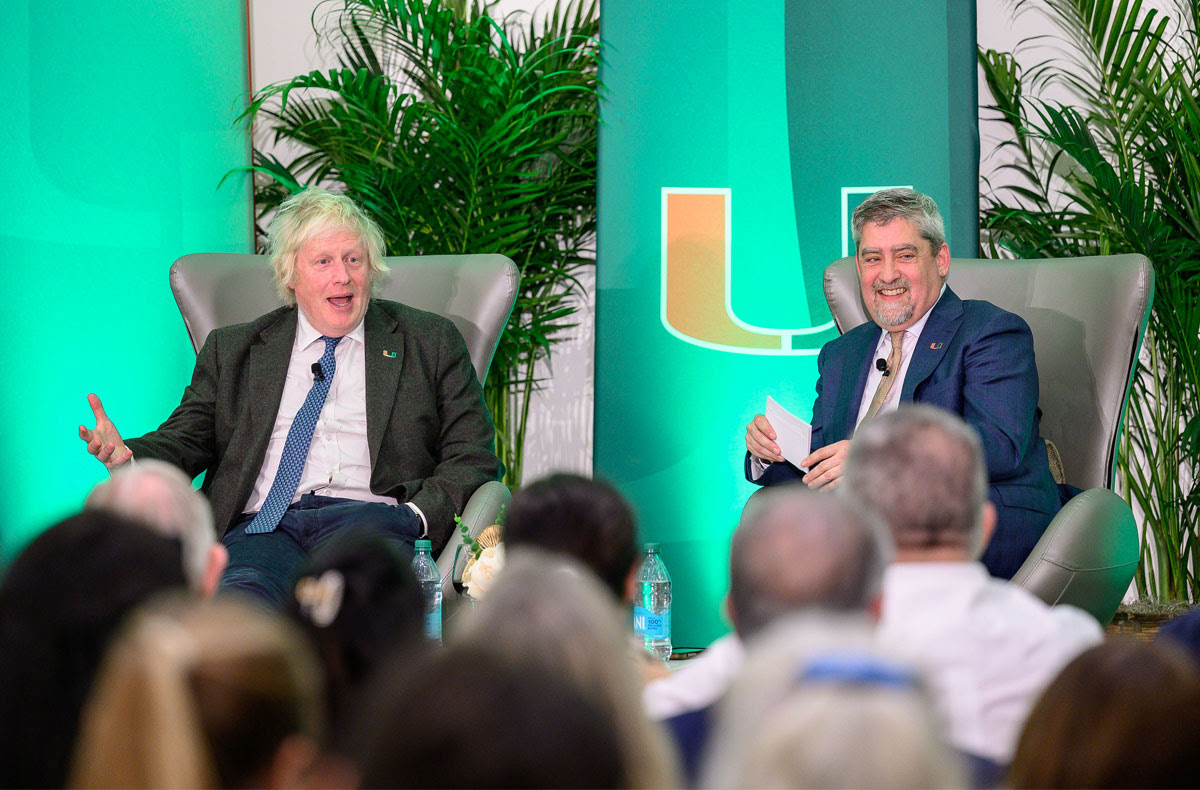
Former UK Prime Minister Boris Johnson did not deliver a conventional policy lecture on the evening of Thursday, Feb. 19, at the University of Miami. Instead, he offered something closer to a political memoir in real time.
Mixing humor, self-reflection and unapologetic opinion, Johnson kept a packed room, laughing one moment and leaning in the next.
The event, “A Conversation with Boris Johnson,” was hosted by the Hanley Democracy Center and led by Provost Joel Samuels. Johnson’s event was open to a crowd of students, faculty, administrators and trustees. This semester, Johnson is on campus serving as a guest lecturer for POL 393, a British politics course.
His time at the university, he said, is funded almost entirely by Ken Griffin, founder and CEO of Citadel, whose philanthropy supports educational programming. The former prime minister has gained national attention as he brings his unique perspective on governance to students in South Florida.
Rather than ticking through the milestones of his premiership, Provost Samuels framed the evening around the forces that shaped Johnson; family, rivalry and education, as well as how those influences carried into his politics.
He credited his sister, journalist and author Rachel Johnson, with sharpening his views on feminism from an early age. Growing up in a competitive household, he said, watching her intellect and ambition left a lasting impression. That experience later informed his belief that educating girls should be treated as a national priority, both at home and abroad.
“Most development aid is wasted unless the country is teaching their daughters as they are their sons,” Johnson said, arguing that access to schooling is as fundamental as food or water. Drawing on his own experience teaching his nine children to read, he sees the issue as a practical one. Societies, he suggests, cannot thrive if half their population is left behind.
He spoke with equal candor about his mother’s struggles with mental health and her eventual recovery and career as a painter, describing her resilience as formative. Childhood competition also featured prominently in his recollections. At one point, he joked about sibling rivalry — including being shot with an airgun by his brother — before adding, “The reason I am who I am is because I have to retain the vestiges of superiority,” drawing laughter from the audience.
Personal anecdotes bled into political reflection, as Johnson defended the difficulty of governing during moments of uncertainty in times like the COVID-19 pandemic and Brexit. Standing by pharmaceutical advances but questioning other aspects of pandemic-era policy, he believes future generations will feel responses went too far.
Turning to the United States, Johnson urged European allies to “stand on their dignity” and assessed that the U.S. has become more assertive in recent years.
“There’s hope and a prospect of change, ” Johnson said. “We have a leader. It’s you, it’s the United States of America.”
Throughout the evening, Johnson leaned into his reputation for theatrical timing, mixing in off-the-cuff humor. One student in attendance, Marizú Weller Rios, a sophomore from Guatemala City, said that beyond his already animated class lectures, Johnson delivered “a very humorous talk,” using stories from his leadership positions and commentary on current events to “delight the audience with some hilarious quotes and anecdotes that go beyond his appearances on TV and news articles.”
“I can definitely say that no matter if you agree with his politics or not, you would find his way of presenting incredibly entertaining,” Weller Rios added, praising the university for planning events that make his presence accessible to the broader UM community.
As the Hanley Democracy Center continues to host influential global figures, Johnson’s appearance fostered open discussion and exposed students to diverse perspectives on global governance.