


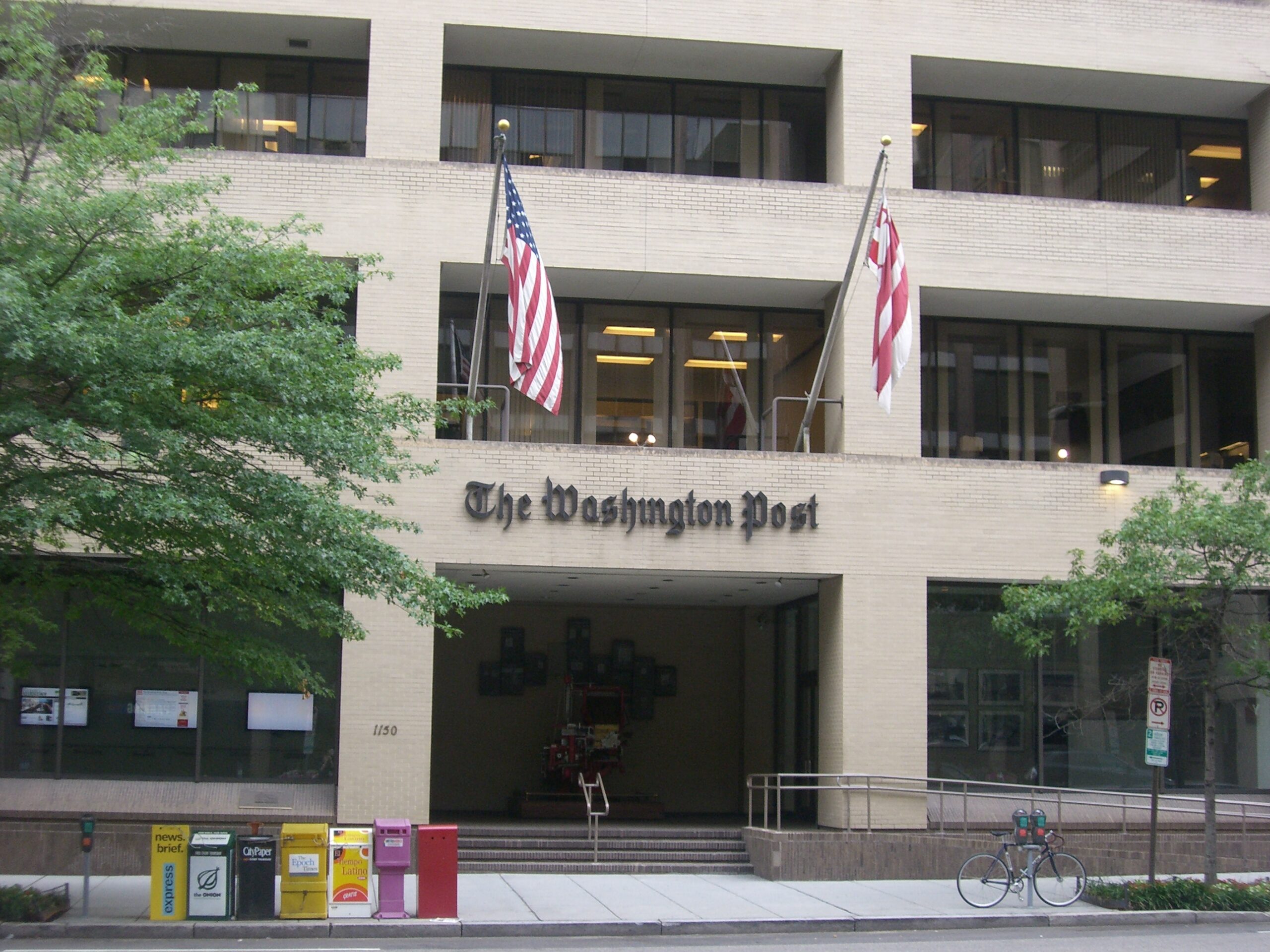
“Democracy dies in darkness.” Under Jeff Bezos, one newsroom’s light is flickering.
The Washington Post was acquired by Bezos in 2013 for roughly $250 million. Acclaimed for breaking news like the Watergate Scandal and publishing the Pentagon Papers, the paper is regarded as a pillar of accountability journalism.
The Post’s recent “financially motivated” decision to lay off roughly one-third of its staff, including entire sections like the International desk — Lizzie Johnson was fired while on the ground, reporting on war in Ukraine — reflects a troubling shift away from journalism that undermines informed civic life.
Change at The Washington Post began with eliminating the editors’ chance to endorse presidential candidates before the 2024 election and moving away from left-leaning opinion pieces. That same year, Bezos sat in the front row of President Trump’s inauguration, alongside Mark Zuckerberg, Elon Musk and Former Prime Minister Boris Johnson.
More recently, Amazon has acquired the rights to the Melania Trump documentary for $40 million, which was $28 million more than the next highest bidder. Multiple anonymous sources from the company’s entertainment division see this as a bribe.
The Washington Post’s leadership has framed the layoffs as a necessary business decision, but journalism should not be framed as an optimizable product when it exists to serve the public.
Thirteen years ago, Bezos pledged that he would not view The Post as a source of income. He framed himself as a protector of the institution. This raises an important question: who is responsible for preserving the information systems democracy relies on? Journalists and press advocates warn that treating news purely as a business risks hollowing out its democratic purpose.
Freedom of the press is an enumerated right, and the free circulation of publications like the Federalist and Anti-federalist papers catalysed the ratification of the U.S. constitution, after circulars and pamphlets rallied the colonies behind the Articles of Confederation.
Much like these historic documents, The Washington Post is a national agenda-setter whose reporting shapes political discourse across the country. When an institution of this scale contracts, the effects ripple outward. This signals to smaller outlets that deep, resource-intensive reporting is increasingly unsustainable.
This moment reflects a broader crisis in democratic information. More than 50 million Americans live in “news deserts,” or areas with one or less local news sources. Research shows that when news coverage declines, civic participation declines with it. These deserts are disproportionately in rural and low-income areas, creating information gaps and a class divide in the ability to engage with our democracy, starting at the local and municipal levels.
At the annual dinner for reporters covering Congress, former Democratic Speaker of the House Nancy Pelosi spoke out against the layoffs, which she believes infringe on the people’s first amendment rights.
“A free press cannot fulfill its mission if it is starved of the resources it needs to survive,” Pelosi said. “When newsrooms are weakened, our republic is weakened with them.”
Choking these institutions financially serves the same purpose as censorship.
So, why does this really matter? As newsroom layoffs accelerate the growth of news deserts, civic participation increasingly becomes a privilege of those with access to quality information, deepening class and geographic divides in democratic engagement. Communities become less informed, civic participation declines, polarization increases and fewer people vote, organize or hold leaders accountable.
Supporting journalism through subscriptions, public pressure and policy conversations is not charity, but a civic act. Use your student accounts and read the local news for your town.
The Washington Post layoffs force readers to confront a difficult truth: Democracy cannot function without strong institutions dedicated to informing the public.
An engaged and truly representative democracy depends on more than access to information, it depends on institutions capable of producing it.