


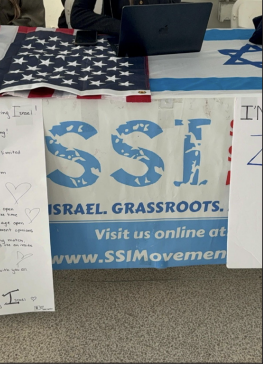
I was not at the Students Supporting Israel table when the altercation began.
I arrived later, shortly after the details of the incident had started circulating. At first, I did not believe it was as disturbing as people had said.
Then I read the article. I watched the video. I spoke with students who were there. I realized my initial disbelief came from assuming there had to be more context, or something missing. There wasn’t. What unfolded was clear, unabashed antisemitism.
At the University of Miami, Jewish life is visible and integrated into campus culture. Student organizations table openly, people walk around with Stars of Davids, chai necklaces, IDF hoodies. UM is proof that a strong Jewish community can exist comfortably inside a diverse university in a major city.
That is why the altercation on Tuesday, Jan. 27, was so jarring. A student approached the peaceful table and began shouting accusations and heated questions.
Kaylee Mahony, a sophomore influencer with more than 125,000 TikTok followers, verbally confronted members of Students Supporting Israel during the Spring Involvement Fair. Mahony referred to Jews as disgusting. She also invoked distorted claims about the Talmud, calling it disgusting and alleging that it teaches Jews to view non-Jews as inferior.
In the video that Mahony posted immediately after the incident, she repeated longstanding antisemitic conspiracy theories, arguing a confident recitation of myths that have circulated online for decades.
She identified herself in her Instagram and TikTok bios as a “proud goy.” Her platform allowed her to spew this rhetoric with millions of viewers and she chose to repeat that hateful rhetoric on campus.
What unsettled me more came after the event. UM is a campus many of us openly call safe. But that sense of security doesn’t make us immune to forms of prejudice and hate.
Antisemitism is easier to dismiss when it feels far away, when it appears on other campuses, in other states or in places we label as volatile. We are not in New England or California, or on the hundreds of campuses around the world where Jewish youth cannot feel safe. We are UM. This University has long felt different, a sense of distance that has been comforting and the reason why I, along with hundreds of students, felt safe choosing UM as a place to express and explore our identities.
Antisemitism today does not always announce itself through institutions. It surfaces when someone feels emboldened enough to say the quiet part out loud, even here.
I still feel protected as a student at UM. I trust the faculty, staff and administrators to support Jewish students. That trust is real.
But safety is not the same as insulation.
What makes this truly disturbing is how obvious her hatred was. Her TikTok and Instagram were filled with obsessive antisemitic videos, some even alluding to Jews and 9/11 and the Israeli Army aiding ICE.
There’s no credible way that her peers or the campus groups she was involved with didn’t know. Even if those clubs later issued denouncements, the sheer intensity and consistency of her rhetoric meant anyone paying attention had to see it. The real danger is their complacency, willful ignorance, or quiet complicity of those around her that allowed this hatred to reach campus unchecked.
The idea that a campus with strong Jewish infrastructure cannot experience antisemitism is comforting and wrong. Infrastructure does not erase prejudice. It raises the stakes of how we respond when it surfaces.
This moment signals proximity.
Antisemitic myths persist because they adapt easily to new platforms. What this moment asks of us is not panic, but vigilance.
From thriving Jewish life to leadership who voiced support for Israel after Oct. 7, UM’s allyship is strong and deserves acknowledgment. At the same time this event reminds us that even a thriving community cannot assume safety is guaranteed.
The lesson is clear: we cannot take our situation for granted. A safe campus requires participation, visibility and refusal to let misinformation spread unchecked. That looks different for everyone — joining organizations, going to Shabbat dinners, asking questions in class, supporting friends or correcting falsehoods.
Antisemitism does not disappear because a campus is well resourced. It recedes when we refuse to let it go unanswered.
This is bigger than any one incident because our strength must be informed and visible. It asks us to remain active, and involved, and to make sure UM continues to be a space where students can learn, thrive and be seen.