


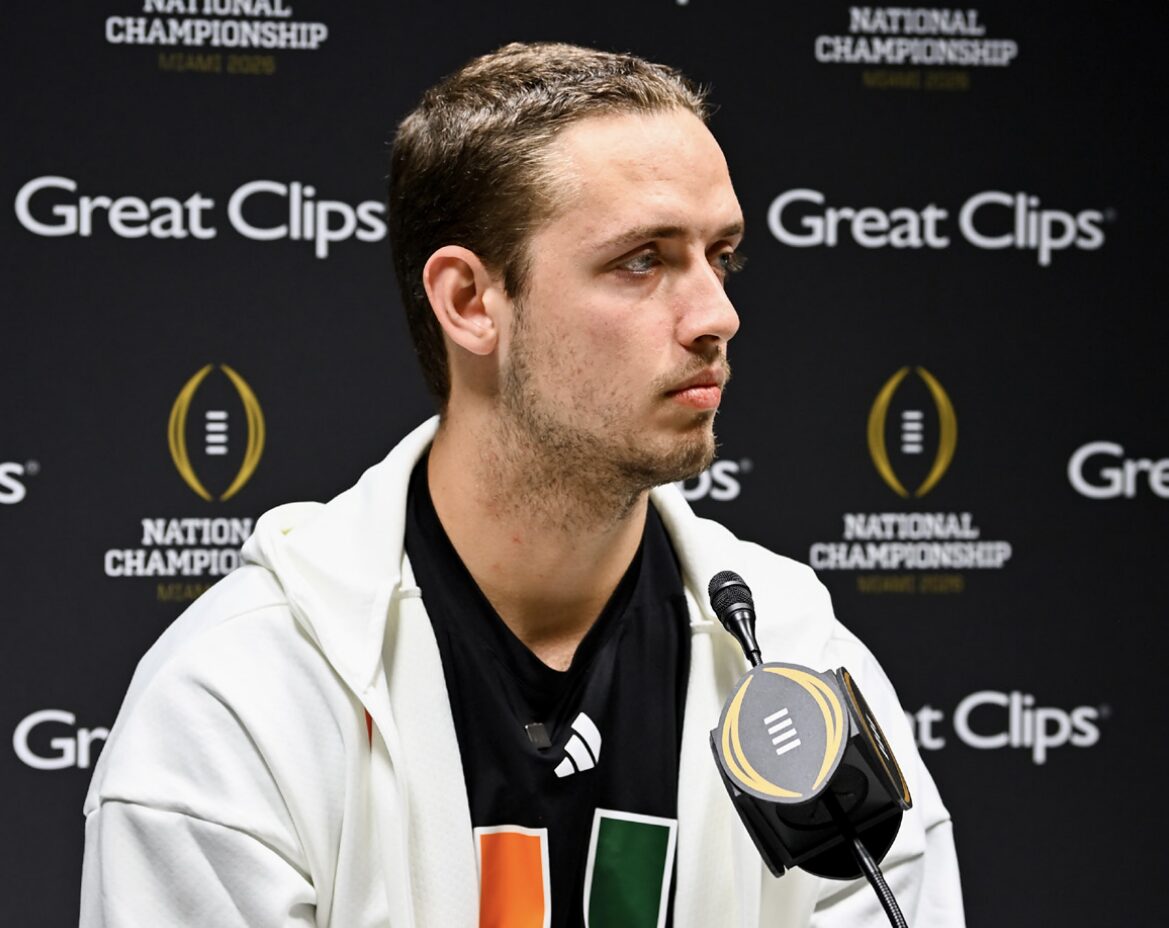
Ahead of the national championship game between the Miami Hurricanes and Indiana Hoosiers, UM quarterback Carson Beck was asked about missing classes for the Jan. 19 matchup.
He laughed.
“No class. I graduated two years ago,” Beck said.
The media room erupted. The internet followed suit. Although many people were outraged at the indifference in Beck’s comment, the moment was seemingly harmless overall — a wink at the reality of modern college football.
But the joke didn’t land as expected. Not because Beck was inherently wrong, but because the moment felt oddly routine. A joke about not attending class shouldn’t register as business as usual. Yet it did.
As a graduate transfer to UM who earned his degree from Georgia in 2024, Beck’s situation is not unusual, nor is it technically controversial. The idea of the “student-athlete” has long rested on the simple idea that education and athletics coexist. But as college sports grow more commercialized, that balance is slipping. And with it, the expectation that athletes — even draft-bound ones — are still students at all.
Allowing draft-bound athletes to opt out of spring academics entirely is more damaging than easing a workload. It signals that education is optional when an athlete becomes “valuable enough.” It says that college is not an institution with standards, but simply a holding space until something better comes along.
This distinction matters, because easing academic pressure is not the same as abandoning it altogether. Until an athlete leaves campus, they are still enrolled students; students who are expected to attend class, even in the spring.
The reaction to Beck’s comment points to a growing debate in college athletics: Should draft-bound athletes who remain enrolled be permitted to forgo spring classes altogether in preparation for professional careers?
In the age of NIL deals and draft projections, elite athletes increasingly occupy a strange in-between space: enrolled in school, branded as professionals all while being treated as something else entirely.
Sure, draft-bound student athletes may be in a league of their own, incomparable to other student athletes, let alone regular students.
And from a purely professional standpoint, spring classes rarely factor into an athlete’s path to the NFL.
But here’s the catch: these athletes are not in the NFL yet.
Yes, draft-bound athletes live in a different reality. They gain national attention, bring donor interest and foster future prestige in their programs. Their schedules are brutal. Their careers can be short.
“Essentially, for these football players, this is their work study program,” said an anonymous former Miami student athlete. “This is their life.” The athlete went on to cite opportunities high-performance college athletes miss out on, such as study abroad.
Indeed, these athletes’ sacrifices should be viewed as sacred — but not at the expense of academic and institutional integrity.
NCAA eligibility rules require athletes to maintain academic progress and enroll in a minimum number of 12 credit hours, maintaining progress towards a degree. Those standards don’t just disappear because a mock-draft looks favorable. Online classes, absences excusals, adjusted schedules and academic support already exist to accommodate athletic demands. Expecting participation is not a punishment, but consistency.
It also deepens an existing imbalance. There is no professional draft awaiting swimmers, rowers or track athletes. These athletes’ commitment to academics is non-negotiable. Carving out exceptions for larger sport athletes to cater to their draft-favoribility reinforces the idea that some athletes meeting certain criteria are permitted to be students only when it’s convenient.
“For example, we have athletes [at UM] that are Olympians, and they take time off of school to compete at the Olympic level, but because there isn’t as much coverage, it flies under the radar,” said a former Miami student athlete who asked to remain anonymous. “When you magnify it to the scale of the football team, it really should be considered with that same leniency.”
This isn’t about denying the reality of NIL or pretending college sports aren’t evolving — they are, rapidly. But evolution doesn’t mean we should abandon the core premise that universities still claim to uphold.
When schools market athletes as students, they have to treat that label as more than branding. Selective standards aren’t flexibility — they’re hypocrisy.
If universities want to continue calling their athletes “students,” they must be willing to uphold that label consistently — even when it’s inconvenient for all parties involved. The water gets murky when college sports can claim educational integrity, all while selectively ignoring academic expectations for their athletes with the most monetary and professional appeal.
Either student status matters, or it doesn’t. Colleges need to start being honest about which it is.