


Despite a historic return to national prominence, the Miami Hurricanes football team still plays its home games miles away from campus. Students and fans living in Coral Gables have to travel nearly an hour north to Hard Rock Stadium, the home of the Miami Dolphins.
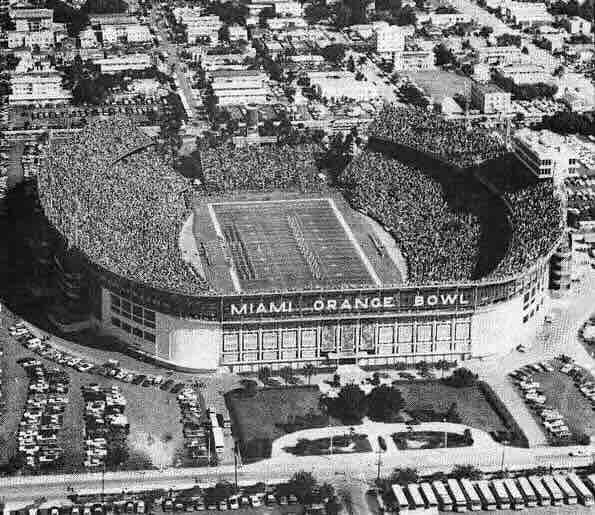
Before the Canes started playing at Hard Rock, the Miami Hurricanes used the Orange Bowl stadium, located in Little Havana, to play home games between 1937 and 2008. The Orange Bowl college football game was held at the stadium annually until it was replaced by LoanDepot Park, the home of the Miami Marlins.
The absence of an on-campus stadium has been a hot topic at UM since the Orange Bowl was demolished in 2008.
According to the Bleacher Report, an on-campus stadium could increase the number of UM students attending home games. It would bring a sense of excitement to alumni and fans throughout the community.
Miami-based attorney John Ruiz suggested that he would fund a new stadium where Tropical Park currently exists, just three miles west of UM.
“There’s about 270 acres there,” Ruiz told the Miami New Times in an interview.
Large college football stadiums rarely exceed 15 acres, meaning the space at Tropical Park would be more than enough. He even had plans drawn up for the potential stadium.
“The design is over the top, it’s gorgeous, I’ve seen it already a couple of times,” he said.
Another proposal was made by Ruiz in 2021 to build a 50,000 person, 13-acre football stadium next to Coral Gables Senior High. Ruiz said it might be necessary to demolish the school to have the necessary space. While it is unclear whether a vote occurred, Miami-Dade County Public Schools are “not entertaining any such idea” relating to demolition plans.
“There is a major misconception that the school is going to be demolished to make this happen,” said Diana Diaz, co-chair of the stadium committee, in an interview with CBS 4 News.
The City of Coral Gables was also not supportive of Ruiz’s plan, telling CBS 4 News that the stadium would not be compatible with the surrounding neighborhoods.
Former UM President Donna Shalala agreed with critics of the proposal.
“I think it’s ridiculous,” Shalala told CBS 4 News. “We looked at every plot of land near the University and there was simply no place where you could build a stadium and have the kind of parking you would need.”
Building a new stadium also places significant financial burdens on the University of Miami. When the University of Minnesota built a new stadium in 2009, the university paid for 52% of the construction costs while the state was responsible for the other 48%. To help fund the project, the University of Minnesota charged the school’s approximately 50,000 students an extra $12.50 per semester.
Since UM has a smaller student population, a similar fee structure would result in higher costs per student. The other portion of the costs for a new UM stadium may fall on the Florida taxpayers, specifically those living in Miami. However, since UM is a private university, they might provide funding for a stadium.
Another concern is the influx of traffic that would come with a new stadium on or near campus. UM is already tightly tucked into Coral Gables, making available land scarce if the University was looking to build new parking lots.
Considering that UM only owns the 239 acres that the Coral Gables campus is composed of, there is very little chance that the University could expand its land for a stadium.